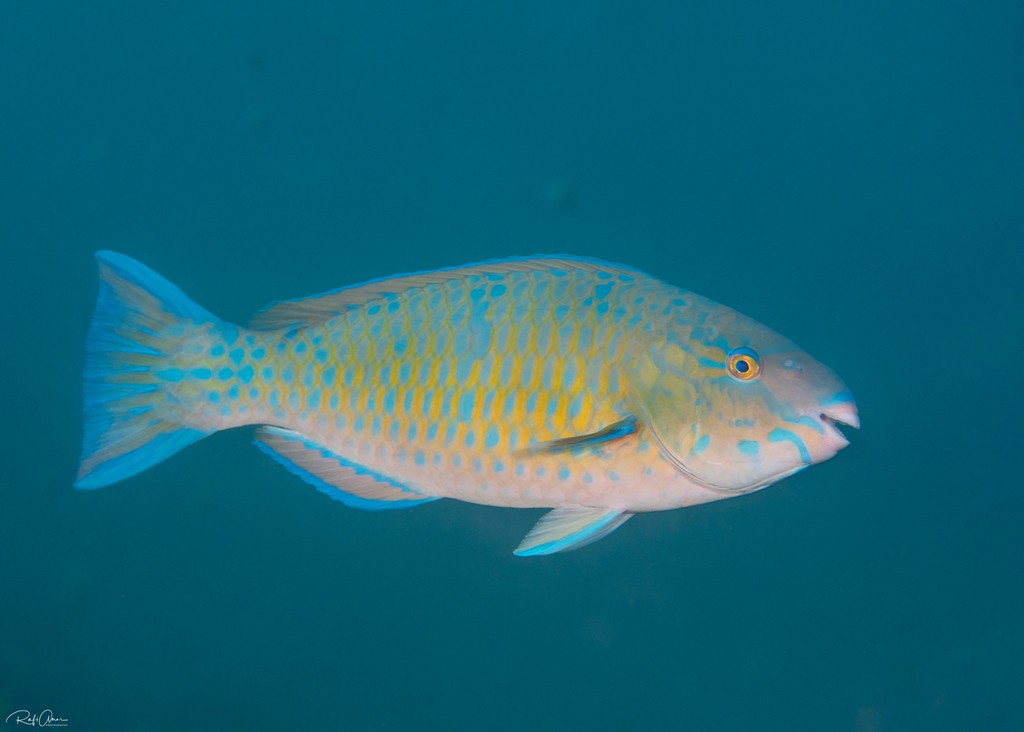
Appearance
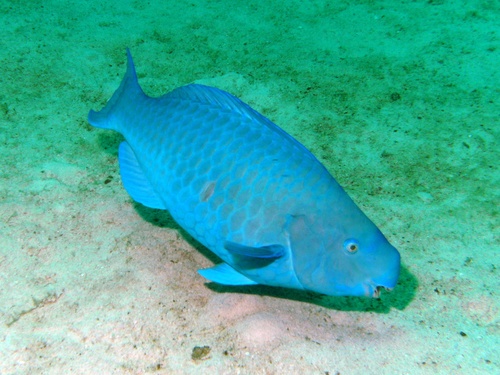
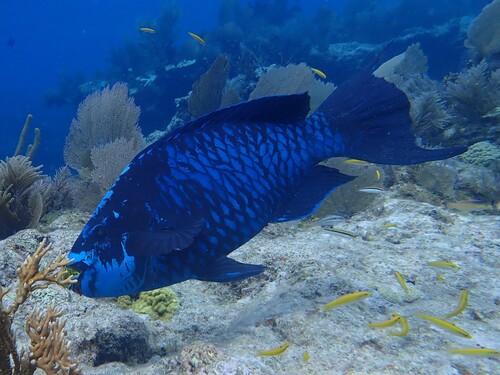
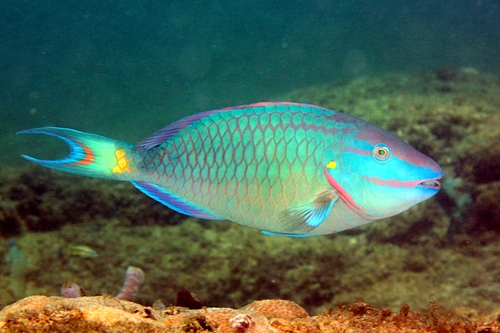
Parrotfish are named for their dentition, which is distinct from other fish, including other labrids; their numerous teeth are arranged in a tightly packed mosaic on the external surface of their jaw bones, forming a parrot-like beak with which they rasp algae from coral and other rocky substrates (which contributes to the process of bioerosion).
Maximum sizes vary within the group, with the majority of species reaching 30–50 cm (12–20 in) in length. However, a few species reach lengths in excess of 1 m (3 ft 3 in), with the green humphead parrotfish can reach up to 1.3 m (4 ft 3 in) TL (though is commonly 0.7 m (2 ft 4 in) SL). The smallest species is the bluelip parrotfish (Cryptotomus roseus), which has a maximum size of 13 cm (5.1 in).
Parrotfish have 10 dorsal soft rays, 9 dorsal spines, 9 anal soft rays, and 3 anal spines.