
← All marine life
Humphead Parrotfish
Species IUCN · Vulnerable (VU)

Humphead Parrotfish

Bolbometopon muricatum, (Valenciennes, 1840)

marine

About Humphead Parrotfish

The green humphead parrotfish (Bolbometopon muricatum) is the largest species of parrotfish, growing to lengths of 1.3 m (4.3 ft) and weighing up to 46 kg (101 lb), though some sources report a total length of 1.5 m (4 ft 11 in) and weight of 75 kg (165 lb). It is the only species in the monotypic genus Bolbometopon. Fossil remains of Bolbometopon sp. are known from the Late Miocene of Sri Lanka.

Other common names include bumphead parrotfish, humphead parrotfish, double-headed parrotfish, buffalo parrotfish, and giant parrotfish.

It inhabits reefs in the Indian and Pacific Oceans, from the Red Sea in the west to Samoa in the east, and from the Yaeyama Islands in the north to the Great Barrier Reef, Australia, in the south. In regions that are not overfished, the humphead parrotfish is a prominent member of the ecosystem, whether through their social interactions or their feeding behavior.

Appearance

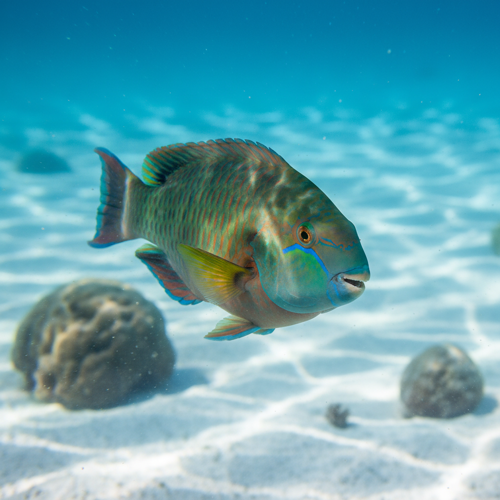
Unlike typical wrasse, it has a vertical head profile, and unlike other parrotfishes, it is uniformly covered with scales except for the leading edge of the head, which is often light green to pink. Primary phase colouration is a dull gray with scattered white spots, gradually becoming uniformly dark green. This species does not display sex-associated patterns of color change common in the wrasse family Labridae. The adult develops a bulbous forehead sometimes described as an "ossified ridge", and the tooth plates are exposed, being only partly covered by lips.

This species is gregarious and usually occurs in small schools, but group size can be quite large on seaward and clear outer lagoon reefs, exceeding 75 individuals. Records from the 1970s suggest even larger schools of up to 250 individual fish.
Habitat

Humphead parrotfish are generally found in the Indian and Pacific oceans, as far as the great barrier reef, covering Samoa, Japan, and the red sea. They live in areas from the surface down as far as 40 meters. Juveniles like to stay in shallower areas, where adults usually stray farther out into deeper waters.

Reproduction

The green humphead parrotfish is slow-growing and long-lived (up to 40 years), with delayed reproduction and low replenishment rates. They are sexually monochromatic, i.e. there is no initial or terminal phase in the life cycle of the adults. The fish spawn pelagically near the outer reef slope or near promontories, gutters, or channel mouths during a lunar cycle, usually spawning just prior to the new moon. They make use of spawning aggregation sites.

Newly settled juveniles are found in branching coral habitats (primarily Acropora) in sheltered lagoons. Small juveniles (<50 mm) are often associated with damselfish. Larger juvenile green humphead parrotfish are found in lagoons, often in seagrass beds, and the adults are found in clear outer lagoons and sea-ward reefs up to a depth of 30 m (98 ft).

Humans & conservation

The large size, slow growth and schooling behavior of this species mean it is susceptible to overfishing. This species is highly sought after by fishermen throughout its range, and it has declined from overharvesting. Spearfishers and netters have targeted large groups as they sleep at night. Additionally, habitat degradation and destruction has accelerated the decline. Juvenile habitats are susceptible to being degraded by poor water quality, such as run-off of sediments from logging.

Part of

Where to see it

No dive sites list Humphead Parrotfish yet. Explore the map to find sites near you.