
← All marine life
Midnight Parrotfish
Species IUCN · Data Deficient (DD)

Midnight Parrotfish

Scarus coelestinus, Valenciennes, 1840

marine

About Midnight Parrotfish

The midnight parrotfish (Scarus coelestinus) is a species of parrotfish that inhabits coral reefs mainly in the Caribbean, Bahamas, and Florida.

The typical size is between 30 and 60 cm, but it can grow to almost 1 m. It has been observed as far north as Maryland and as far south as Brazil. Usually found between 3 and 80 m deep, it swims over reefs and sandy areas, where it feeds on algae by scraping it with its teeth fused into a beak.

Appearance

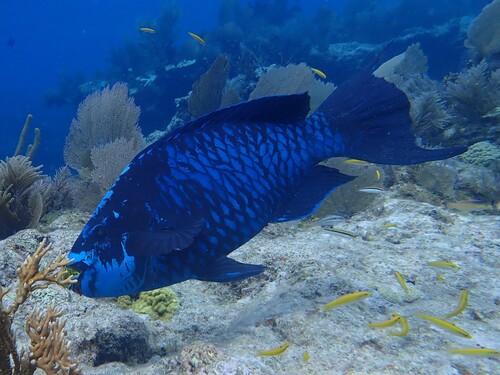
The midnight parrotfish has a deep blue body with light blue patches along its sides and head. The exact location of light blue patches differs between each fish, but all midnight parrotfish have a light blue patch on the underside of the beak.

Unlike most other parrotfish species, the midnight parrotfish retains its coloration through its juvenile and adult stages of life. Both male and female midnight parrotfish exhibit this coloration.

Parrotfishes gain their name from the hard beak that they use to scrape food from hard substrates.

The midnight parrotfish is most closely related to two other large-bodied parrotfish species, S. guacamaia and S. trispinosus.
Habitat

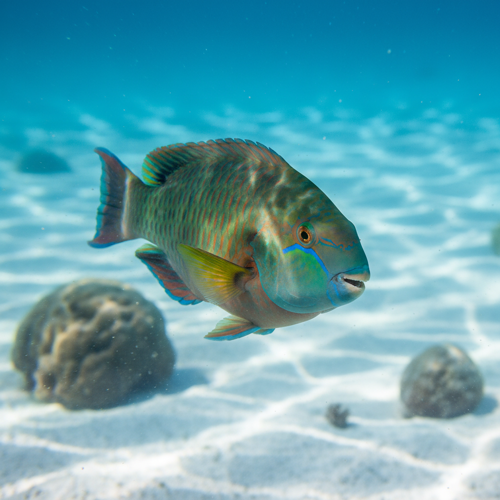
The midnight parrotfish inhabits coral reefs mainly in the Caribbean, southern Florida, and the southern Gulf of Mexico, but has been found as far north as Maryland and as far south as Brazil.

Midnight parrotfish were found to be the only species of 32 Caribbean reef fishes to not have a significant zonation among patch or crest reefs. While less abundant than other parrotfish species such as the queen parrotfish (Scarus vetula), striped parrotfish (Scarus iseri), stoplight parrotfish (Sparisoma viride), and redband parrotfish (Sparisoma aurofrenatum), the midnight parrotfish is an important part of the trophic web. Like other parrotfish, the midnight parrotfish controls algal populations through feeding, and encourages coral growth through its grazing.

Midnight parrotfish have been found at depths between 5 and 75 meters.

Diet

The midnight parrotfish, along with other parrotfishes, is primarily a herbivore. Their main source of food is algae, which they scrape from coral and other hard substrates using their beak. Through this process, the parrotfish also consumes carbonate sediments and assists in moving sediment around the reef. The midnight parrotfish can take up to 16,000 bites a day as an adult, and 28,000 a day as a juvenile. In addition to herbivory, midnight parrotfish have also been observed consuming sergeant major damselfish eggs. Unlike other species of parrotfish that live in mangrove forests, the midnight parrotfish has not been shown to consume sponges.

Behaviour

As is the case with other large-bodied parrotfish species, midnight parrotfish are relatively rare throughout their range. However, in areas where they are not fished for, they can be locally abundant; in such areas, feeding midnight parrotfish may form schools of over 30 individuals in order to raid food from the algae "farms" and egg nests of territorial damselfish (e.g., sergeant majors and Stegastes), overwhelming the damselfish's defences with their sheer numbers. Bite scars found on sergeant major damselfish nests indicate this behaviour is common.

Humans & conservation

Midnight parrotfish are cited as 'Least Concern' on the IUCN Red List. This is due to the high concentrations of midnight parrotfish in the Gulf of Mexico and Caribbean. Midnight parrotfish are protected species in United States waters, as well as a number of marine protected areas in the Caribbean. However, Cuban spear-fishers often target the midnight parrotfish along with other parrotfish species, which has led to a slight decline in population.

Part of

Where to see it

No dive sites list Midnight Parrotfish yet. Explore the map to find sites near you.