← All marine life
Stoplight Parrotfish
Species IUCN · Least Concern (LC)

Stoplight Parrotfish

Sparisoma viride, (Bonnaterre, 1788)

marine

About Stoplight Parrotfish

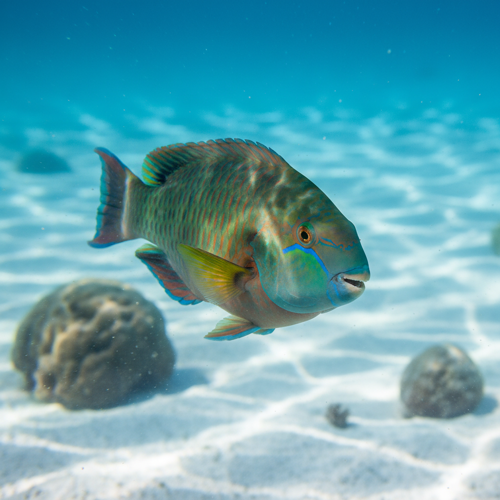
The stoplight parrotfish (Sparisoma viride) is a species of marine ray-finned fish, a parrotfish from the family Scaridae, inhabiting coral reefs in Florida, Caribbean Sea, Gulf of Mexico, Bermuda and as far south as Brazil.

It mainly feeds on algae by scraping and excavating it with its teeth. Like most parrotfish, it is able to change sex.

Appearance

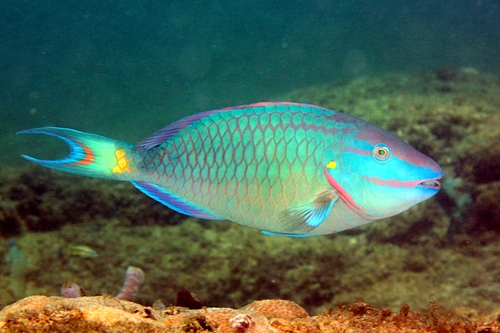
The common name "stoplight parrotfish" comes from the marked yellow spot near the pectoral fin, which is clearly visible only in specimens in the terminal phase.

Its typical length is between 1 and 1.5 ft (30–45 cm), but it can reach up to 2 ft (64 cm).

Habitat

It is normally found during the day at depths between 15 and 80 ft (5–25 m), but can be found from 10 to 165 ft (3–50 m) The stoplight parrotfish inhabits shallow coral reefs not disturbed by humans in Florida, the Caribbean Sea, Gulf of Mexico, Bermuda and Brazil. They are only active during the day and spend most of their time foraging, swimming, or hovering. At night, they remain hidden under coral boulders. Large individuals typically spend more time swimming and spend a significant amount of time sheltering among crevices, while smaller individuals spend more time hovering. The stoplight parrotfish have a high density in areas of higher algal production. As adults, the stoplight parrotfish are site-attached with limited home ranges.

Diet

The stoplight parrotfish employs a scraping and excavating grazing mode and feeds almost exclusively on algae that are associated with dead coral substrates. They have higher grazing rates and assimilation efficiencies in areas with high-quality food.

Reproduction

Stoplight parrotfishes engage in reproductive activity throughout the year. They are harem-forming fishes and territorial terminal phase males defend areas that are shared with 1–14 initial phase parrotfishes, with whom they mate. There is more territorial defense in areas with high-quality food. Single terminal phase males also defend the deeper reef from conspecifics.

Stoplight parrotfish males will often control territories containing many sexually mature females to breed with. Males that have territories and those that don't will have vastly different levels of testosterone.

Part of

Where to see it

No dive sites list Stoplight Parrotfish yet. Explore the map to find sites near you.