← All marine life
Cuttlefish
Group

Cuttlefish

Sepiidae, Leach, 1817

marine
Where to see it

About Cuttlefish

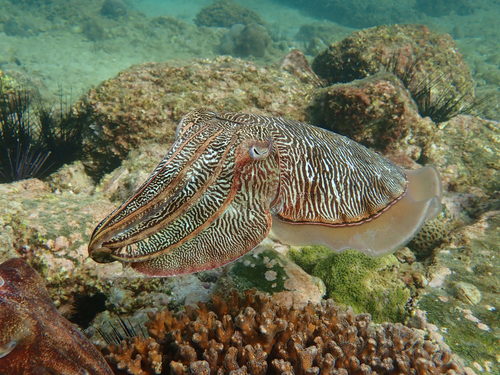
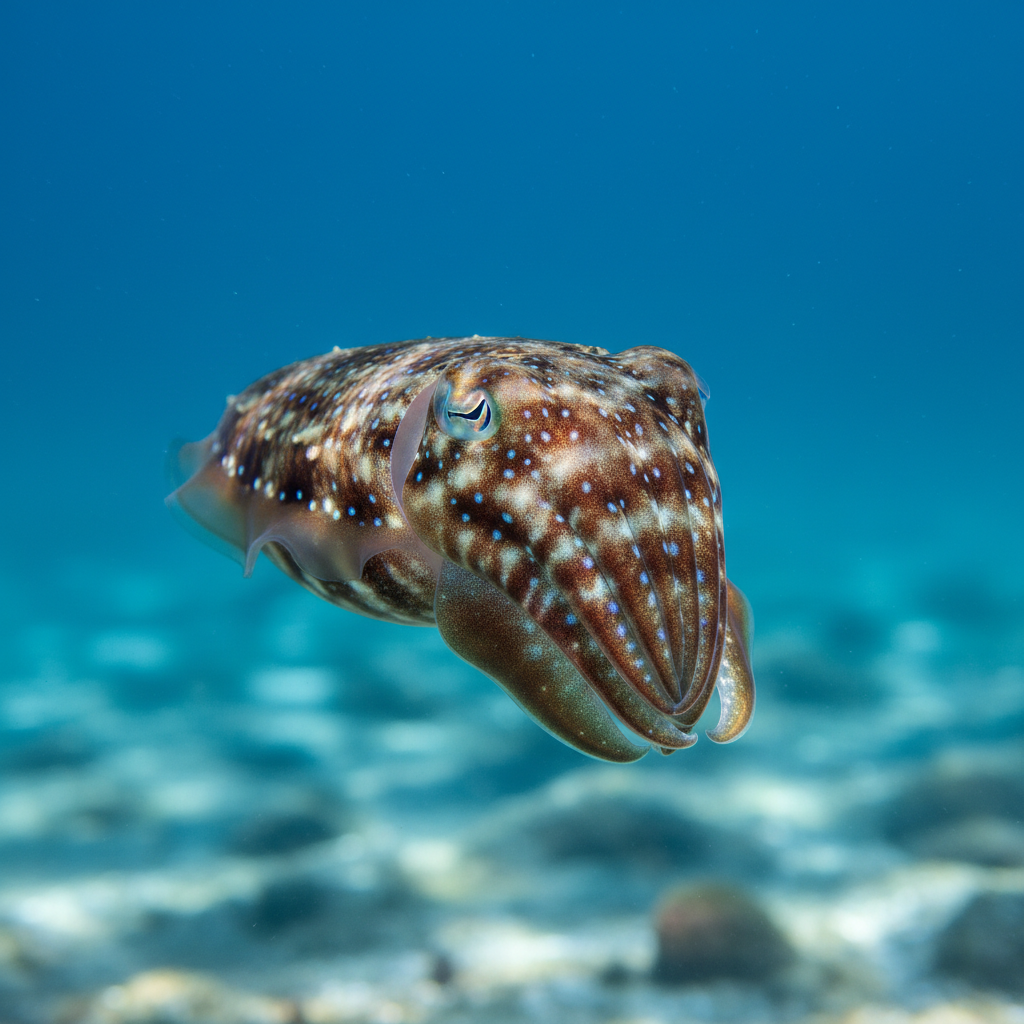
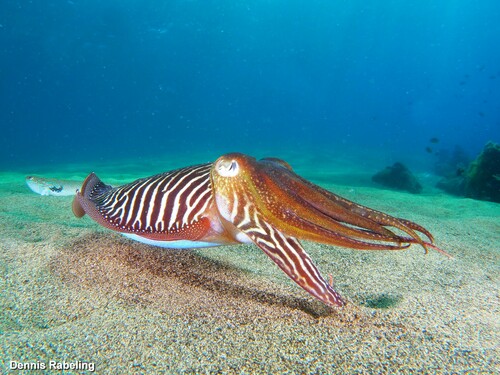
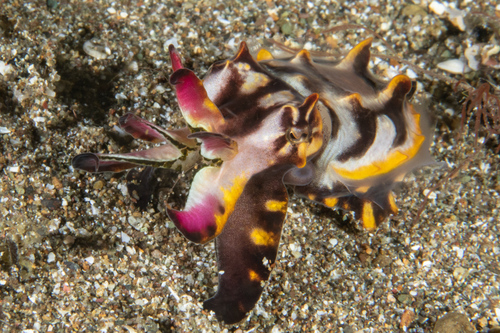
Cuttlefish, or cuttles, are marine molluscs of the family Sepiidae. They belong to the class Cephalopoda which also includes squid, octopuses, and nautiluses. Cuttlefish have a unique internal shell, the cuttlebone, which is used for control of buoyancy. They have large, W-shaped pupils, eight arms, and two tentacles furnished with denticulated suckers, with which they secure their prey. They generally range in size from 15 to 25 cm (6 to 10 in), with the largest species, the giant cuttlefish (Sepia apama), reaching 50 cm (20 in) in mantle length and more than 10.5 kg (23 lb) in mass.

Cuttlefish eat small molluscs, crabs, shrimp, fish, octopuses and other cuttlefish. Their predators include dolphins, larger fish (including sharks), seals, seabirds, and other cuttlefish. The typical life expectancy of a cuttlefish is about 1–2 years. Studies are said to indicate cuttlefish to be among the most intelligent invertebrates. Cuttlefish also have one of the largest brain-to-body size ratios of all invertebrates.

The Greco-Roman world valued the cuttlefish as a source of the unique brown pigment the creature releases from its siphon when it is alarmed. The word for the cuttlefish in both Greek and Latin, sepia, now refers to the reddish-brown color sepia in English.

Appearance

Unlike other cephalopods, cuttlefish possess a unique internal structure called the cuttlebone, a highly modified internal shell, which is porous and is made of aragonite. Except for Spirula, they are the only coleoid cephalopods with a shell with a phragmocone divided into chambers separated by septa. The pores provide it with buoyancy, which the cuttlefish regulates by changing the gas-to-liquid ratio in the chambered cuttlebone via the ventral siphuncle. Each species' cuttlebone has a distinct shape, size, and pattern of ridges or texture. The cuttlebone is unique to cuttlefish, and is one of the features that distinguish them from their squid relatives.
Habitat

The family Sepiidae, which contains all cuttlefish, inhabits tropical and temperate ocean waters. They are mostly shallow-water animals, although they are known to go to depths of about 600 m (2,000 ft). They have an unusual biogeographic pattern; they are present along the coasts of East and South Asia, Western Europe, and the Mediterranean, as well as all coasts of Africa and Australia, but are totally absent from the Americas. By the time the family evolved, ostensibly in the Old World, the North Atlantic possibly had become too cold and deep for these warm-water species to cross. The common cuttlefish (Sepia officinalis), is found in the Mediterranean, North and Baltic seas, although populations may occur as far south as South Africa. They are found in sublittoral depths, between the low tide line and the edge of the continental shelf, to about 180 m (600 ft).

Behaviour

Sleep is a state of immobility characterized by being rapidly reversible, homeostatically controlled, and increasing an organism's arousal threshold. One cephalopod species, Octopus vulgaris, has been shown to satisfy these criteria. Another species, Sepia officinalis, satisfies two of the three criteria but has not yet been tested on the third (arousal threshold). Recent research shows that the sleep-like state in a common species of cuttlefish, Sepia officinalis, shows predictable periods of rapid eye movement, arm twitching and rapid chromatophore changes.

Humans & conservation

Cuttlefish are caught for food in the Mediterranean, Asia, the English Channel, and elsewhere.

In East Asia, dried, shredded cuttlefish is a popular snack food. In the Qing Dynasty manual of Chinese gastronomy, the Suiyuan shidan, the roe of the cuttlefish, is considered a difficult-to-prepare, but sought-after delicacy. Cuttlefish thick soup is a signature dish in Taiwan.

In Southeast Asia, cuttlefish is a regional dish typical of the Sundanese people in west Java, Indonesia, known as balakutak. The dish is squid stir-fried with various spices and mixed with its ink.

In Sri Lanka, hot butter cuttlefish (batter fried cuttlefish stir fried with butter, chilli flakes, capsicums, and spring onions) is a popular dish that can be found anywhere in the country, usually served as a starter together with drinks.

Species in this group

Where to see it

Top-rated dive sites where divers have spotted Cuttlefish.

Camp Cove

Camp Cove

⭐ 4.3 (4)
Australia, Sydney Sydney Harbour Aquatic Reserve
Easy Sydney shore dive known for seahorses and macro.
👣 Shore Beginner
Anse du Petit Mugel

Anse du Petit Mugel

⭐ 5.0 Scout Score
France, La Ciotat Calanques National Park
Diverse, shallow Mediterranean cove with drop-off, meadows, and unique coral.
👣 Shore All levels
Pointe de l'Aiguille

Pointe de l'Aiguille

⭐ 3.0 Scout Score
Shallow, beginner-friendly site in France, good for snorkeling and training.
👣 Shore Beginner
Cala di Reta

Cala di Reta

⭐ 3.0 Scout Score
Beautiful rocky cove, ideal snorkeling, small fish, cuttlefish.
🚤 Shore & Boat All levels
Plage du Lazaret

Plage du Lazaret

⭐ 1.0 Scout Score
Prohibited snorkeling site with diverse rocky seabed and marine life.
👣 Shore
Playa de Maro

Playa de Maro

⭐ 4.0 Scout Score
Crystal clear bay, rich marine life, rocky outcrops, beginner friendly.
👣 Shore All levels
La Plagette

La Plagette

⭐ 4.0 Scout Score
Shallow volcanic snorkel trail with diverse Mediterranean rocky marine life.
👣 Shore Beginner
Bat Cave 蝙蝠洞公園
👣 Shore Advanced
Punta Molentis

Punta Molentis

⭐ 4.0 Scout Score
Shallow, calm Mediterranean site ideal for beginners and snorkelers.
👣 Shore Beginner
Rondinara

Rondinara

⭐ 4.0 Scout Score
Calm, shallow, clear bay, ideal for snorkeling and beginners.
👣 Shore Beginner
Cala Berretta

Cala Berretta

⭐ 4.0 Scout Score
Italy, San Vito Lo Capo Zingaro Nature Reserve
Excellent snorkeling in a natural reserve with vibrant rocky bottom.
🚤 Shore & Boat All levels