
← All marine life
Flamboyant Cuttlefish
Species IUCN · Data Deficient (DD)

Flamboyant Cuttlefish

Metasepia pfefferi, (Hoyle, 1885)

marine

About Flamboyant Cuttlefish

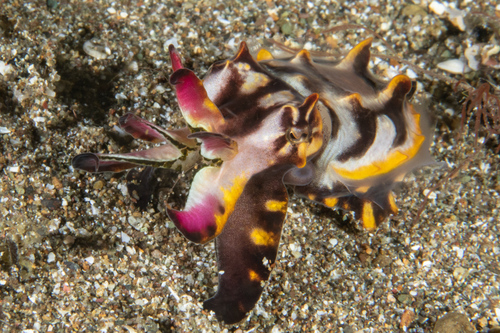
Ascarosepion pfefferi, also known as the flamboyant cuttlefish, is a species of cuttlefish occurring in tropical Indo-Pacific waters off northern Australia, southern New Guinea, as well as numerous islands of the Philippines, Indonesia, and Malaysia.

Appearance

A. pfefferi is a robust-looking species, having a very broad, oval mantle. Arms are broad and blade-like and have four rows of suckers. The modified arm used by males for fertilisation, called the hectocotylus, is borne on the left ventral arm. The oral surface of the modified region of the hectocotylus is wide, swollen, and fleshy. It bears transversely-grooved ridges and a deep furrow running along the middle. The sucker-bearing surface of the tentacular clubs is flattened, with 5 or 6 suckers arranged in transverse rows. These suckers differ greatly in size, with the largest located near the centre of the club. Three to four median suckers are especially large, occupying most of middle portion of the club. The swimming keel of the club extends considerably near to the carpus.

Habitat

The natural range of A. pfefferi extends from Mandurah in Western Australia (32°33′S 115°04′E), northeastward to Moreton Bay in southern Queensland (27°25′S 153°15′E), and across the Arafura Sea to the southern coast of New Guinea. The species has also been recorded from Sulawesi and the Maluku Islands in Indonesia, and even as far west as the Malaysian islands of Mabul and Sipadan. They are also common in the Philippines and are frequently sighted in the Visayas.

Reproduction

Copulation occurs face-to-face, with the male inserting a packet of sperm into a pouch on the underside of the female's mantle. The female then fertilises her eggs with the sperm. The eggs are laid singly and placed by the female in crevices or ledges in coral, rock, or wood. In one instance, around a dozen eggs were found under an overturned coconut husk half. They had been placed there by a female which had inserted them through the central hole of the husk. Thereby, the eggs were protected from predatory fish.

Freshly-laid eggs are white, but slowly turn translucent with time, making the developing cuttlefish clearly visible. From emergence, hatchling A. pfefferi are capable of producing the same camouflage patterns as adults; they are truly precocial and do not receive any care from their parents.

Part of

Where to see it

No dive sites list Flamboyant Cuttlefish yet. Explore the map to find sites near you.