
← All marine life
Common Cuttlefish
Species IUCN · Least Concern (LC)

Common Cuttlefish

Sepia officinalis, Linnaeus, 1758

marinebrackish

About Common Cuttlefish

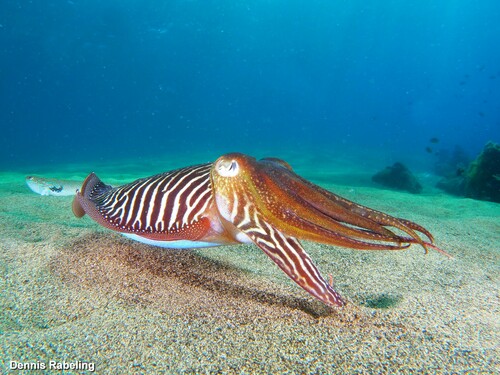
The common cuttlefish or European common cuttlefish (Sepia officinalis) is one of the largest and best-known cuttlefish species. They are a migratory species that spend the summer and spring inshore for spawning and then move to depths of 100–200 metres (330–660 ft) during autumn and winter. They grow to 49 centimetres (19 in) in mantle length and 4 kilograms (8.8 lb) in weight. Animals from subtropical seas are smaller and rarely exceed 30 centimetres (12 in) in mantle length.

The common cuttlefish is native to at least the Mediterranean Sea, North Sea, and Baltic Sea, although subspecies have been proposed as far south as South Africa. It lives on sand and mud seabeds and it can tolerate brackish water conditions.

Appearance

The common cuttlefish is one of the largest species of cuttlefish with a mantle length reaching up to 45 cm (18 in) and a mass of 4 kg (8.8 lb) on a presumed male, although this is for an exceptional specimen in temperate waters; specimens in subtropical waters rarely surpass a mantle length of 30 cm (12 in) and 2 kg (4.4 lb) in mass. The mantle houses the reproductive and digestive tracts of the cuttlefish and is also home to an internal shell called the cuttlebone, located on the dorsal side of the animal. The common cuttlefish has two highly developed eyes, eight arms which are located around the mouth and are used to hold and manipulate prey, two specialized feeding tentacles which are used to ambush prey, and a beak housing a radula used in breaking down and consuming their (often armored) prey.

Behaviour

During the day, most cuttlefish can be found buried below the substrate and fairly inactive. At night however, they are actively searching for prey and can ambush them from under the substrate. Cuttlefish are carnivorous and eat a variety of organisms including crustaceans (crabs and shrimp), small demersal fish, molluscs (clams and snails), and sometimes other cuttlefish which is more commonly seen when the abundance of other prey is low.

A 2008 study on S. officinalis revealed that cuttlefish embryos, if visually exposed to a certain species of prey (e.g. crabs), will hunt primarily for that prey in later life. S. officinalis usually prefer shrimp to crabs, but when the embryos were exposed to crabs and the embryos had hatched, the young cuttlefish switched preferences and proceeded to hunt the crabs more often than the shrimp.

Part of

Where to see it

No dive sites list Common Cuttlefish yet. Explore the map to find sites near you.