
← All marine life
Pharaoh Cuttlefish
Species IUCN · Data Deficient (DD)

Pharaoh Cuttlefish

Sepia pharaonis, (Ehrenberg, 1831)

marine

About Pharaoh Cuttlefish

The pharaoh cuttlefish (Acanthosepion pharaonis) is a large cuttlefish species, growing to 42 cm in mantle length and 5 kg in weight.

Acanthosepion pharaonis is likely a complex of at least three species, Acanthosepion pharaonis I, commonly located in the Red Sea and Persian Gulf, A. pharaonis II, located from Japan to the Gulf of Thailand and northern Australia; and A. pharaonis III, located from the Indian Ocean to the Andaman Sea.

The type specimen was collected in the Gulf of Suez and is deposited at the Museum für Naturkunde in Berlin.

Appearance

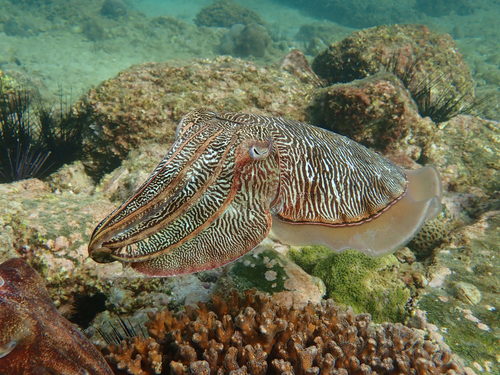
Pharaoh cuttlefish often show a solid colour when resting on a solid colour background, alternating from a pale white to all dark brown. Additionally, they can show a mottled white and brown colour, with a centre circle of brown. The mechanism for colour in the Pharaoh cuttlefish is about the same as it is in other cuttlefish. This colour-changing function is produced by groups of red, yellow, brown, and black pigmented chromatophores above a layer of reflective blue and green tinted iridophores and leucophores, with up to 200 of these specialized pigment cells per square millimeter. These sacs of colour are controlled by rings of muscle around the sac. The cuttlefish expands and contracts these muscle rings in order to show different colours.

Habitat

The pharaoh cuttlefish is native to at least the western Indian Ocean, including the Red Sea and Persian Gulf. Of all the cuttlefish species in the Persian Gulf, it is the most commonly caught. When hunting at night, it swims up to shallower parts of the sea to feast on a variety of smaller fish, crabs, and occasionally other cuttlefish. It is thought to have reached the Mediterranean Sea as a Lessepsian migrant via the Suez Canal after many of its cuttlebones were washed up on beaches in Israel in the early 2000s.

They have been observed to exhibit migratory behaviour off the south-west coast of India. They are more commonly found furthest north during August, and further south in May. They show an even distribution in October and February. Additionally, there are more juveniles present in May, and more adults present in August.

Diet

Most cephalopods use their two elongated tentacles for prey hunting, and particularly cuttlefish are known to use a three-step process of attention, positioning, and seizure. Adult pharaoh cuttlefish and most juveniles begin their attention stance with throwing their arms and tentacles into a triangle shape, turning to the prey. This is followed by a positioning stage where the tentacles are moved slowly from the centre of the triangle as they move towards their prey. They finish this with their seizure phase, where they move forward until lunging their tentacles rapidly to grasp their prey before retracting the prey back towards them. Due to their small squat body size and lack of speed in forward propulsion, Acanthosepion pharaonis have adapted to use this ambush style of tentacle lunging.

Reproduction

Pharaoh cuttlefish reproduce similarly to most other cuttlefish. Large males compete with each other through combat until a victor is decided, although it is often decided without any initiation of physical combat. The males circle each other, performing threatening displays of colour and tentacles until one male swims off in defeat. The victorious male then mates with females by grabbing them with their tentacles, turning the female so that the two animals are face-to-face, then using a specialized tentacle to insert sperm sacs into an opening near the female's mouth. The male then guards the female until she lays the fertilised eggs a few hours later. Females undergo a series of phases when laying their eggs, beginning with a temporary posture where their arms are bunched in a fist-like position.

Humans & conservation

The pharaoh cuttlefish is a commonly fished species of cuttlefish in the Philippines, as well as the most economically important cuttlefish in the northern Indian Ocean. It is often eaten by humans in these areas. Typically, cuttlefish is consumed as dried, shredded cuttlefish, a popular snack food. In the Qing Dynasty-era manual of Chinese gastronomy, the Suiyuan shidan, the roe of the cuttlefish is considered a difficult to prepare but sought-after delicacy. This species is also being harvested by fishermen as a commercial species in the Suez Canal, Egypt.

Cuttlefish ink was used as a dye called sepia, an important pigment which has now been mostly supplanted by artificial dyes.

Part of

Where to see it

No dive sites list Pharaoh Cuttlefish yet. Explore the map to find sites near you.