
← All marine life
Species

Pygmy Cuttlefish

Sepia bandensis, (Adam, 1939)

marine

About Pygmy Cuttlefish

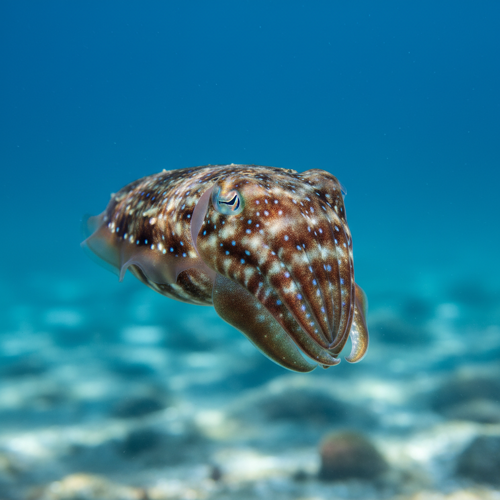
The dwarf cuttlefish (Ascarosepion bandense), also known as the stumpy-spined cuttlefish, is a species of cuttlefish native to the shallow coastal waters of the Central Indo-Pacific. A 2023 phylogenetic analysis reassigned this species from its former name (Sepia bandensis). Sepia baxteri and Sepia bartletti are possible synonyms. It is common in coral reef and sandy coast habitats, usually in association with sea cucumbers and sea stars.

Like other cephalopods, the dwarf cuttlefish can rapidly change its skin pattern for camouflage and communication. It exhibits notable cognitive abilities, supported by a complex nervous system that includes a centralized brain and extensive networks of neurons in its arms. Due to its manageable size, rich behavioral repertoire, and growing genetic tools, it is increasingly used as a model organism in neuroscience and behavior research.

Appearance

As is typical of cuttlefish, the body of A. bandense consists of a mantle (generally around 4–7 cm at adult size), 8 visible arms, and 2 feeding tentacles (normally kept tucked inside the head). Their skin is covered in chromatophores and subcutaneous muscles known as papillae, both of which are under neural control. Chromatophores develop shortly before hatching and allow the cuttlefish to quickly and dramatically change its patterning. In a similar fashion, the papillae allow the cuttlefish to change its physical texture by raising and lowering portions of its skin. These changes in appearance are used for camouflaging to its environment, as well as social signaling between conspecifics.
Diet

Dwarf cuttlefish are generalist obligate carnivores, and hunt a variety of crustaceans and small fish. When a cuttlefish identifies a prey item, primarily by sight, they will often change patterns and "stalk" slowly towards it with their arms raised. The cuttlefish will then rapidly launch its feeding tentacles to grab the prey and pull it towards its oral cavity. The cuttlefish will hold onto its prey with its arms and inject it with venom to paralyze it. Once the prey is sedated, the cuttlefish will bite off small pieces with its beak. Research is currently ongoing into the precise makeup and evolution of cuttlefish venoms, and how they compare to those found in other animals.

Behaviour

Female dwarf cuttlefish are reproductively active for a period 1–2 months, over which they can lay multiple clutches of eggs. Dwarf cuttlefish eggs are roughly 1 cm in diameter and covered in embryonic jelly mixed with ink for protection. Eggs are laid in clusters of around 5–40, resembling grapes, attached to corals or other firm surfaces and are left to develop without parental care.

Part of

Where to see it

No dive sites list Pygmy Cuttlefish yet. Explore the map to find sites near you.

Sources