About Whale

Whales are a widely distributed and diverse group of fully aquatic placental marine mammals. As an informal and colloquial grouping, they correspond to large members of the infraorder Cetacea, i.e. all cetaceans apart from dolphins and porpoises. Dolphins and porpoises may be considered whales from a formal, cladistic perspective. Whales, dolphins and porpoises belong to the order Cetartiodactyla, which consists of even-toed ungulates. Their closest non-cetacean living relatives are the hippopotamuses, from which they and other cetaceans diverged about 54 million years ago. The two parvorders of whales, baleen whales (Mysticeti) and toothed whales (Odontoceti), are thought to have had their last common ancestor around 34 million years ago. Mysticetes include four extant (living) families: Balaenopteridae (the rorquals), Balaenidae (right whales), Cetotheriidae (the pygmy right whale), and Eschrichtiidae (the grey whale). Odontocetes include the Monodontidae (belugas and narwhals), Physeteridae (the sperm whale), Kogiidae (the dwarf and pygmy sperm whale), and Ziphiidae (the beaked whales), as well as the six families of dolphins and porpoises which are not considered whales in the informal sense.

Behaviour

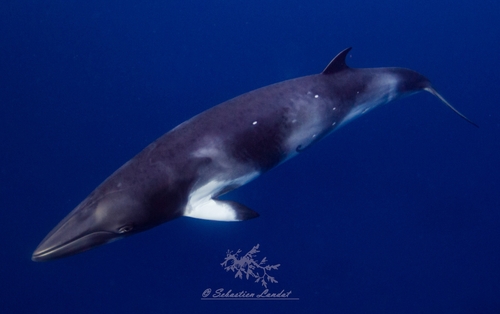
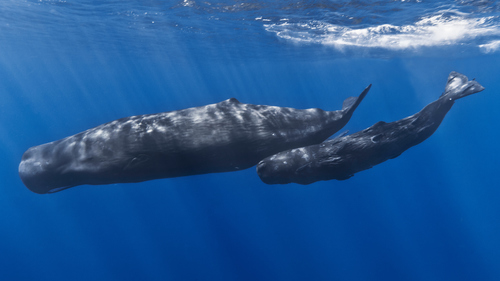
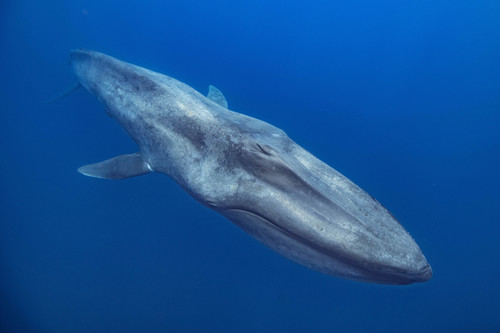
All whales are carnivorous and predatory. Odontocetes, as a whole, mostly feed on fish and cephalopods, and then followed by crustaceans and bivalves. All species are generalist and opportunistic feeders. Mysticetes, as a whole, mostly feed on krill and plankton, followed by crustaceans and other invertebrates. A few are specialists. Examples include the blue whale, which eats almost exclusively krill, the minke whale, which eats mainly schooling fish, the sperm whale, which specialize on squid, and the grey whale which feed on bottom-dwelling invertebrates. The elaborate baleen "teeth" of filter-feeding species, mysticetes, allow them to remove water before they swallow their planktonic food by using the teeth as a sieve. Usually, whales hunt solitarily, but they do sometimes hunt cooperatively in small groups.
Reproduction

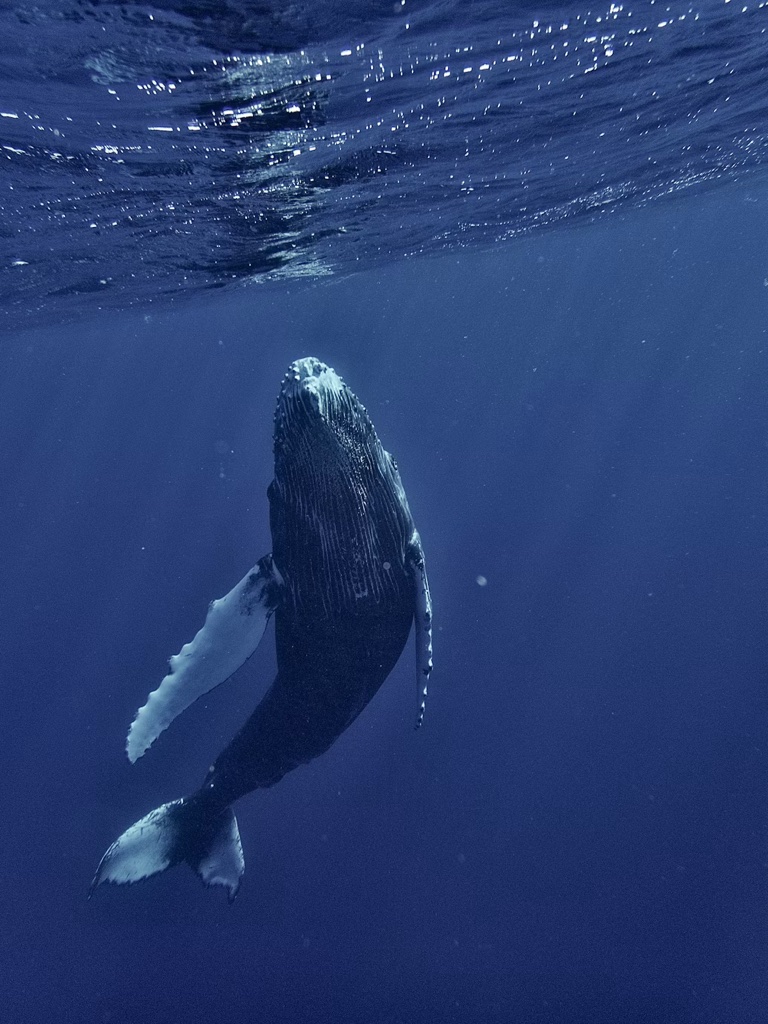
As with humans, the whale mode of reproduction typically produces but one offspring approximately once each year. This implies ensuring a high probability of survival for each calf with maternal care.

Whales have a typical gestation period of 12 months. Once born, the absolute dependency of the calf upon the mother lasts from one to two years. Sexual maturity is achieved at around seven to ten years of age. The length of the developmental phases of a whale's early life varies between different whale species.

Humans & conservation

Whaling by humans has existed since the Stone Age. Ancient whalers used harpoons to spear the bigger animals from boats out at sea. People from Norway and Japan started hunting whales around 2000 B.C. Whales are typically hunted for their meat and blubber by aboriginal groups; they used baleen for baskets or roofing, and made tools and masks out of bones. The Inuit hunted whales in the Arctic Ocean. The Basques started whaling as early as the 11th century, sailing as far as Newfoundland in the 16th century in search of right whales. 18th- and 19th-century whalers hunted whales mainly for their oil, which was used as lamp fuel and a lubricant, baleen or whalebone, which was used for items such as corsets and skirt hoops, and ambergris, which was used as a fixative for perfumes. The most successful whaling nations at this time were the Netherlands, Japan, and the United States.

Species in this group

Where to see it

Top-rated dive sites where divers have spotted Whale.

Eua Whale Swimming

Eua Whale Swimming

Not yet rated
Global renowned humpback whale watching and swimming with rough sea and good viz
🚤 Boat Intermediate

Sources

  • Wikipedia — licensed CC BY-SA 4.0 · Text adapted from the Wikipedia article; modifications by WikiBubbles are shared under the same license.