
← All marine life
Bowhead Whale
Species IUCN · Least Concern (LC)

Bowhead Whale

Balaena mysticetus, Linnaeus, 1758

marine

About Bowhead Whale

The bowhead whale (Balaena mysticetus), sometimes known as the Greenland right whale, Arctic whale, and polar whale, is a species of baleen whale belonging to the family Balaenidae and is the only living representative of the genus Balaena. It is the only baleen whale endemic to the Arctic and subarctic waters, and is named after its characteristic massive triangular skull, which it uses to break through Arctic ice.

Bowheads have the largest mouth of any animal, representing almost one-third of the length of the body. They also have the longest baleen plates among whales, with a maximum length of 2.97 to 5.2 metres (9.7 to 17.1 ft). They may be the longest-lived of all mammals, with the ability to reach an age of more than 200 years.

The bowhead was an early whaling target. Their population was severely reduced before a 1966 moratorium was passed to protect the species. Of the five stocks of bowhead populations, three are listed as endangered, one as vulnerable, and one as lower risk, conservation dependent according to the IUCN Red List. The global population is assessed as of least concern.

Appearance

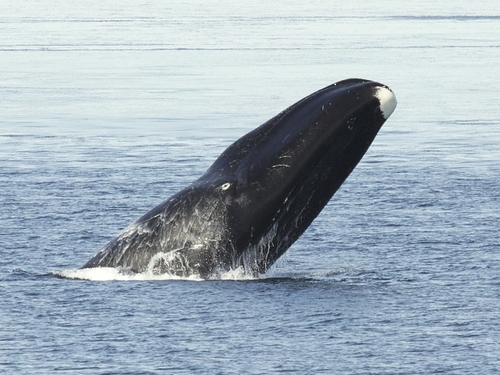
The bowhead whale is among the largest baleen whale species and is distinguished by its round body with an exceptionally curved rostrum, a large head, and long, dark baleen plates. Relative to its size, the bowhead whale has the largest head of any cetacean, measuring nearly 40% of the total body length. Two blowholes are situated atop its head, and help propel a stream of water up to 6.1 m (20 ft) in the air. The lower lips encompasses the baleen racks and resembles a curved circular shape when viewed from the side. It also has wide, trigonal flukes and fairly large, oar-shaped flippers. The skin is mostly black with white patches around the flukes, tail, eyes, and chin. These patches develop throughout life, with the exception of the patch surrounding the chin, which is usually visible in newborn calves, and increases in size at the same rate with the whale's overall growth.
Diet

The head of the bowhead whale comprises a large portion of its body length, creating an enormous feeding apparatus. The bowhead whale is a filter feeder, and feeds by swimming forward with its mouth wide open. It has hundreds of overlapping baleen plates consisting of keratin hanging from each side of the upper jaw. The mouth has a large, upturning lip on the lower jaw that helps to reinforce and hold the baleen plates within the mouth. This also prevents buckling or breakage of the plates from the pressure of the water passing through them as the whale advances. To feed, water is filtered through the fine hairs of keratin of the baleen plates, trapping the prey inside near the tongue where it is then swallowed. The diet consists of mostly zooplankton, which includes krill, copepods, mysids, amphipods, and many other crustaceans. About 1.8 t (2 short tons) of food are consumed each day.

Behaviour

The bowhead whale typically travels alone or in small pods of up to six. It is able to dive and remain submerged under water for up to an hour. The time spent under water in a single dive is usually limited to 9–18 minutes. The bowhead is not thought to be a deep diver, but can reach a depth down to 150 m (500 ft). It is a slow swimmer, normally travelling around 2 to 5 kilometres per hour (0.56 to 1.39 m/s; 1.2 to 3.1 mph). When fleeing from danger, it can travel at a speed of 10 km/h (2.8 m/s; 6.2 mph). During periods of feeding, the average swim speed is increased to 1.1–2.5 m/s (4.0–9.0 km/h; 2.5–5.6 mph).

Reproduction

Sexual activity occurs between pairs and in boisterous groups of several males and one or two females. Breeding season is observed from March through August; conception is believed to occur primarily in March when song activity is at its highest. Sexual maturity is estimated to be reached at 15–25 years, and physical maturity at 50–60 years. The gestation period is 13–14 months with females producing a calf once every three to four years. There is no evidence of reproductive aging in males, and a case of penile sperm discharge from a male bowhead whale estimated to be 159 years old has been reported. However, there is evidence of possible reproductive aging in female bowhead whales, with females aged 133, 139, and 149 years, respectively, suggesting reproductive cessation or senescence. The oldest female captured with a fetus was estimated to be 121 years old.

Humans & conservation

The bowhead is listed in Appendix I of CITES. While the global population is thought to be secure, thus assigned least concern status, some populations are listed by the National Marine Fisheries Service as endangered under the auspices of the United States' Endangered Species Act. The IUCN Red List data are:

Svalbard population – critically endangered

Sea of Okhotsk subpopulation – endangered

Baffin Bay-Davis Strait stock – endangered

Hudson Bay-Foxe Basin stock – vulnerable (estimated to be 1,026 individuals in 2005 by DFO)

Bering-Chukchi-Beaufort stock – lower risk – conservation dependent

The Alaska Department of Fish and Game and the USA government list the bowhead whale as federally endangered.

Part of

Where to see it

No dive sites list Bowhead Whale yet. Explore the map to find sites near you.