← All marine life
Sperm Whale
Species IUCN · Vulnerable (VU)

Sperm Whale

Physeter macrocephalus, Linnaeus, 1758

marine

About Sperm Whale

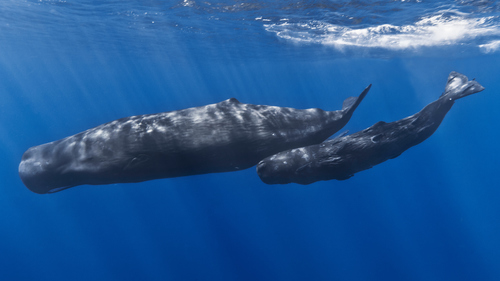
The sperm whale or cachalot (Physeter macrocephalus) is the largest of the toothed whales and the largest toothed predator. It is the only living member of the genus Physeter and one of three extant species in the sperm whale superfamily Physeteroidea, along with the pygmy sperm whale and dwarf sperm whale of the genus Kogia.

The sperm whale is a pelagic mammal with a worldwide range, and will migrate seasonally for feeding and breeding. Females and young males live together in groups, while mature males (bulls) live solitary lives outside of the mating season. The females cooperate to protect and nurse their young. Females give birth every four to twenty years and care for the calves for more than a decade. A mature, healthy sperm whale has no natural predators, although calves and weakened adults are sometimes killed by pods of orcas.

Mature males average 16 metres (52 ft) in length, with the head representing up to one-third of the animal's length. Plunging to 2,250 metres (7,380 ft), it is the third deepest diving mammal, exceeded only by the southern elephant seal and Cuvier's beaked whale. The sperm whale uses echolocation and vocalization with source level as loud as 236 decibels (re 1 μPa m) underwater, the loudest of any animal. It has the largest brain on Earth, more than five times heavier than a human's. Sperm whales can live 70 years or more.

Diet

Sperm whales usually dive between 300 and 800 metres (980 and 2,620 ft), and sometimes 1 to 2 kilometres (3,300 to 6,600 ft), in search of food. Such dives can last more than an hour. They feed on several species, notably the giant squid, but also the colossal squid, octopuses, and fish such as demersal rays and sharks, but their diet is mainly medium-sized squid. Sperm whales may also possibly prey upon swordfish on rare occasions. Some prey may be taken accidentally while eating other items. Most of what is known about deep-sea squid has been learned from specimens in captured sperm whale stomachs, although more recent studies analysed faeces.

Behaviour

Sperm whales are among the most cosmopolitan species. They prefer ice-free waters over 1,000 metres (3,300 ft) deep. Although both sexes range through temperate and tropical oceans and seas, only adult males populate higher latitudes. Among several regions, such as along coastal waters of southern Australia, sperm whales have been considered to be locally extinct.

Reproduction

Sperm whales can live 70 years or more. The oldest recorded living sperm whale was 77–80 years old. According to data on cetacean hunting collected in South Africa, the ages of the older individuals among the 22 surveyed were estimated to be between 42 and 61 years. They are a prime example of a species that has been K-selected, meaning their reproductive strategy is associated with stable environmental conditions and comprises a low birth rate, significant parental aid to offspring, slow maturation, and high longevity.
How they choose mates has not been definitively determined. Bulls will fight with each other over females, and males will mate with multiple females, making them polygynous, but they do not dominate the group as in a harem. Bulls do not provide paternal care to their offspring but rather play a fatherly role to younger bulls to show dominance.

Humans & conservation

Spermaceti, obtained primarily from the spermaceti organ, and sperm oil, obtained primarily from the blubber in the body, were much sought after by 18th, 19th, and 20th century whalers. These substances found a variety of commercial applications, such as candles, soap, cosmetics, machine oil, other specialised lubricants, lamp oil, pencils, crayons, leather waterproofing, rust-proofing materials and many pharmaceutical compounds. Ambergris, a highly expensive, solid, waxy, flammable substance produced in the digestive system of sperm whales, was also sought as a fixative in perfumery.

Part of

Where to see it

No dive sites list Sperm Whale yet. Explore the map to find sites near you.