
← All marine life
Blue Whale
Species IUCN · Endangered (EN)

Blue Whale

Balaenoptera musculus, (Linnaeus, 1758)

marine

About Blue Whale

The blue whale (Balaenoptera musculus) is a species of baleen whale and the largest marine mammal in the rorqual family Balaenopteridae. Reaching a maximum confirmed length of 29.9–30.5 m (98–100 ft) and weighing up to 190–200 t (190–200 long tons; 210–220 short tons), it is the largest animal known to have ever existed. The blue whale's long and slender body can be of various shades of greyish-blue on its upper surface and somewhat lighter underneath. Four subspecies are recognized: B. m. musculus in the North Atlantic and North Pacific, B. m. intermedia in the Southern Ocean, B. m. brevicauda (the pygmy blue whale) in the Indian Ocean and South Pacific Ocean, and B. m. indica in the Northern Indian Ocean. There is a population in the waters off Chile that may constitute a fifth subspecies.

In general, blue whale populations migrate between their summer feeding areas near the poles and their winter breeding grounds near the tropics. There is also evidence of year-round residencies, and partial or age- and sex-based migration. Blue whales are filter feeders; their diet consists almost exclusively of krill. They are generally solitary or gather in small groups, and have no well-defined social structure other than mother–calf bonds. Blue whales vocalize, with a fundamental frequency ranging from 8 to 25 Hz; their vocalizations may vary by region, season, behavior, and time of day.

Appearance

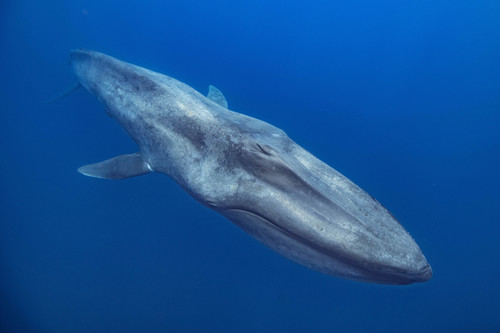
The blue whale is a slender-bodied cetacean with a broad U-shaped head; thin, elongated flippers; a small sickle-shaped dorsal fin located close to the tail, and a large tail stock at the root of the wide and thin flukes. The upper jaw is lined with 70–400 black baleen plates less than 1 m (3.3 ft) in length. The throat region has 60–88 grooves which allows the skin to expand during feeding. It has two blowholes that can squirt 9.1–12 m (30–39 ft) up in the air. The skin has a mottled grayish-blue coloration, appearing blue underwater. The mottling patterns near the dorsal fin vary between individuals. The underbelly has lighter pigmentation and can appear yellowish due to diatoms in the water, which historically earned them the nickname "sulphur bottom". Some albino individuals can be completely white.
Diet

The blue whale's diet consists almost exclusively of krill, which they capture through lunge feeding, where they swim towards krill at high speeds with their mouths open up to 80 degrees. They may engulf 220 t (220 long tons; 240 short tons) of water at one time. They squeeze the water out through their baleen plates with pressure from the throat pouch and tongue, and swallow the remaining krill. Blue whales have been recorded making 180° rolls during lunge-feeding, possibly allowing them to search the prey field and find the densest patches.

Behaviour

The blue whale is usually solitary, but can be found in pairs. When productivity is high enough, blue whales can be seen in gatherings of more than 50 individuals. Populations may go on long migrations, traveling to their summer feeding grounds towards the poles and then heading to their winter breeding grounds in more equatorial waters. The animals appear to use memory to locate the best feeding areas. There is evidence of alternative strategies, such as year-round residency, and partial (where only some individuals migrate) or age/sex-based migration. Some whales have been recorded feeding in breeding grounds.

Reproduction

The age of sexual maturity in blue whales is thought to be between 5 and 15 years, with females reaching an average of 10 years and males reaching an average of 12 years. In the Northern Hemisphere, the length at which they reach maturity is 21–23 m (69–75 ft) for females and 20–21 m (66–69 ft) for males. In the Southern Hemisphere, the length of maturity is 23–24 m (75–79 ft) and 22 m (72 ft) for females and males, respectively. Male pygmy blue whales average 18.7 m (61.4 ft) at sexual maturity. Female pygmy blue whales are 21.0–21.7 m (68.9–71.2 ft) in length and roughly 10 years old at the age of sexual maturity. Since corpora are added every ~2.5 years after sexual maturity, physical maturity is assumed to occur at 35 years. Little is known about mating behavior, or breeding and birthing areas. Blue whales appear to be polygynous, with males competing for females.

Humans & conservation

In Antarctic waters, blue whales accumulate diatoms of the species Cocconeis ceticola and the genera Navicola, which are normally removed when the whales enter warmer waters. Barnacles such as Coronula diadema, Coronula reginae, and Cryptolepas rhachianecti, latch on to whale skin deep enough to leave behind a pit if removed. Whale lice species make their home in cracks of the skin and are relatively harmless. The copepod species Pennella balaenopterae digs in and attaches itself to the blubber to feed on. Intestinal parasites include the trematode genera Ogmogaster and Lecithodesmus; the tapeworm genera Priapocephalus, Phyllobotrium, Tetrabothrius, Diphyllobotrium, and Diplogonoporus; and the thorny-headed worm genus Bolbosoma. In the North Atlantic, blue whales also contain the protozoans Entamoeba, Giardia and Balantidium.

Part of

Where to see it

No dive sites list Blue Whale yet. Explore the map to find sites near you.