
← All marine life
Minke Whale
Species IUCN · Least Concern (LC)

Minke Whale

Balaenoptera acutorostrata, Lacépède, 1804

marine

About Minke Whale

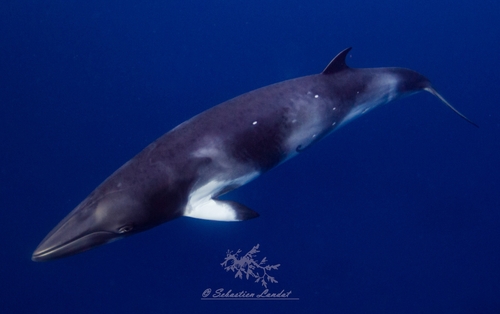
The common minke whale or northern minke whale (Balaenoptera acutorostrata) is a species of minke whale within the suborder of baleen whales.

It is the smallest species of the rorquals and the second smallest species of baleen whale. Although first ignored by whalers due to its small size and low oil yield, it began to be exploited by various countries beginning in the early 20th century. As other species declined, larger numbers of common minke whales were caught, largely for their meat. It is now one of the primary targets of the whaling industry. There is a dwarf form in the Southern Hemisphere.

This species is known in the fossil record from the Pliocene epoch to the Quaternary period (age range: 4.7 million years ago to present day).

Appearance

The common minke whale is the smallest of the rorquals, and one of the smallest baleen whales (second smallest only to the Pygmy right whale). In the North Atlantic, Norwegian whaling vessels in 1940 allegedly caught individuals of up to 10.7 m (35 ft) in length, but they were likely only measured visually in comparison to objects of known dimensions aboard the ships themselves – the longest caught in subsequent years were typically only up to 9.4–10.05 m (30.8–33.0 ft) in length. In the North Pacific, Soviet vessels operating out of the Kuril Islands claimed to have caught two males of 12.2 (40 ft) and 12 m (39 ft) and a female of 10.7 m (35 ft) – the first two were landed in 1951, the third in 1960. These likely represent undersized sei whales, part of the massive misreporting of whaling data by the Soviet Union in the North Pacific and elsewhere.
Habitat

There are approximately 209,800 common minke whales worldwide. They have a disjointed distribution. In the North Atlantic, they occur as far north as Baffin Bay, Svalbard, Franz Josef Land, and Novaya Zemlya and as far south as 40°N (New Jersey) and the Hebrides and central North Sea during summer. There are a few records from Hudson Bay (James Bay in 1986 and Button Bay in 1990), and they have also been observed occasionally in Hudson Strait and Ungava Bay. They have been recorded off Madeira and occur year-round off the Canary Islands. There are occasional sightings and strandings off Spain and Portugal, western Sahara, Mauritania, and Senegal. It is rare off the Azores and a vagrant in the Gulf of Mexico and the Mediterranean Sea, with a few records from the Black Sea (1880 and 1926).

Diet

There have been numerous recorded instances of killer whales preying on or attacking common minke whales in places such as the Kamchatka Peninsula, Alaska, British Columbia, Washington State, California, the Gulf of St. Lawrence, Greenland, and Svalbard. They are normally able to outpace pursuing killer whales in open water or are trapped in a bay, where they are rammed and drowned or strand and die – in one instance a minke whale was able to refloat itself on the rising tide and swim away. Chases usually last about 30 minutes to an hour and can reach speeds of up 30 km/h (19 mph), often with both species porpoising out of the water in low-angle leaps. Typically two to four killer whales and a lone minke are involved. If the pursuing killer whales do catch up to the minke it does not defend itself, which is typical of the fast-moving members of its genus.

Behaviour

Common minke whales are normally seen singly. In the San Juan Islands, although up to six whales could be seen in a feeding area at once they usually acted independently, with no indications of cooperative feeding like that observed in their larger relatives the humpback and fin whale. On occasion, two whales could be seen surfacing at the same time, within one or two body lengths of each other – such associations could last for only one surfacing to as long as about 90 minutes. Only once were three individuals seen together for a couple surfacings. In the Monterey Bay area, usually only one whale was visible at a time; on only four occasions were two whales seen swimming together. On several occasions in the Johnstone Strait area pairs and trios were briefly seen surfacing together.

Humans & conservation

The common minke whale is listed as least concern on the IUCN Red List. It is listed on Appendix I of CITES. In addition, the species is covered by the Memorandum of Understanding for the Conservation of Cetaceans and Their Habitats in the Pacific Islands Region (Pacific Cetaceans MOU) and the Agreement on the Conservation of Cetaceans in the Black Sea Mediterranean Sea and Contiguous Atlantic Area (ACCOBAMS).

Part of

Where to see it

No dive sites list Minke Whale yet. Explore the map to find sites near you.