← All marine life
Sponge
Group

Sponge

Porifera, Grant, 1836

marinebrackishfreshwater
Where to see it

About Sponge

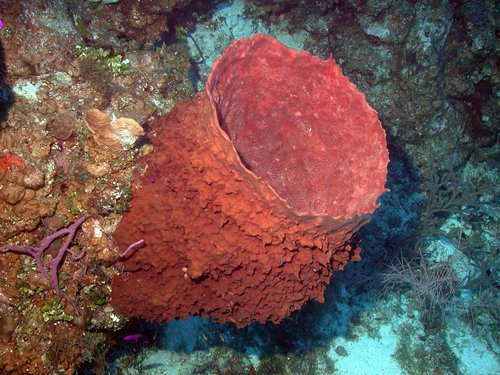
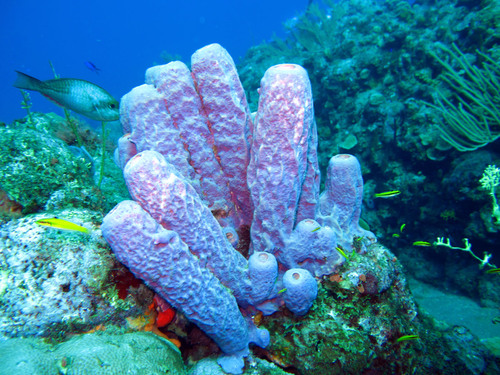
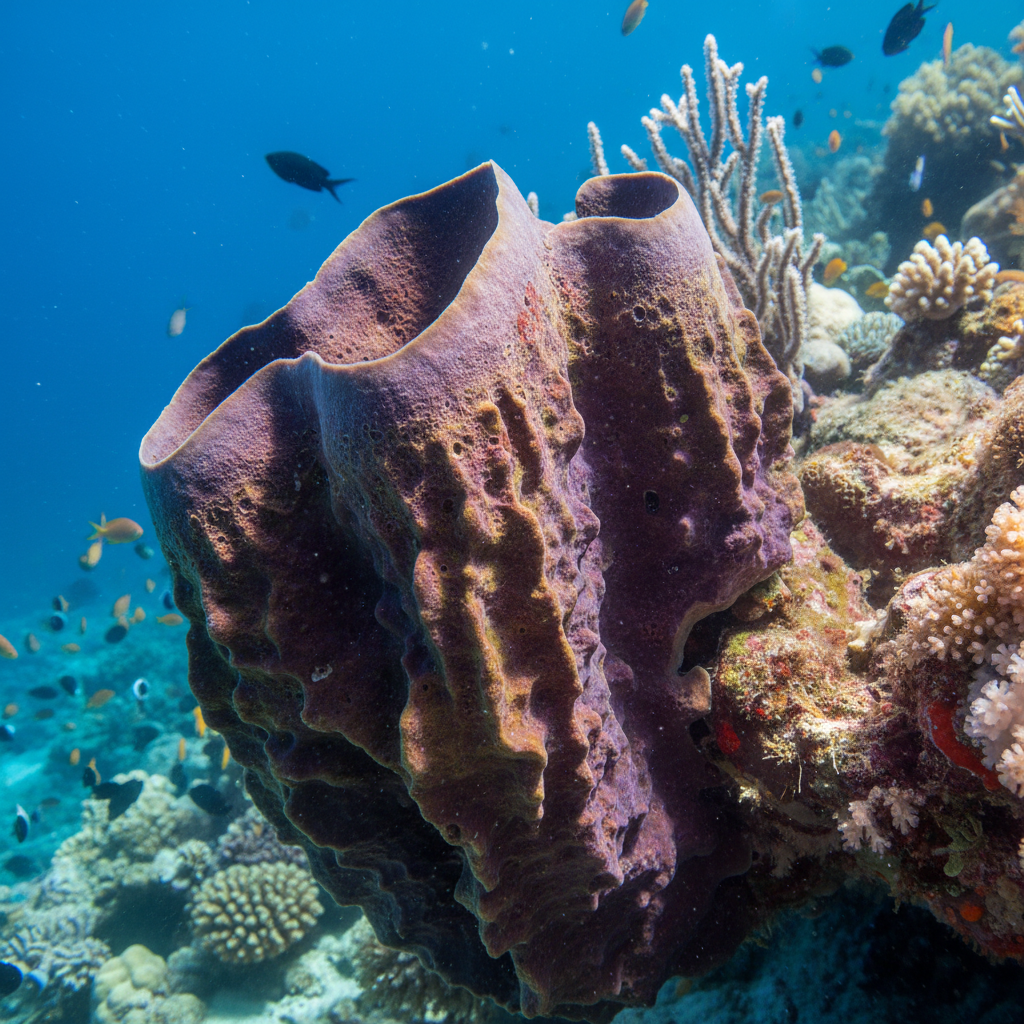
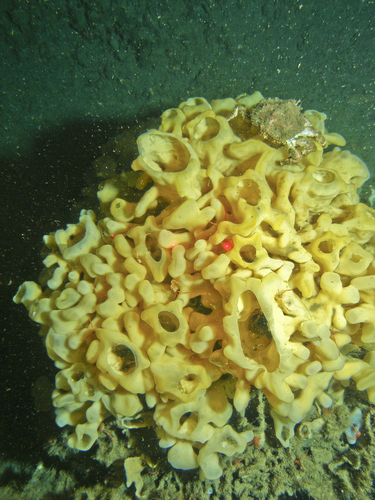
Sponges or sea sponges are primarily marine invertebrates of the animal phylum Porifera (; meaning 'pore bearer'). They are filter feeders that are typically bound to the seabed, being sessile. Sponges are one of the most ancient members of living seabed community (macrobenthos), with many species being important reef-builders. Some sponge species inhabit freshwater.

Sponges are multicellular organisms consisting of jelly-like mesohyl sandwiched between two thin layers of cells, and usually have tube-like bodies full of pores and channels that allow water to circulate through them. They have unspecialized cells that can transform into other types and that often migrate between the main cell layers and the mesohyl in the process. They do not have complex nervous, digestive or circulatory systems. Instead, most sponges rely on maintaining a constant water flow through their bodies to obtain food and oxygen and to remove waste products, usually via flagellar movements of the so-called "collar cells".

Sponges may be the sister group to all other animals, although the evidence for this relationship remains inconclusive, and different studies may recover different placements between sponges and other animal clades. Fossil evidence of primitive sponges such as Otavia dates to as early as the Tonian period (around 800 Mya). The branch of zoology that studies sponges is spongiology. Historically, the skeletons of sea sponges were used as the cleaning tool of the same name, though this is no longer a common practice.

Diet

Sponges do not have distinct circulatory, respiratory, digestive, and excretory systems – instead, the water flow system supports all these functions. They filter food particles out of the water flowing through them. Particles larger than 50 micrometers cannot enter the ostia and pinacocytes consume them by phagocytosis (engulfing and intracellular digestion). Particles from 0.5 μm to 50 μm are trapped in the ostia, which taper from the outer to inner ends. These particles are consumed by pinacocytes or by archaeocytes that partially extrude themselves through the walls of the ostia. Bacteria-sized particles, below 0.5 micrometers, pass through the ostia and are caught and consumed by choanocytes. Since the smallest particles are by far the most common, choanocytes typically capture 80% of a sponge's food supply.
Behaviour

Sponges are worldwide in their distribution, living in a wide range of ocean habitats, from the polar regions to the tropics. Most live in quiet, clear waters, because sediment stirred up by waves or currents would block their pores, making it difficult for them to feed and breathe. The greatest numbers of sponges are usually found on firm surfaces such as rocks, but some sponges can attach themselves to soft sediment by means of a root-like base.

Reproduction

Sponges have three asexual methods of reproduction: after fragmentation, by budding, and by producing gemmules. Fragments of sponges may be detached by currents or waves. They use the mobility of their pinacocytes and choanocytes and reshaping of the mesohyl to re-attach themselves to a suitable surface and then rebuild themselves as small but functional sponges over the course of several days. The same capabilities enable sponges that have been squeezed through a fine cloth to regenerate. A sponge fragment can only regenerate if it contains both collencytes to produce mesohyl and archeocytes to produce all the other cell types. A very few species reproduce by budding.

Humans & conservation

The calcium carbonate or silica spicules of most sponge genera make them too rough for most uses, but two genera, Hippospongia and Spongia, have soft, entirely fibrous skeletons. Early Europeans used soft sponges for many purposes, including padding for helmets, portable drinking utensils and municipal water filters. Until the invention of synthetic sponges, they were used as cleaning tools, applicators for paints and ceramic glazes and discreet contraceptives. However, by the mid-20th century, overfishing brought both the animals and the industry close to extinction.

Many objects with sponge-like textures are now made of substances not derived from poriferans. Synthetic sponges include personal and household cleaning tools, breast implants, and contraceptive sponges. Typical materials used are cellulose foam, polyurethane foam, and less frequently, silicone foam.

Species in this group

Where to see it

Top-rated dive sites where divers have spotted Sponge.

Buyuk

Buyuk

⭐ 5.0 (1)
Indonesia, Bali, Nusa Penida Nusa Penida Marine Protected Area (MPA)
Easy drift dive with rich corals, macro and pelagics.
🚤 Boat all levels
Cavern Bay

Cavern Bay

⭐ 4.0 Scout Score
Croatia, Vis Not in marine park
Shallow bay with a spectacular, light-filled underwater cavern.
🚤 Boat All levels
Hilda

Hilda

⭐ 4.0 Scout Score
Australia, Sydney Sydney Marine Park
Historic shipwreck offering impressive structure and dense marine life.
🚤 Boat Advanced
Alice in Wonderland

Alice in Wonderland

⭐ 4.0 Scout Score
Accessible shore dive with vibrant reefs and a unique statue.
👣 Shore all levels
Gustinja

Gustinja

⭐ 4.0 Scout Score
Dive site with abundant marine life near Rovinj.
🚤 Boat All Levels
100 Steps Vrbnik

100 Steps Vrbnik

⭐ 4.0 Scout Score
Croatia, Krk Not in marine park
Dramatic wall dive with caves and diverse macro life.
👣 Shore All levels
Panteronisi

Panteronisi

⭐ 4.0 Scout Score
Crystal clear water around a beautiful Aegean islet.
🚤 Boat all levels
Piedra de la Higuera

Piedra de la Higuera

⭐ 4.0 Scout Score
Spain, Costa Tropical, La Herradura Acantilados y Fondos Marinos de la Punta de la Mona
Submerged pinnacle with dramatic topography and diverse Mediterranean marine life.
🚤 Boat all levels
Grotta delle Stalattiti

Grotta delle Stalattiti

⭐ 4.0 Scout Score
Italy, Sicily Riserva Naturale Orientata Capo Gallo - Isola delle Femmine
Challenging tec cave dive with spectacular stalactite formations.
🚤 Boat advanced
La Grotte du Pari

La Grotte du Pari

Not yet rated
Large lavatube cave rich in macro life and bioluminescent fish.
🚤 Boat Beginner
Secca di Marassi

Secca di Marassi

⭐ 4.0 Scout Score
Secca di Marassi: Italian wall dive with eels and lobsters
🚤 Boat Intermediate
Marie Grota Cave/cliff

Marie Grota Cave/cliff

⭐ 4.0 Scout Score
Advanced cave and deep cliff dive on Šolta island.
🚤 Boat advanced
Relitto Toikosan Maru

Relitto Toikosan Maru

⭐ 4.0 Scout Score
Italy, Sicily, Catania Near Riserva Naturale della Timpa di Acireale
Historic Italian shipwreck dive, famous for its inverted position.
🚤 Boat advanced
Dragon's Eye Lake

Dragon's Eye Lake

⭐ 4.0 Scout Score
Croatia, Rogoznica Protected Geomorphological Monument
Unique stratified lake dive with a visible chemocline layer.
👣 Shore Advanced
Aquarium Reef 1

Aquarium Reef 1

⭐ 4.0 Scout Score
Australia, Western Australia, Abrolhos Islands Houtman Abrolhos Islands Fish Habitat Protection Area
Shallow reef dive with a short, explorable cave system.
🚤 Boat intermediate
Santa Caterina di Nardò

Santa Caterina di Nardò

⭐ 4.0 Scout Score
Easy shore dive with abundant marine life in shallow waters
👣 Shore Beginner
Wall Reef

Wall Reef

⭐ 5.0 Scout Score
Maldives wall reef with diverse macro life and vibrant corals.
🚤 Boat All levels
Cathedral Tower

Cathedral Tower

⭐ 4.0 Scout Score
Philippines, Negros Oriental Apo Island Protected Landscape and Seascape
Deep dive exploring a massive pinnacle on a vibrant reef.
🚤 Boat advanced
Isola Bella South

Isola Bella South

⭐ 4.0 Scout Score
Italy, Sicily, Taormina Riserva Naturale Orientata Isola Bella
Mediterranean maze of swim-throughs and fascinating rock formations.
🚤 Boat all levels
The Valley

The Valley

⭐ 5.0 Scout Score
Australia, Sydney Long Reef Aquatic Reserve
Deep boat dive with stunning topography and abundant marine life.
🚤 Boat Advanced