
← All marine life
Giant Barrel Sponge
Species

Giant Barrel Sponge

Xestospongia muta, (Schmidt, 1870)

marine

About Giant Barrel Sponge

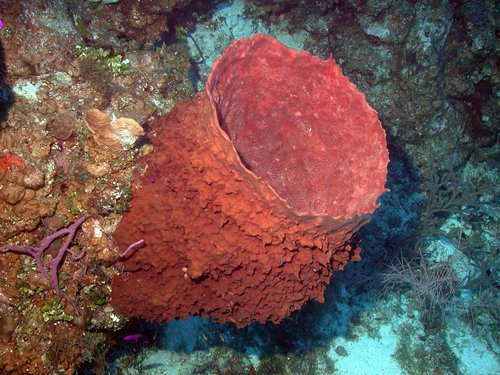
The giant barrel sponge (Xestospongia muta) is the largest species of sponge found growing on Caribbean coral reefs. It is common at depths greater than 10 metres (33 ft) down to 120 metres (390 ft) and can reach a diameter of 1.8 metres (6 feet). It is typically brownish-red to brownish-gray in color, with a hard or stony texture.

The giant barrel sponge has been called the "redwood of the reef" because of its large size and its long lifespan, which can be more than 2,000 years. It is, perhaps, the best-studied species of sponge in the sea; a population on Conch Reef, in the Florida Keys, has been monitored and studied since 1997.

Appearance

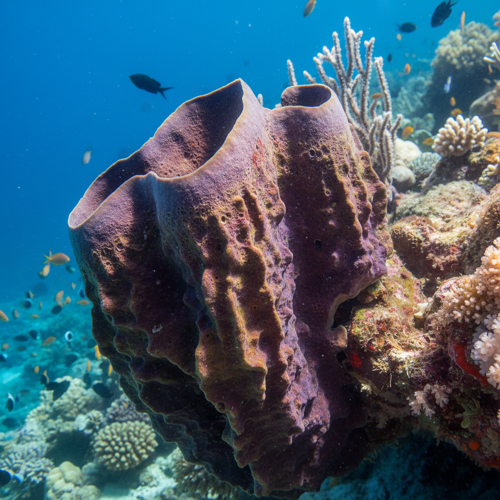
The giant barrel sponge is variable in form. It is very large and firm, typically being barrel-shaped, with a cone-shaped cavity at the apex known as the osculum. However, some individuals within the same population may be low and squat or relatively tall and thin. Similarly, the surface can range from smooth to rough, rugged, and irregular, sometimes with buttresses. In shallow water, the color is brownish-red to brownish-gray; but, at greater depths and in caves and under-hangs, or when the sponge is undergoing cyclic bleaching events, it is pinkish or white.
Habitat

The giant barrel sponge is common on reefs throughout the Caribbean Sea, the Bahamas, Bermuda, the reefs and hard-bottom areas of Florida, and the Gulf of Mexico. In terms of benthic surface coverage, it is the second most abundant sponge on reefs in the Caribbean region. On the reefs off the Florida Keys, it may be as common at two individuals per square metre (yard), and the total biomass of the sponge is greater than any other benthic invertebrate. The sponge grows on any hard surface; the smallest individuals observed are about 1 cm. Two or more closely related species that are visually indistinguishable from X. muta are found on reefs in the Pacific and Indian Oceans (particularly Xestospongia testudinaria).

Behaviour

The tissues of the giant barrel sponge contain photosynthetic symbiotic cyanobacteria, Synechococcus spongiarum, which give the sponge its color. Individuals may undergo periodic bleaching, but this is a cyclic event, and the sponge recovers its normal coloration over time. This cyclical bleaching is likely to be a response by the cyanobacteria rather than by the host sponge, it has no negative effect on the host sponge. Unlike the circumstances for coral bleaching, X. muta does not appear to rely on its photosynthetic symbionts for nutrition, and they are considered commensals. Unrelated to cyclic bleaching is a pathogenic condition of X. muta called "sponge orange band" that can result in the death of the sponge. The cause and transmission of this pathogenic condition remains a mystery.

Part of

Where to see it

No dive sites list Giant Barrel Sponge yet. Explore the map to find sites near you.