← All marine life
Rainbow Wrasse
Group IUCN · Least Concern (LC)

Rainbow Wrasse

Coris julis, (Linnaeus, 1758)

marine
Where to see it

About Rainbow Wrasse

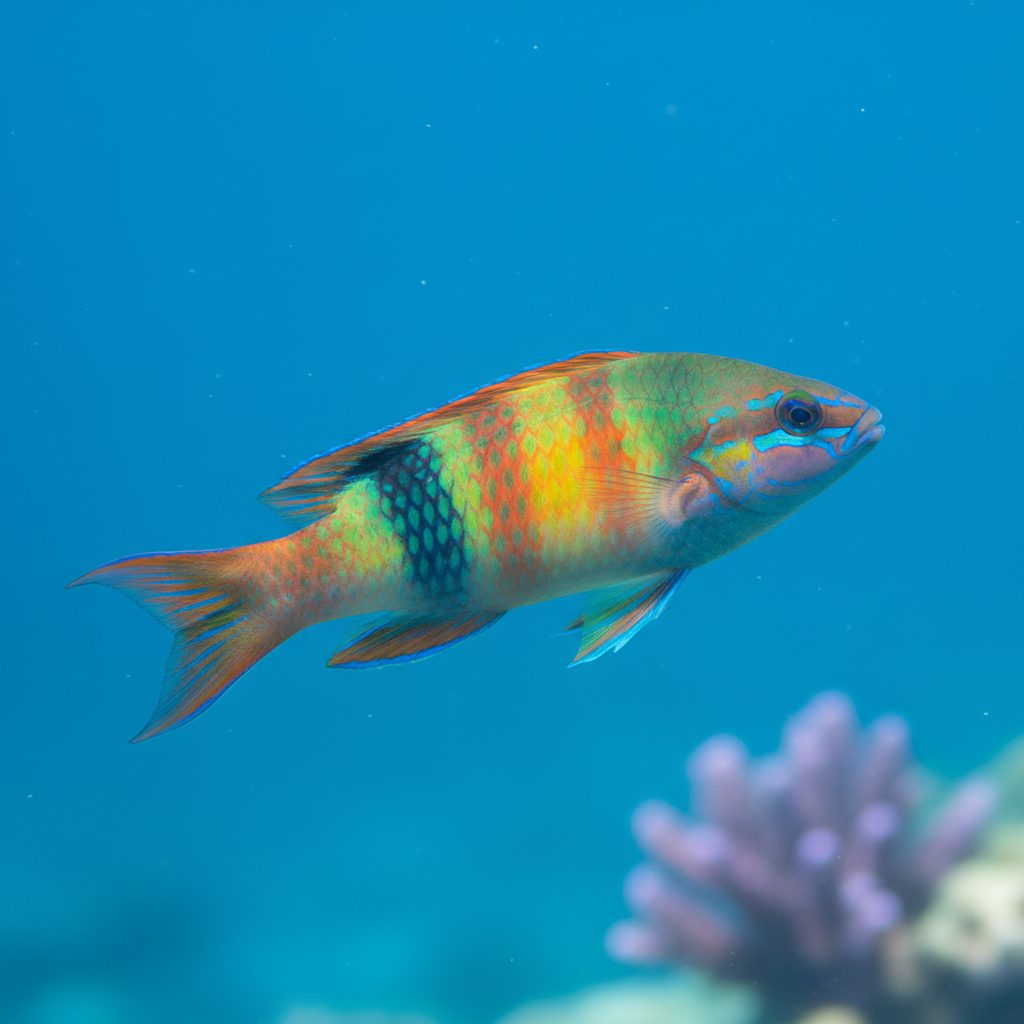
Coris julis also known by its common name, the Mediterranean rainbow wrasse, is a Mediterranean and Eastern Atlantic fish. Phylogenetically they belong to the Labridae family, also known as the wrasses. Within their genus, Coris, there are a total of 28 species. As discussed more in the Life History section below, they can present with more than one coloration. This is because they are diandric protogynous hermaphrodites. These fish are born as what scientists term primary males and females and can transition from a female to a secondary male. Primary individuals are described to be less than 18cm in length and all those larger are secondary males.

Appearance

Characteristics of the species include body shape and structural anatomy. Though secondary males are longer, all individuals have been described with either a long and slender, slightly compressed, or fusiform body shape. Their flexible bodies allow them to make sharp turns, swimming mainly with their pectoral fins and using the caudal and ventral for stability.

Habitat

C. julis typically inhabits rock/sandy substrates at the oceans floor and can commonly be found in seagrass beds. They also bury themselves in sand between sunset and sunrise. These habitats are in shallower coastal waters, and their standard depth range has been described as 0–50m with extremes of 0–120m. Geographically, as their name indicates, these fish are found in the Mediterranean Sea with an apparently even distribution. However, it can also be found as far North as Norway and as far South as Senegal. Further south you begin to see the related species Coris atlantica which is less widespread and lives in Western-central Africa. These two species represent the only 2 in the genus Coris found in the Eastern Atlantic. The other 26 are found in the Indo-Pacific. Although based upon the study mentioned under Species Description, C. julis should be split into C. julis and C. menalura.

Behaviour

As mentioned above, this species lives in rocky or sandy substrates as well as seagrass beds at typical depths of 0–50 m. They feed on benthic organisms such as mollusks and crustaceans. They forage in groups by day, disappearing before sunset by burying themselves in the sand and reemerging at sunrise. One study even showed that the fish are in a sleeplike state at night, indicated by their lowered reactiveness. C. julis are also documented to be territorial, though only the secondary males exhibit this behavior. Although they are territorial, they do not control the movements of females within their territory or where they spawn. One study showed that secondary males are more likely to be territorial with other males when they can distinguish between long and short-wave colors.

Reproduction

When mating, the terminal males swim rapidly with their dorsal fins erect in short up and down motions. Both phases of males can mate but secondary males have higher success rates for spawning. After the mating ritual, eggs are fertilized and hatch about two days later. They live as larvae with the zooplankton for about a month then fall to the bottom of the ocean and begin their juvenile stage. They are known to be reproductively active between May and July in the Balearic Islands. This life history strategy of non-year-round reproduction allows C. julis to put resources toward growth the rest of the year without sacrificing reproductive success.

Humans & conservation

According to the IUCN redlist, C. julis is listed as stable and of Least Concern as of the 2019 assessments. There are no commercial fisheries known for this fish however, it is possible they could be caught as bycatch and have been known to be caught for food. They also face the same issues that all marine fish face in the 21st century such as pollution, coastal development, etc.

Where to see it

Top-rated dive sites where divers have spotted Rainbow Wrasse.

White River

White River

⭐ 4.0 (1)
Shallow shore dive with beautiful rock formations and swim-throughs.
👣 Shore All levels
Nissi Beach

Nissi Beach

⭐ 3.0 (2)
Shallow, clear waters ideal for training and beginner dives.
👣 Shore Beginner
Kastri

Kastri

⭐ 4.0 Scout Score
Shallow Greek dive with stunning visibility and picturesque landscape.
Beginner
Amphiteather/pistol Bay-stage

Amphiteather/pistol Bay-stage

⭐ 3.0 Scout Score
Cyprus, Akamas Peninsula Akamas Peninsula National Park
Simple, accessible shore dive perfect for beginner training.
👣 Shore Beginner
Cirkewwa - Paradise Bay Reef

Cirkewwa - Paradise Bay Reef

⭐ 4.0 Scout Score
Shallow reef with stunning arches, swim-throughs, and varied topography.
👣 Shore Beginner
Trigger Reef, Kos

Trigger Reef, Kos

⭐ 4.0 Scout Score
Kos's Trigger Reef: caverns, diverse marine life
🚤 Boat Beginner
Bahia del Pont de’n Gil

Bahia del Pont de’n Gil

⭐ 4.0 Scout Score
Boat dive in Spain with diverse marine life
🚤 Boat Beginner
Sandy Bay

Sandy Bay

⭐ 3.0 Scout Score
Shallow, easy bay dive ideal for beginners and training.
👣 Shore Beginner
Bubblecave

Bubblecave

⭐ 4.0 Scout Score
Cyprus, Paphos Akamas Peninsula National Park
Unique cavern dive featuring a surreal curtain of natural bubbles.
🚤 Boat All levels
Garden

Garden

⭐ 4.0 Scout Score
Croatia, Vis Not in marine park
Shallow, vibrant reef with rich marine life and topography.
🚤 Boat All levels
Avlaki Blue Flag Beach

Avlaki Blue Flag Beach

⭐ 3.0 Scout Score
Protected, clear water beach dive ideal for beginners and snorkelers.
Beginner
3 - Rocks

3 - Rocks

⭐ 4.0 Scout Score
Shallow historical dive with ancient anchors, turtles, and barracudas.
🚤 Boat All levels
Tre Pietrazze

Tre Pietrazze

⭐ 4.0 Scout Score
Italy, Sicily AMP Capo Milazzo
Biodiverse shore dive with varied terrain in a marine park.
Beginner
Fortizza Reef - Sliema

Fortizza Reef - Sliema

⭐ 4.0 Scout Score
Shallow shore dive with excellent rock formations and caverns.
👣 Shore All levels
Spanish Barges

Spanish Barges

⭐ 4.0 Scout Score
Gibraltar Gibraltar Marine Reserve
Four historic wrecks creating a thriving artificial reef habitat.
👣 Shore Intermediate
482m & Batty's Barge

482m & Batty's Barge

⭐ 4.0 Scout Score
Gibraltar Gibraltar Marine Reserve
Two purpose-sunk wrecks creating a vibrant artificial reef.
👣 Shore All levels
Sa Farola

Sa Farola

⭐ 4.0 Scout Score
Beginner-friendly shallow dive with diverse fish life
👣 Shore Beginner
Inchkeith Wreck

Inchkeith Wreck

⭐ 4.0 Scout Score
India, Andaman Islands Rani Jhansi Marine National Park
Mysterious shallow cargo wreck with an enormous propeller.
🚤 Boat Intermediate
Zapalo Bay

Zapalo Bay

⭐ 4.0 Scout Score
Secluded beginner-friendly bay with caves, accessed by boat.
🚤 Boat Beginner
Akrotiri Fish Reserve

Akrotiri Fish Reserve

⭐ 4.0 Scout Score
Cyprus, Akrotiri Akrotiri Fish Reserve
Shallow dive with helicopter and fire engine wrecks.
🚤 Boat All levels