← All marine life
Kelp
Group

Kelp

Laminariales, Migula, 1909

marine
Where to see it

About Kelp

Kelps are large brown algae or seaweeds that make up the order Laminariales. There are about 30 genera. Despite its appearance and use of photosynthesis in chloroplasts, kelp is not a plant but a stramenopile.

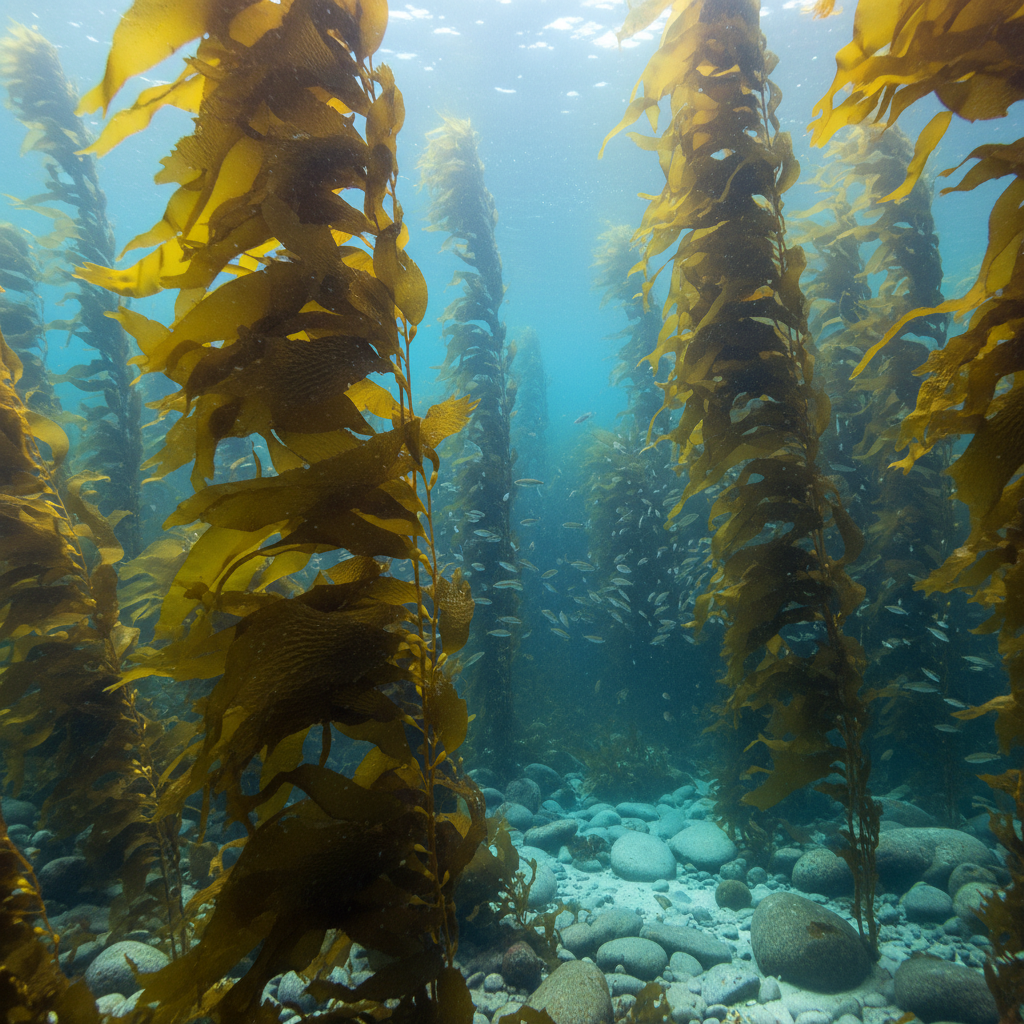
Kelp grows from stalks close together in very dense, forest-like areas under shallow temperate and Arctic oceans. They were previously thought to have appeared in the Miocene, 5 to 23 million years ago based on fossils from California. Kelps were present in the northeastern Pacific Ocean by at least 32 million years ago. These organisms require nutrient-rich water with temperatures between 6 and 14 °C (43 and 57 °F). They are known for their fast growth —the genera Macrocystis and Nereocystis can grow as fast as half a metre a day (that is, about 20 inches a day), ultimately reaching 30 to 80 metres (100 to 260 ft).

Through the 19th century, the word "kelp" was closely associated with seaweeds that could be burned to obtain soda ash (primarily sodium carbonate). The seaweeds used included species from both the orders Laminariales and Fucales. The word "kelp" was also used directly to refer to these processed ashes.

Appearance

The thallus (or body) consists of flat or leaf-like structures known as lamina (or blades) that originate from elongated stem-like structures, referred to as the stipes. A root-like structure (called the holdfast) anchors the kelp to the substrate of the ocean. Gas-filled bladders (pneumatocysts) form at the base of blades of American species, such as Nereocystis lueteana, to hold the kelp blades close to the surface to access light for photosynthesis. (Mert. & Post & Rupr.) The stipes are generally covered with a slimy mucilage layer, rather than a waxy cuticle.

Behaviour

Kelp may develop dense forests with high production, biodiversity and ecological function. Along the Norwegian coast these forests cover 5,800 km2, and they support large numbers of animals. Numerous sessile animals (sponges, bryozoans and ascidians) are found on kelp stipes and mobile invertebrate fauna are found in high densities on epiphytic algae on the kelp stipes and on kelp holdfasts. More than 100,000 mobile invertebrates per square meter are found on kelp stipes and holdfasts in well-developed kelp forests. While larger invertebrates and in particular sea urchins (Strongylocentrotus droebachiensis) are important secondary consumers controlling large barren ground areas on the Norwegian coast, they are scarce inside dense kelp forests.

Reproduction

Growth occurs at the base of the meristem, where the blades and stipe meet. Growth may be limited by grazing. Sea urchins, for example, can reduce entire ecosystems to kelp-less wastelands known as urchin barrens. The kelp life cycle involves a diploid sporophyte and haploid gametophyte stage. The haploid phase begins when the mature organism releases many spores, which then germinate to become male or female gametophytes. Sexual reproduction then results in the beginning of the diploid sporophyte stage, which will develop into a mature individual.

Humans & conservation

Overfishing nearshore ecosystems leads to the degradation of kelp forests. Herbivores are released from their usual population regulation, leading to over-grazing of kelp and other algae. This can quickly result in barren landscapes where only a small number of species can thrive. Other major factors which threaten kelp include marine pollution and the quality of water, climate changes and certain invasive species.

Kelp forests are some of the most productive ecosystems in the world - they are home to a great diversity of species. Many groups, like those at the Seattle Aquarium, are studying the health, habitat, and population trends in order to understand why certain kelp (like bull kelp) thrives in some areas and not others. Remotely Operated Vehicles are used in the surveying of sites and the data extracted is used to learn about which conditions are best suited for kelp restoration.

Species in this group

Where to see it

Top-rated dive sites where divers have spotted Kelp.

Osborn Shoals

Osborn Shoals

⭐ 5.0 (1)
Kelp-covered reef with diverse Sydney marine life and sponges.
🚤 Boat All levels
Shelly Beach / Cabbage Tree Bay
Australia, Sydney Cabbage Tree Bay Aquatic Reserve
Accessible, biodiverse shore dive suitable for all levels.
👣 Shore All levels
Clovelly Pool

Clovelly Pool

⭐ 3.0 (2)
Australia, Sydney Bronte-Coogee Aquatic Reserve
Protected bay ideal for training, night dives, and macro.
👣 Shore Beginner
Durdle Door

Durdle Door

⭐ 3.0 Scout Score
United Kingdom, Dorset Purbeck Coast Marine Conservation Zone (MCZ)
Iconic UK landmark dive with kelp, gullies, and cavern.
all levels
Lynch Blinder

Lynch Blinder

⭐ 4.0 Scout Score
Saldanha Bay rock formation dive
🚤 Boat Beginner
Gylly Beach

Gylly Beach

⭐ 4.0 Scout Score
Shallow shore dive with reefs, seagrass, and cephalopods.
👣 Shore beginner
Little Wooden Island

Little Wooden Island

⭐ 4.0 Scout Score
New Zealand, Hauraki Gulf Hauraki Gulf Marine Park
Hauraki Gulf island with rocky reefs and temperate marine life.
🚤 Boat All levels
Portnahapple

Portnahapple

⭐ 4.0 Scout Score
A sheltered, shallow shore dive with abundant UK marine life.
👣 Shore Beginner
El Arco

El Arco

⭐ 4.0 Scout Score
Stunning rock arch with sponges and diverse fish life.
🚤 Boat All levels
Paaltjies

Paaltjies

⭐ 4.0 Scout Score
Shallow rock reef with diverse marine life in Saldanha Bay
🚤 Boat Beginner
Portugese Cove

Portugese Cove

⭐ 4.0 Scout Score
Challenging shore entry to a rewarding shallow cove dive.
👣 Shore Intermediate
Ferguson's Cove

Ferguson's Cove

⭐ 3.0 Scout Score
Accessible Nova Scotia cove with varied marine life and structures.
👣 Shore All levels
Rikoriko Cave

Rikoriko Cave

⭐ 5.0 Scout Score
New Zealand, Poor Knights Islands Poor Knights Islands Marine Reserve
Explore the world's largest sea cave with unique features.
🚤 Boat Intermediate
Langebaan Main Beach - Cuttle Fish Alley
Cuttlefish Alley: Shallow reef dive in Langebaan
🚤 Boat Beginner
Canal Rocks

Canal Rocks

⭐ 4.0 Scout Score
Australia, Busselton Ngari Capes Marine Park
Unique granite channels, swim-throughs, and abundant marine life.
🚤 Shore & Boat All levels
Crescent Bay

Crescent Bay

⭐ 4.0 Scout Score
United States, California, Laguna Beach Laguna Beach State Marine Reserve
Shallow, rocky cove ideal for beginners and marine life.
👣 Shore Beginner
Castle Beach

Castle Beach

⭐ 4.0 Scout Score
United Kingdom, Cornwall, Falmouth Fal and Helford Special Area of Conservation (SAC)
Shallow Cornish shore dive with diverse marine life and wreck.
👣 Shore Beginner
Cactus Beach

Cactus Beach

⭐ 1.0 Scout Score
Australia, Eyre Peninsula Far West Coast Marine Park
Shallow surf beach with snorkeling among seaweed and kelp.
👣 Shore Beginner
Partridge Point

Partridge Point

⭐ 4.0 Scout Score
South Africa, Cape Peninsula Table Mountain National Park Marine Protected Area
Granite reef complex with kelp, swim-throughs, and fur seals.
🚤 Boat Intermediate
Lundy Island - Gannet's Bay

Lundy Island - Gannet's Bay

⭐ 4.0 Scout Score
United Kingdom, Lundy Island Lundy Marine Conservation Zone
Playful seals and vibrant shallow reef for all divers.
🚤 Boat All levels