← All marine life
Giant Kelp
Species

Giant Kelp

Macrocystis pyrifera, (Linnaeus) C.Agardh, 1820

marine

About Giant Kelp

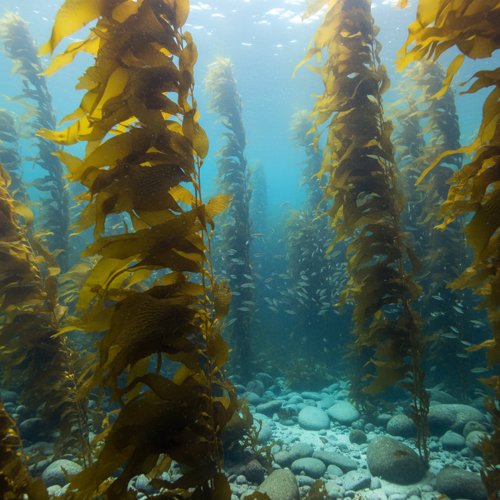
Macrocystis, commonly known as giant kelp, is a monospecific genus of kelp (large brown algae). Previously, several species had been reognized, including M. pyrifera, M. angustifolia, M. integrifolia, and M. laevis. Various technical studies corroborated this, especially a molecular genetics study concluding that in spite of great morphological and ecological difference, there is only one species. This genus contains the largest of all the Phaeophyceae or brown algae. Macrocystis has pneumatocysts (air bladders) at the base of its blades. Sporophytes, the macroscopic forms, are perennial and the individual may live for up to three years depending on geographic location and weather conditions; stipes/fronds within a whole individual undergo senescence, where each frond may persist for approximately 100 days. The genus is found widely in subtropical, temperate, and sub-Antarctic oceans of the Southern Hemisphere and in the northeast Pacific. Macrocystis is often a major component of temperate kelp forests.

Appearance

Macrocystis is a monospecific genus; the sole species is M. pyrifera. Some individuals are so huge that they may grow to up to 60 m (200 ft) longthough in some parts of the world they may be only a few meters in extent. The stipes arise from a holdfast and branch three or four times from near the base. Blades develop at irregular intervals along the stipe. The stipes are unbranched and each vegetative blade has a gas bladder at its base.

Habitat

Macrocystis is distributed along the eastern Pacific coast from Alaska to Mexico and from Peru and along the Argentinian coast as well as in Australia, New Zealand, South Africa and most sub-Antarctic islands to 60°S.

Behaviour

Macrocystis typically grow forming extensive beds, large "floating canopies", on rocky substrata between the low intertidal. It was harvested by barges which used large blades to harvest up to 300 tons a day along the coast of California.

Macrocystis pyrifera is found in North America (Alaska to California), South America, South Africa, New Zealand, and southern Australia. It thrives in cooler waters where the ocean water temperature remains mostly below 21 °C (70 °F). The species is also found near Tristan da Cunha in the Mid-South Atlantic Ocean.

Reproduction

The macroscopic sporophyte has many specialized blades growing near the holdfast called sporophylls. These blades bear various sori containing sporangia, which release haploid spores, which will grow into microscopic female and male gametophytes. These gametophytes, after reaching the appropriate substrata, grow mitotically to eventually produce gametes.

Females release their eggs (oogonia) along with a pheromone, the lamoxirene. This compound triggers sperm release by males. The Macrocystis sperm consists of biflagellate non-synthetic antherozoids, which find their way to the oogonia following the lamoxirene. The egg is then fertilized to form the zygote, which, through mitosis, begins growth.

Humans & conservation

In recent years, the kelp forests have decreased dramatically throughout Japan, Chile, Korea, Australia and North America. Harvesting of kelp as a food source and other uses may be the least concerning aspect to its depletion. In the Northwest Pacific kelp forests in waters near large population centres may be most affected by the sewer/stormwater discharge.

The natural phenomenon known as El Niño cycles warm, tropical water from the South Pacific to Northern waters. This has been known to kill off M. pyrifera, due to its need for cold waters it would usually find in the North Pacific Ocean. In California, El Niño also brought along a population bloom of purple sea urchins which feed on the giant kelp.

Part of

Where to see it

No dive sites list Giant Kelp yet. Explore the map to find sites near you.