About Giant Clam

Tridacna gigas, the giant clam, is the best-known species of the giant clam genus Tridacna. Giant clams are the largest living bivalve molluscs. Several other species of "giant clam" in the genus Tridacna are often misidentified as Tridacna gigas.

These clams were known to indigenous peoples of East Asia for thousands of years and the Venetian scholar and explorer Antonio Pigafetta documented them in a journal as early as 1521. One of a number of large clam species native to the shallow coral reefs of the South Pacific and Indian oceans, they may weigh more than 200 kilograms (440 lb), measure as much as 120 cm (47 in) across, and have an average lifespan in the wild of more than 100 years. They also are found off the shores of the Philippines and in the South China Sea in the coral reefs of Malaysia and are generally found at a depth of 6-65 feet.

The giant clam lives on flat coral sand or broken coral and may be found at depths of as great as 20 m (66 ft). Its range covers the Indo-Pacific, but populations are diminishing quickly and the giant clam has become extinct in many areas where it was once common.

Although larval clams are planktonic, they become sessile in adulthood. The creature's mantle tissues act as a habitat for the symbiotic single-celled dinoflagellate algae (zooxanthellae) from which the adult clams get most of their nutrition. By day, the clam opens its shell and extends its mantle tissue so that the algae receive the sunlight they need to photosynthesise. This method of algal farming is under study as a model for highly efficient bioreactors.

Appearance

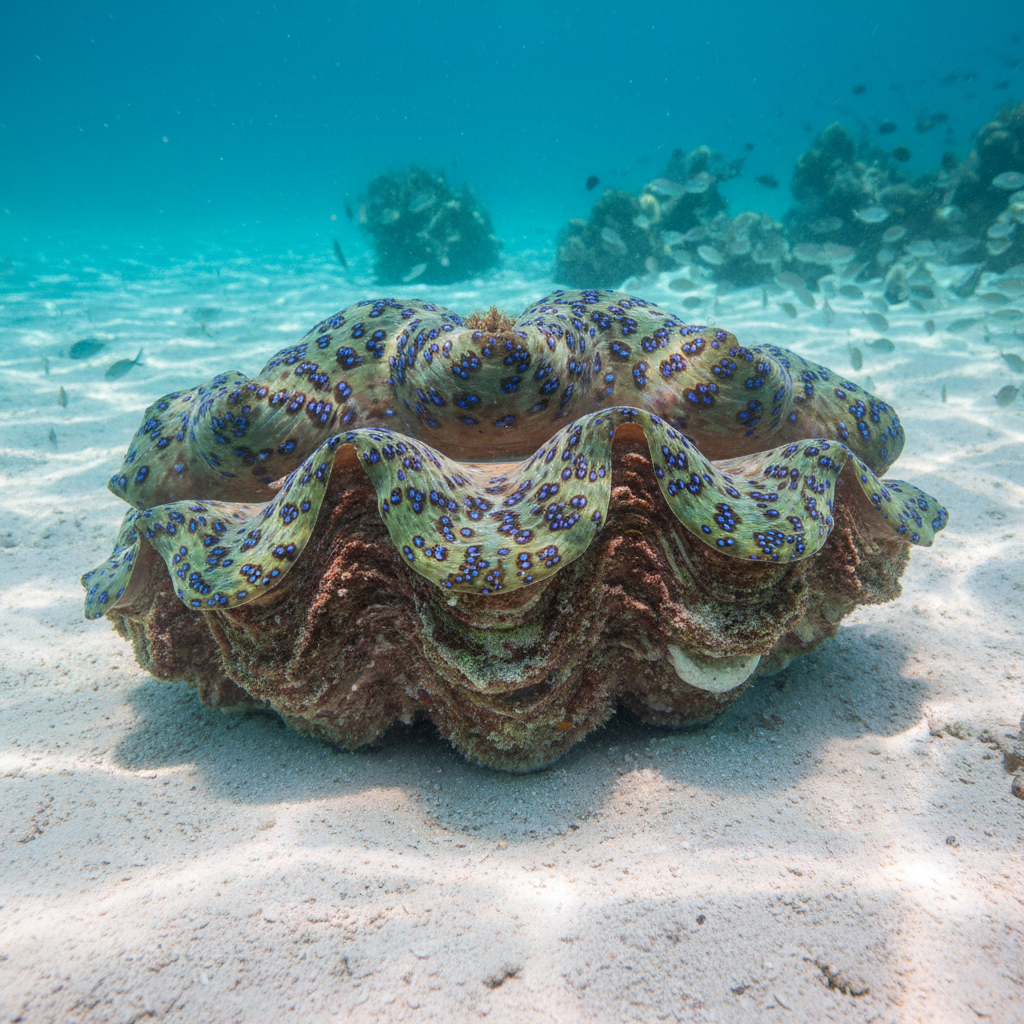
Young T. gigas are difficult to distinguish from other species of Tridacninae. Adult T. gigas are the only giant clams unable to close their shells completely, allowing part of the brownish-yellow mantle to remain visible. Tridacna gigas has four or five vertical folds in its shell, which serves as the main characteristic differentiating it from the similar T. derasa that has six or seven vertical folds. Similar to coral matrices composed of calcium carbonate, giant clams grow their shells through the process of biomineralization, which is very sensitive to seasonal temperature. The isotopic ratio of oxygen in carbonate and the ratio between strontium and calcium together may be used to determine historical sea surface temperature.

Behaviour

Giant clams are filter-feeders, yet 65–70 percent of their nutritional needs are supplied by zooxanthellae. This enables giant clams to grow as large as one meter in length even in nutrient-poor coral-reef waters. The clams cultivate algae in a special circulatory system that enables them to keep a substantially higher number of symbionts per unit of volume. The mantle's edges are packed with symbiotic zooxanthellae, which presumably use carbon dioxide, phosphates, and nitrates supplied by the clam.

In very small clams—10 milligrams (0.010 g) dry tissue weight—filter feeding provides approximately 65% of total carbon needed for respiration and growth; comparatively larger clams (10 grams (0.35 oz)) acquire only 34% of carbon from this source. A single species of zooxenthellae may be symbionts of both giant clams and nearby reef–building (hermatypic) corals.

Reproduction

Tridacna gigas reproduce sexually and are hermaphrodites (producing both eggs and sperm by one clam). While self-fertilization is not possible, having both characteristics does allow them to reproduce with any other member of the species as well as hermaphrodically. As with all other forms of sexual reproduction, hermaphroditism ensures that new gene combinations be passed to further generations. This flexibility in reproduction reduces the burden of finding a compatible mate, while simultaneously doubling the number of offspring produced.

Humans & conservation

The main reason that giant clams are becoming endangered is likely to be intensive exploitation by bivalve fishers. Mainly large adults are killed because they are the most profitable.

The giant clam is considered a delicacy in Japan (known as himejako), France, Southeast Asia, and many Pacific Islands. Some Asian foods include the meat from the muscles of clams. Large amounts of money are paid for the adductor muscle, which is believed to have aphrodisiac powers in some Chinese regions.

On the black market, giant clam shells are sold as decorative accoutrements.

Where to see it

Top-rated dive sites where divers have spotted Giant Clam.

Mun Nai Jetty

Mun Nai Jetty

⭐ 5.0 (1)
Thailand, Rayong Khao Laem Ya–Mu Ko Samet National Park
Shallow jetty dive, a paradise for nudibranchs and macro.
🚤 Boat Beginner
Aow Leuk

Aow Leuk

⭐ 4.0 (1)
Shallow bay with artificial reefs and juvenile reef sharks.
Beginner
Tennis Courts

Tennis Courts

⭐ 4.0 Scout Score
Australia, Great Barrier Reef Great Barrier Reef Marine Park
Vibrant reef with impressive coral formations and abundant marine life.
🚤 Boat Intermediate
Monkey Beach

Monkey Beach

⭐ 4.0 Scout Score
Australia, Queensland, Great Keppel Island Great Barrier Reef Marine Park
Shallow, vibrant reef perfect for beginners and snorkelers.
🚤 Boat beginner
Papua Drop Off

Papua Drop Off

Not yet rated
Easy Cook Islands drop-off, known for eagle rays and turtles.
🚤 Boat All levels
Tavanipupu

Tavanipupu

⭐ 4.0 Scout Score
Pristine coral reefs with giant clams, clownfish, excellent snorkeling.
👣 Shore Beginner
Museum of Underwater Art (Moua) at John Brewer Reef
Australia, Great Barrier Reef, Townsville Great Barrier Reef Marine Park
Unique underwater art museum on a vibrant coral reef.
🚤 Boat All levels
Fukui Point

Fukui Point

⭐ 4.0 Scout Score
Indonesia, Bunaken National Park Bunaken National Marine Park
Unique sloping reef with rich coral gardens and marine life.
🚤 Boat All levels
Lobster Cave

Lobster Cave

Not yet rated
Turtles and million dollar fresh water pipe running from the main island to Liuqiu
👣 Shore Beginner
Triple Rock

Triple Rock

⭐ 5.0 Scout Score
Three Giris with overhangs, soft corals, fish shoals, macro paradise.
🚤 Boat All levels
Big Broadhurst Reef

Big Broadhurst Reef

⭐ 4.0 Scout Score
Australia, Great Barrier Reef Great Barrier Reef Marine Park
Vibrant outer reef with diverse corals and marine life.
🚤 Boat All levels
Agincourt Ribbon Reefs

Agincourt Ribbon Reefs

⭐ 4.0 Scout Score
Australia, Great Barrier Reef, Port Douglas Great Barrier Reef Marine Park
Pristine outer GBR reefs with diverse coral and marine life.
🚤 Boat All levels
Maite

Maite

⭐ 4.0 Scout Score
Philippines, Siquijor Maite Sanctuary
Protected marine sanctuary with abundant corals and diverse reef life.
Beginner
Green Island

Green Island

⭐ 4.0 Scout Score
Australia, Cairns Great Barrier Reef Marine Park
Accessible Great Barrier Reef snorkeling and shallow diving.
👣 Shore Beginner
Hastings Reef

Hastings Reef

⭐ 4.0 Scout Score
Australia, Great Barrier Reef, Cairns Great Barrier Reef Marine Park
Vibrant outer reef with swim-throughs, caves, and abundant life.
🚤 Boat All levels
Milln Reef

Milln Reef

⭐ 4.0 Scout Score
Australia, Great Barrier Reef, Cairns Great Barrier Reef Marine Park
Pristine outer reef with walls, pinnacles, and abundant marine life.
🚤 Boat All levels
Little Tracey's

Little Tracey's

⭐ 4.0 Scout Score
Australia, Great Barrier Reef, Cairns Great Barrier Reef Marine Park
Vibrant coral gardens with diverse and abundant marine life.
🚤 Boat All levels
Turtle City/ Heaven

Turtle City/ Heaven

⭐ 4.0 Scout Score
Indonesia, Lombok, Gili Islands Gili Matra Marine Natural Recreation Park
Pinnacle dive site famous for abundant sea turtle sightings.
🚤 Boat All levels
Gordons Mooring

Gordons Mooring

⭐ 4.0 Scout Score
Australia, Great Barrier Reef, Cairns Great Barrier Reef Marine Park
Photogenic reef with bommies, swim-throughs, and abundant marine life.
🚤 Boat All levels
Cathederals

Cathederals

⭐ 4.0 Scout Score
Australia, Great Barrier Reef Great Barrier Reef Marine Park
Dramatic coral canyons with abundant and diverse marine life.
🚤 Boat Intermediate

Sources

  • Wikipedia — licensed CC BY-SA 4.0 · Text adapted from the Wikipedia article; modifications by WikiBubbles are shared under the same license.