About Anemonefish

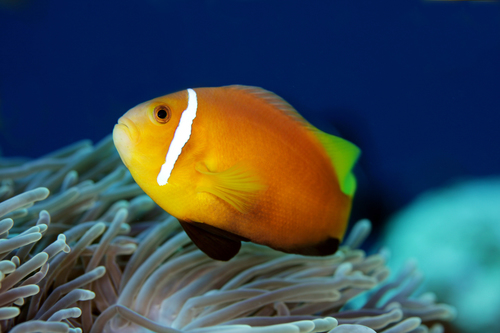
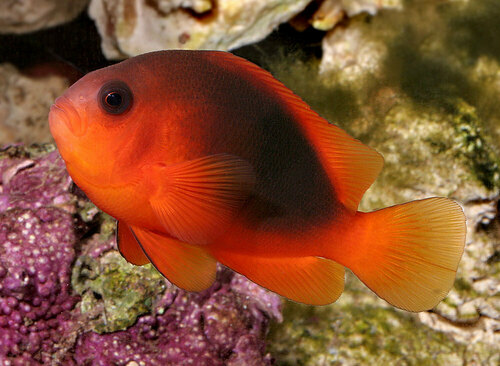
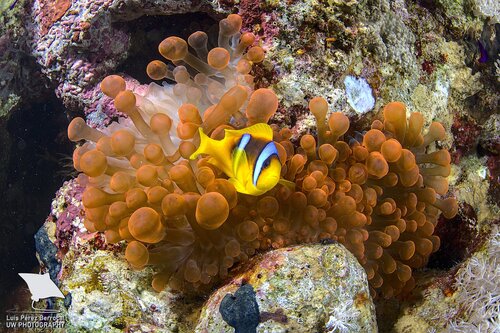
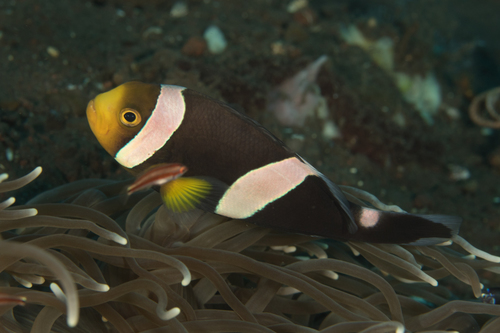
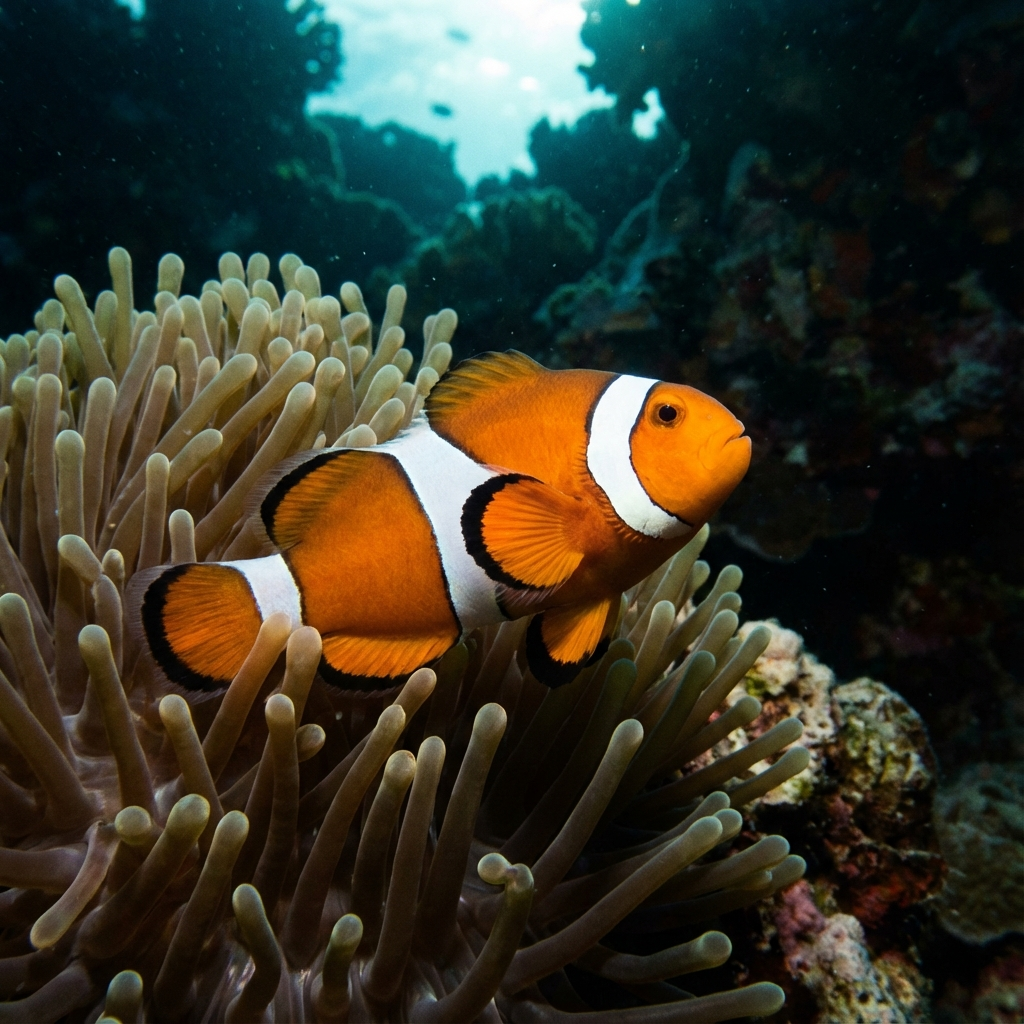
Clownfish or anemonefishes (genus Amphiprion) are saltwater fish found in the warm and tropical waters of the Pacific Ocean. They mainly inhabit coral reefs and have a distinctive colouration typically consisting of white vertical bars on a red, orange, yellow, brown or black background. Clownfish developed a symbiotic and mutually beneficial relationship with sea anemones, on which they rely for shelter and protection from predators. In turn, clownfish protect the anemone from anemone-eating fish, as well as clean and fan them, and attract beneficial microorganisms with their waste.

Clownfish are omnivorous and mostly feed on plankton. They live in groups consisting of a breeding female and male, along with some non-breeding individuals. Clownfish have a size-based dominance hierarchy with the breeding female ranking at the top, followed by the breeding male and then the largest non-breeder and so on. When the female disappears, the breeding male changes sex and takes her place while the others move up the hierarchy. During reproduction, the female deposits eggs on a rock near their anemone, and the male fertilises them. After hatching, clownfish disperse into the open ocean as larvae, eventually settling on the bottom and searching for an anemone host as juveniles.

Appearance

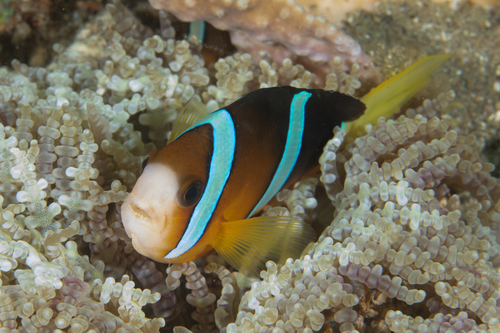
Clownfish vary in size; the maroon clownfish can reach 160 mm (6.3 in) long while the orange clownfish reaches only 80 mm (3.1 in). Females are larger than males and the smallest individuals in a group are only 6–15 mm (0.24–0.59 in). Clownfish vary from oval-shaped to streamlined, and have rounded heads that lack scales between the snout and eyes. Teeth are present on both the oral and pharyngeal (throat) jaws but absent on the palate, and may be conical or chisel-shaped. Clownfish have saw-shaped edges along the operculum (gill covering) and under the eyes, which is the source of their genus name. The dorsal fin has 10 spines followed by 14–20 soft rays. It varies in shape; the ocellaris clownfish has a large recess between the spines and soft rays, while in the red saddleback anemonefish they are mostly continuous.
Habitat

Clownfish inhabit warm and tropical waters spanning the Indian Ocean and the western Pacific; from the Red Sea to French Polynesia, and from Japan down to Australia. Some species are more widespread than others, and some live only around islands or archipelagos. Areas closer to the edges of their distribution have fewer species; both the Red Sea and French Polynesia have only one species each. By contrast, as many as 12 species can be found in an area in other regions such as Southeast Asian and northern Australian waters.

Behaviour

Clownfish are omnivorous, and mostly feed on planktonic food such as algae, copepods and larval tunicates. Algae makes up much of the diet of the pink skunk clownfish. Clownfish also feed on the waste discharged by the anemone. Feeding takes up most of a clownfish's daily activity. Where predators are less common, clownfish may forage in an area as large as 20 m2 (220 sq ft) around their anemone. Otherwise they are restricted to feeding in the water column above their host. The dominant pair in a clownfish group feed further from the anemone than the smaller subordinates.

Reproduction

Clownfish breed year-round in tropical waters while in more temperate waters, like those around Japan, breeding occurs mostly in spring and summer. Only the dominant female and male reproduce, which mostly occurs during a full moon. In the days leading up to spawning, the pair perform courtship rituals that involve the male chasing and nibbling the female as well as erecting his dorsal, pelvic and anal fins while staying motionless in front or alongside her. Both the female and male then prepare a nest by cleaning up a nearby rock. Here the female deposits eggs for the male to fertilise. Clownfishes lay up to a thousand eggs, which are conical in shape, 3–4 mm (0.12–0.16 in) long and stick to the rocky substrate by bundles of short fibres. The male tends to the fertilised eggs, cleaning and guarding them as well as fanning them with his pectoral fins.

Humans & conservation

As of 2025, 25 of the 29 clownfish species along with the hybrid white bonnet anemonefish are assessed by the IUCN Red List; most are classified as Least-concern except for Mccullochi's anemonefish, which is classified as Vulnerable. Additionally, the wide-band anemonefish is listed as Data Deficient. Threats to clownfish populations in the wild include ocean warming and acidification, exploitation for the aquarium trade and human development along the coast; the first two are linked to global warming.

Species in this group

Where to see it

Top-rated dive sites where divers have spotted Anemonefish.

Lipah Bay

Lipah Bay

⭐ 5.0 (1)
Shallow reef shark nursery, great for snorkelers and photographers.
👣 Shore all levels
The Labyrinth

The Labyrinth

⭐ 5.0 (1)
Indonesia, Lombok, Gili Islands Gili Matra Marine Natural Recreation Park
Unique navigation through a fun, labyrinthine rock formation.
🚤 Boat Intermediate
Wonderwall

Wonderwall

⭐ 4.0 Scout Score
Philippines, Bohol, Anda Anda Municipal Marine Park
Beautiful wall dive with abundant macro life for all levels.
🚤 Boat all levels
Magic Island House Reef

Magic Island House Reef

⭐ 4.0 Scout Score
Dramatic wall dive with abundant turtles and mandarin fish.
🚤 Boat all levels
Mandu

Mandu

⭐ 4.0 Scout Score
Australia, Exmouth Ningaloo Marine Park
Spectacular coral wall and garden drift dive on Ningaloo Reef.
🚤 Boat Intermediate
Pancang Point

Pancang Point

⭐ 4.0 Scout Score
Malaysia, Tunku Abdul Rahman National Park Tunku Abdul Rahman National Park
Gentle sloping reef ideal for beginners and macro lovers.
🚤 Boat all levels
Dapa

Dapa

⭐ 4.0 Scout Score
Vibrant reef and wall dive with turtles for all.
🚤 Boat all levels
Dega Thia

Dega Thia

⭐ 4.0 Scout Score
Pinnacles and swim-throughs with turtles and reef fish.
🚤 Boat all levels
Grouper Farm

Grouper Farm

⭐ 4.0 Scout Score
Malaysia, Pulau Payar Pulau Payar Marine Park
Hard coral site with giant groupers, ideal for all.
🚤 Boat all levels
Magic Rock

Magic Rock

⭐ 4.0 Scout Score
Malaysia, Tunku Abdul Rahman National Park Tunku Abdul Rahman National Park
Submerged pinnacle with diverse macro life and interesting topography.
🚤 Boat all levels
Lau Lau Reef

Lau Lau Reef

⭐ 4.0 Scout Score
Indonesia, Raja Ampat Raja Ampat Marine Park
Reef dive featuring boulders and potential wobbegong shark encounters.
🚤 Boat all levels
Mangrove

Mangrove

⭐ 4.0 Scout Score
Indonesia, Bali, Nusa Lembongan Nusa Penida Marine Protected Area
Gentle drift dive over a vast, vibrant coral garden.
🚤 Boat all levels
Wellbeach House Reef

Wellbeach House Reef

⭐ 4.0 Scout Score
Vibrant house reef with diverse corals and macro life.
all levels
Jalan Jalan

Jalan Jalan

⭐ 4.0 Scout Score
Malaysia, Sipadan Mabul Islands Tun Sakaran Marine Park
A relaxed, gentle reef dive perfect for spotting turtles.
🚤 Boat all levels
Leopard Reef

Leopard Reef

⭐ 4.0 Scout Score
Malaysia, Sabah, Kota Kinabalu Tunku Abdul Rahman National Park
Pinnacle site with resting sharks and abundant macro life.
🚤 Boat all levels
Red Hill

Red Hill

⭐ 4.0 Scout Score
Shallow pinnacle drift dive with abundant Hawaiian reef fish.
🚤 Boat all levels
Dungon Wall

Dungon Wall

⭐ 4.0 Scout Score
Philippines, Mindoro, Puerto Galera Puerto Galera Biosphere Reserve
Wall and wreck dive with abundant macro life and corals.
🚤 Boat all levels
Disneyland

Disneyland

⭐ 4.0 Scout Score
Shallow coral gardens with lionfish, great for night dives.
🚤 Boat beginner
Barge Reer

Barge Reer

⭐ 4.0 Scout Score
Explore a shallow WWII wreck on a vibrant coral reef.
beginner
Gaya Strip

Gaya Strip

⭐ 3.0 Scout Score
Malaysia, Sabah, Kota Kinabalu Tunku Abdul Rahman Marine Park
Sloping reef with great macro life, ideal for all levels.
🚤 Boat all levels

Sources

  • Wikipedia — licensed CC BY-SA 4.0 · Text adapted from the Wikipedia article; modifications by WikiBubbles are shared under the same license.