
← All marine life
Clown Anemonefish
Species IUCN · Least Concern (LC)

Clown Anemonefish

Amphiprion ocellaris, Cuvier, 1830

marine

About Clown Anemonefish

The ocellaris clownfish (Amphiprion ocellaris), also known as the false percula clownfish or common clownfish, is a marine fish belonging to the family Pomacentridae, which includes clownfishes and damselfishes. A. ocellaris are found in different colors, depending on where they are located. For example, black A. ocellaris with white bands can be found near northern Hawaii, USA, North America, Australia, Southeast Asia, and Japan. Orange or red-brown A. ocellaris also exist with three similar white bands on the body and head. A. ocellaris can be distinguished from other Amphiprion species based on the number of pectoral rays and dorsal spines. A. ocellaris are known to grow about 11 cm (4.3 inches) long. Females are larger than males. The life cycle of A. ocellaris varies in whether they reside at the surface or bottom of the ocean. When they initially hatch, they reside near the surface. However, when A. ocellaris enter into the juvenile stage of life, they travel down to the bottom to find shelter in a host anemone. Once they find their anemone, they form a symbiotic relationship with them.

Appearance

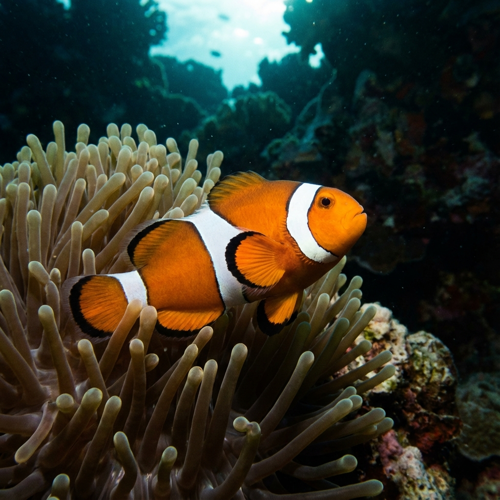
The common clownfish is a small fish which grows up to 11 cm (4.3 inches). Its body has a stocky appearance and oval shape. It is compressed laterally, with a round profile. The coloration of its body is orange to reddish-brown, but it can also be black in some particular areas such as the Northern Territory in Australia. It has three vertical white stripes outlined with a fine black line. The first passes just behind the eye, the second in the middle of the body widens forward to the head centrally and the third one circles the caudal peduncle. All the fins are also outlined with a fine black line. A. ocellaris is often confused with Amphiprion percula, which possesses exactly the same colours and patterns at first sight but distinguishes itself by the thickness of the black outlines. Additionally, A. ocellaris has a taller dorsal fin, and typically possesses 11 dorsal-fin spines vs.
Habitat

This species is found in the Eastern Indian Ocean and in the western Pacific Ocean. As mentioned earlier, they can also be found in Hawaii, USA, North America, Northern Australia, Southeast Asia and Japan.

Amphiprion ocellaris typically lives in small groups on outer reef slopes or in sheltered lagoons at a maximal depth of 15 meters. It inhabits three different species of sea anemones: Heteractis magnifica, Stichodactyla gigantea and Stichodactyla mertensii and have symbiotic relationships with the anemone.

Diet

Amphiprion ocellaris feed on plankton and algae, thus they are considered omnivores. Feeding is also affected by the hierarchy in A. ocellaris groups. Since the smaller, less dominant fish face aggression from the more aggressive fish, they have less energy to forage for food. Thus, they usually do not eat as much as the dominant fish do, because of reduced energy, but also because of the increased danger they face when they leave their anemone since they are smaller. In other words, the larger fish will usually travel farther than the smaller fish. Generally, the A. ocellaris feed on algae, copepods, and zooplankton.

Behaviour

Amphiprion ocellaris is a diurnal fish. It is a protandrous hermaphrodite, which means the male can change its sex to female during its life, and lives in a harem in which an established dominance hierarchy manages the group and keeps individuals at a specific social rank.

It is aggressively territorial and is completely dependent on its sea anemone.

Reproduction

Amphiprion ocellaris have reproductive behaviors very similar to that of all anemonefish. They have monogamous mating systems, and in their spawning processes, they also have the same levels of aggressiveness between males and females. In addition, there is a reproductive hierarchy that exists between age and sex.

Humans & conservation

Amphiprion ocellaris are utilized as part of the tropical fish aquarium trade. However, only certain colors are in demand. In addition, A. ocellaris are used in research since they can be bred easily. This high demand in trade has been dangerous for A. ocellaris' population due to overexploitation .

Part of

Where to see it

No dive sites list Clown Anemonefish yet. Explore the map to find sites near you.