Appearance
European perch are greenish with red pelvic, anal and caudal fins. They have five to eight dark vertical bars on their sides. When the perch grows larger, a hump grows between its head and dorsal fin.

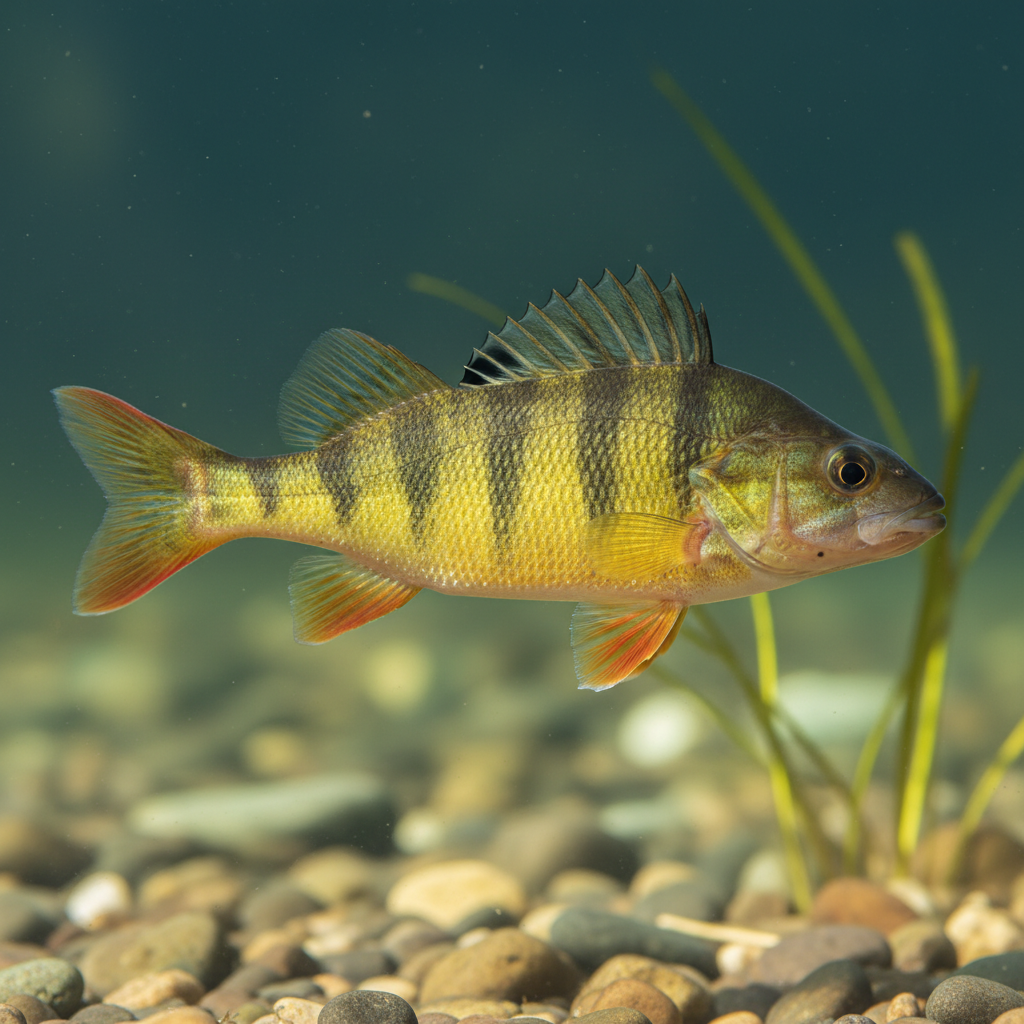
Perca fluviatilis, Linnaeus, 1758
The European perch (Perca fluviatilis), also known as the common perch, redfin perch, big-scaled redfin, English perch, Euro perch, Eurasian perch, Eurasian river perch, Hatch, poor man's rockfish or in Anglophone parts of Europe, simply the perch, is a predatory freshwater fish native to Europe and North Asia. It is the type species of the genus Perca.
The perch is a popular predatory game fish for recreational anglers, and has been widely introduced beyond its native Eurasian habitats into Australia, New Zealand and South Africa. Known locally simply as "redfin", they have caused substantial damage to native fish populations in Australia and have been proclaimed a noxious species in New South Wales.
European perch are greenish with red pelvic, anal and caudal fins. They have five to eight dark vertical bars on their sides. When the perch grows larger, a hump grows between its head and dorsal fin.
The range of the European perch covers fresh water basins all over Europe, excluding the Iberian Peninsula. Their range is known to reach the Kolyma River in Siberia to the east. It is also common in some of the brackish waters of the Baltic Sea.
The European perch lives in slow-flowing rivers, deep lakes and ponds. It tends to avoid cold or fast-flowing waters but some specimens penetrate waters of these type, although they do not breed in this habitat. They are most abundant in relatively shallow lakes and lakes with deep light penetration, and less abundant in deep lakes and those with low light penetration.
The European perch is a frequent prey of many fish-eating predators such as the Western osprey (Pandion haliaetus), great cormorant (Phalacrocorax carbo) and common kingfisher (Alcedo atthis), and it is an important item in the diet of the globally threatened Dalmatian pelican (Pelecanus crispus). Other non-avian predators include the northern pike (Esox lucius) and the Eurasian otter (Lutra lutra).
The European perch is carnivorous, with juveniles feeding on zooplankton, bottom invertebrate fauna and other perch fry, while adults feed on both invertebrates and fish, mainly sticklebacks, perch, roach and minnows. Perch start eating other fish when they become fingerlings at a size of around 120 mm (4.7 in).
European perch is fished for food and as game. Its flesh is described as good eating, with a white, firm, flaky texture and well flavoured. According to FAO statistics, 28,920 tonnes were caught in 2013. Largest perch fishing countries were Russia, (15,242 tonnes), Finland (7,666 tonnes), Estonia (2,144 t), Poland (1,121 t) and Kazakhstan (1,103 t).
Baits for perch include baitfishes (e.g. minnows, goldfish), weather loaches, pieces of raw squid or pieces of raw fish (mackerel, bluey, jack mackerel, sardine), or brandling, red, marsh, and lob worms, maggots, shrimp (Caridina, Neocaridina, Palaemon, Macrobrachium) and peeled crayfish tails. The tackles needed are fine but strong.
Top-rated dive sites where divers have spotted Perch.


