← All marine life
Penguin
Group

Penguin

Sphenisciformes

marine

About Penguin

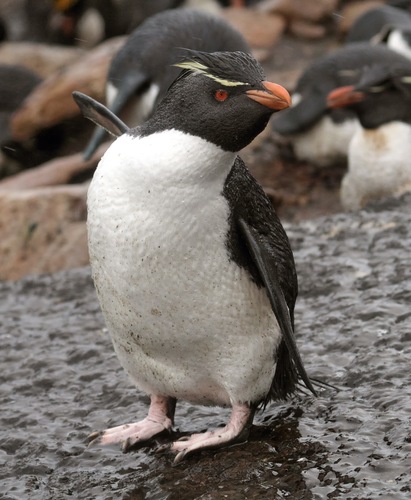
Penguins are a group of flightless semi-aquatic sea birds which live almost exclusively in the Southern Hemisphere. Only one species, the Galapagos penguin, lives at, and slightly north of, the equator. Highly adapted for life in the ocean water, penguins have countershaded dark and white plumage and flippers for swimming. Most penguins feed on krill, fish, squid and other forms of sea life which they catch with their bills and swallow whole while swimming. A penguin has a spiny tongue and powerful jaws to grip slippery prey.

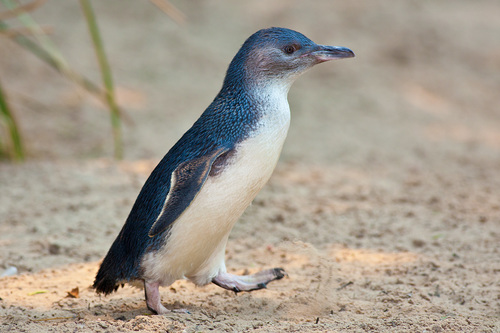
They spend about half of their lives on land and the other half in the sea. The largest living species is the emperor penguin (Aptenodytes forsteri): on average, adults are about 1.1 m (3 ft 7 in) tall and weigh 35 kg (77 lb). The smallest penguin species is the little blue penguin (Eudyptula minor), also known as the fairy penguin, which stands around 30–33 cm (12–13 in) tall and weighs 1.2–1.3 kg (2.6–2.9 lb). Today, larger penguins generally inhabit colder regions, and smaller penguins inhabit regions with temperate or tropical climates. Some prehistoric penguin species were enormous: as tall or heavy as an adult human. There was a great diversity of species in subantarctic regions, and at least one giant species in a region around 2,000 km south of the equator 35 mya, during the Late Eocene, a climate decidedly warmer than today.

Appearance

Penguins are superbly adapted to aquatic life. Their wings have evolved to become flippers, useless for flight in the air. In the water, however, penguins are astonishingly agile. Penguins' swimming looks very similar to birds' flight in the air. Within the smooth plumage a layer of air is preserved, ensuring buoyancy. The air layer also helps insulate the birds in cold waters. On land, penguins use their tails and wings to maintain balance for their upright stance.

All penguins are countershaded for camouflage – that is, they have black backs and wings with white fronts. A predator looking up from below (such as an orca or a leopard seal) has difficulty distinguishing between a white penguin belly and the reflective water surface. The dark plumage on their backs camouflages them from above.
Habitat

Although almost all penguin species are native to the Southern Hemisphere, they are not found only in cold climates, such as Antarctica. In fact, only a few species of penguin actually live so far south. Several species live in the temperate zone; one, the Galápagos penguin, lives as far north as the Galápagos Islands, but this is only made possible by the cold, rich waters of the Antarctic Humboldt Current that flows around these islands. Also, though the climate of the Arctic and Antarctic regions is similar, there are no penguins found in the Arctic.

Behaviour

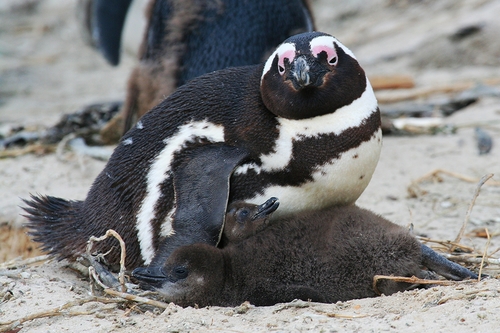
Penguins for the most part breed in large colonies, the exceptions being the yellow-eyed and Fiordland species; these colonies may range in size from as few as 100 pairs for gentoo penguins to several hundred thousand in the case of king, macaroni and chinstrap penguins. Living in colonies results in a high level of social interaction between birds, which has led to a large repertoire of visual as well as vocal displays in all penguin species. Agonistic displays are those intended to confront or drive off, or alternately appease and avoid conflict with, other individuals.

Humans & conservation

The majority of living penguin species have declining populations. According to the IUCN Red List, their conservation statuses range from Least Concern through Critically Endangered.

Species in this group

Where to see it

No dive sites list Penguin yet. Explore the map to find sites near you.