
← All marine life
Little Penguin
Species IUCN · Least Concern (LC)

Little Penguin

Eudyptula minor, (Forster, 1781)

marine

About Little Penguin

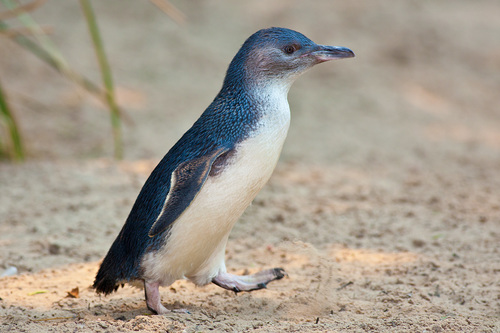
The little penguin (Eudyptula minor) is the smallest species of penguin in the world, and originates from New Zealand and Australia. It is commonly known as the fairy penguin, little blue penguin, or blue penguin, owing to its slate-blue plumage, and is also known by its Māori name kororā. It is a marine neritic species that dives for food throughout the day and returns to burrows on the shore at dusk. Eudyptula minor feathers are dense in melanosomes, which increase water resistance and give them their unique blue colour.

The Australian little penguin (Eudyptula novaehollandiae), from Australia and the Otago region of New Zealand, was initially described as Spheniscus novaehollandiae in 1826 but was later classified as Eudyptula minor novaehollandiae, a subspecies of the little penguin.

Appearance

Like those of all penguins, the wings of Eudyptula species have developed into flippers used for swimming.

Eudyptula species typically grow to between 30 and 33 cm (12 and 13 in) tall and on average weigh 1.5 kg (3.3 lb). The head and upper parts are blue in colour, with slate-grey ear coverts fading to white underneath, from the chin to the belly. Their flippers are blue in colour. The dark grey-black beak is 3–4 cm (1.2–1.6 in) long, the irises pale silvery- or bluish-grey or hazel, and the feet pink above with black soles and webbing. An immature individual will have a shorter bill and lighter upperparts.

Like most seabirds, the Eudyptula species have a long lifespan. The average for the species is 6.5 years, but flipper ringing experiments show that in very exceptional cases they may live up to 25 years in captivity.

Habitat

The Australian little penguin is native to Southern Australia. The species also colonised the Otago region of New Zealand after the human-caused decline of the endemic species Eudyptula minor.

Tagged or banded birds later recaptured or found deceased have shown that individual birds can travel great distances during their lifetimes. In 1984, a penguin that had been tagged at Gabo Island in eastern Victoria was found dead at Victor Harbor in South Australia. Another little penguin was found near Adelaide in 1970 after being tagged at Phillip Island in Victoria the previous year. In 1996, a banded penguin was found dead at Middleton. It had been banded in 1991 at Troubridge Island in Gulf St Vincent, South Australia.

The Australian little penguin's foraging range is quite limited in terms of distance from shore when compared to seabirds that can fly.

Diet

Predation by native animals is not considered a threat to little penguin populations, as these predators' diets are diverse. In Australia, large native reptiles including the tiger snake and Rosenberg's monitor are known to take little penguin chicks and common blue-tongued skinks are known to take eggs. At sea, Australian little penguins are eaten by long-nosed fur seals. A study conducted by researchers from the South Australian Research and Development Institute found that roughly 40 percent of seal droppings in South Australia's Granite Island area contained little penguin remains. Other marine predators include Australian sea lions, sharks, and barracouta.

The introduction of Tasmanian devils to Maria Island in 2012 led to the complete destruction of a population of Australian little penguins that numbered 3,000 breeding pairs before the introduction.

Behaviour

Little penguins feed by hunting small clupeoid fish, cephalopods, and crustaceans, for which they travel and dive quite extensively including to the sea floor. Researcher Tom Montague studied a Victorian population for two years in order to understand its feeding patterns. Montague's analysis revealed a penguin diet consisting of 76% fish and 24% squid. Nineteen fish species were recorded, with pilchard and anchovy dominating. The fish were usually less than 10 cm long and often post-larval or juvenile. Less common little penguin prey include: crab larvae, eels, jellyfish, and seahorses. In New Zealand, important little penguin prey items include arrow squid, slender sprat, Graham's gudgeon, red cod, and ahuru.

Reproduction

Australian little penguins reach sexual maturity at different ages. The female matures at two years old and the male at three years old.

Between June and August, males return to shore to renovate or dig new burrows and display to attract a mate for the season. Males compete for partners with their displays. Breeding occurs annually, but the timing and duration of the breeding season varies from location to location and from year to year. Breeding occurs during spring and summer when oceans are most productive and food is plentiful.

Australian little penguins remain faithful to their partner during a breeding season and whilst hatching eggs. At other times of the year, they tend to swap burrows. They exhibit site fidelity to their nesting colonies and nesting sites over successive years. Little penguins can breed as isolated pairs, in colonies, or semi-colonially.

Humans & conservation

Australian little penguins have long been a curiosity to humans. Captive animals are often exhibited in zoos. Over time attitudes towards penguins have evolved from direct exploitation (for meat, skins, and eggs) to the development of tourism ventures, conservation management and the protection of both birds and their habitat.

Part of

Where to see it

No dive sites list Little Penguin yet. Explore the map to find sites near you.