
← All marine life
African Penguin
Species IUCN · Critically Endangered (CR)

African Penguin

Spheniscus demersus, (Linnaeus, 1758)

marine

About African Penguin

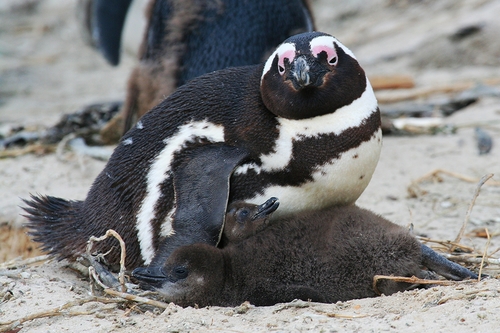
The African penguin (Spheniscus demersus), also known as the Cape penguin or the South African penguin, is a species of penguin confined to southern African waters. It is the only penguin found in the Old World. Like all penguins, it is flightless, with a streamlined body and wings stiffened and flattened into flippers for a marine habitat. Adults weigh an average of 2.2–3.5 kg (4.9–7.7 lb) and are 60–70 cm (24–28 in) tall. The species has distinctive pink patches of skin above the eyes and a black facial mask. The body's upper parts are black and sharply delineated from the white underparts, which are spotted and marked with a black band.

The African penguin is a pursuit diver and feeds primarily on fish and squid. Once extremely numerous, the African penguin is now the rarest species of penguin, classified as critically endangered, with its population declining rapidly due to a combination of several threats, such as habitat loss, overfishing and climate change. It is a charismatic species and is popular with tourists. Other vernacular names of the species include black-footed penguin and jackass penguin, due to the species' loud, donkey-like noise (although several related species of South American penguins produce the same sound). They can be found along the coast of South Africa and Namibia.

Appearance

African penguins grow to 60–70 cm (24–28 in) tall and weigh between 2.2–3.5 kg (4.9–7.7 lb). The beak length of the African penguin varies, usually growing between 4.8–6.5 cm (1.9–2.6 in). They have a black stripe and black spots on the chest, the pattern of which is unique to each penguin, like human fingerprints. The sweat glands above the eyes cool the birds' blood and as the temperature rises, increased blood flow causes the glands to get pinker. This species exhibits slight sexual dimorphism; the males are slightly larger than the females and have longer beaks. Juveniles do not possess the bold, delineated markings of the adult, but instead have dark upperparts that vary from greyish-blue to brown; the pale underparts lack both spots and the band. The beak is more pointed than that of the Humboldt penguin.

Habitat

The African penguin is found on the southern and southwestern coast of Africa, living in colonies on 27 islands between Namibia and Algoa Bay, near Port Elizabeth, South Africa. It is the only penguin species that breeds in Africa, and its presence gave name to the Penguin Islands.

Two colonies were established by penguins in the 1980s on the mainland near Cape Town, namely Boulders Beach near Simon's Town and Stony Point in Betty's Bay. Mainland colonies likely became possible only in recent times due to the reduction of predator numbers, although the Betty's Bay colony has been attacked by leopards. The only other mainland colony is in Namibia, but it is not known when it was established.

Boulders Beach is a tourist attraction due to the beach, swimming, and the penguins themselves. The penguins will allow people to approach them as close as a meter.

Diet

The average lifespan of an African penguin is 10 to around 25 years in the wild and up to 34 in captivity.

The primary predators of African penguins at sea include sharks and fur seals. Predators of nesting penguins and their chicks include kelp gulls, Cape genets, mongooses, caracals and domestic cats and dogs. Mortality from terrestrial predators is higher if penguins are forced to breed in the open, in the absence of suitable burrows or nest boxes.

Behaviour

African penguins forage in the open sea, where they feed on pelagic fish such as sardines (including the blue pilchard), South African mullet, Cape horse mackerels, red-eye round herrings and anchovies (specifically the European anchovy and the Southern African anchovy) and marine invertebrates such as squids (Loligo reynaudi) and small crustaceans, primarily krills, shrimps and Pterygosquilla armata. Penguins normally swim within 20 km (12 mi) of the shore. A penguin may consume up to 540 grams (1.19 lb) of prey every day, but this may increase to over 1 kg (2.2 lb) when raising older chicks.

Reproduction

The African penguin is monogamous; it breeds in colonies and pairs return to the same site each year. It has an extended breeding season, with nesting usually peaking from March to May in South Africa and November to December in Namibia. A clutch of two eggs is laid either in burrows burrowed in guano or nests in the sand under boulders or bushes. Incubation is undertaken equally by both parents for around 40 days. At least one parent guards the chicks for about one month, whereafter the chicks join a crèche with other chicks and both parents spend most of the day foraging in the sea.

Chicks fledge at 60 to 130 days, the timing depending on environmental factors such as the quality and availability of food. The fledged chicks then go to sea on their own, where they spend the next one to nearly two years. They then return to their natal colony to moult into adult plumage.

Humans & conservation

African penguin eggs were considered a delicacy and were still being eaten and collected for sale as recently as the 1970s. In the 1950s, they were being collected from Dassen Island and sold in nearby towns. In 1953, 12,000 eggs were collected. In the late 1950s, some French chefs expressed interest in recipes including African penguin eggs collected from the islands off the west coast of South Africa and placed annual orders for small quantities. In the mid-1960s, eggs were collected in the thousands and sold by the dozen, with each customer limited to two dozen eggs in total.

Part of

Where to see it

No dive sites list African Penguin yet. Explore the map to find sites near you.