← All marine life
Hammerhead Shark
Group IUCN · Critically Endangered (CR)

Hammerhead Shark

Sphyrna lewini, (Griffith & Smith, 1834)

marinebrackish
Where to see it

About Hammerhead Shark

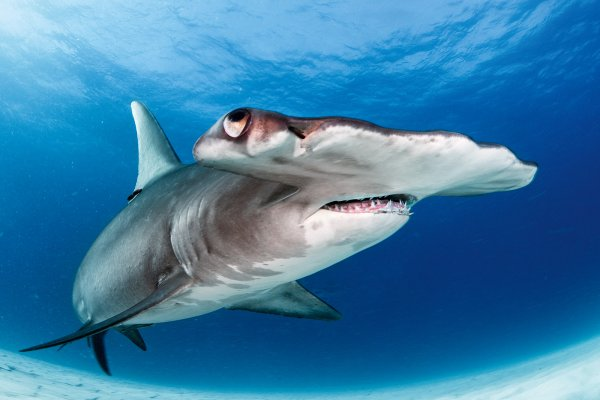
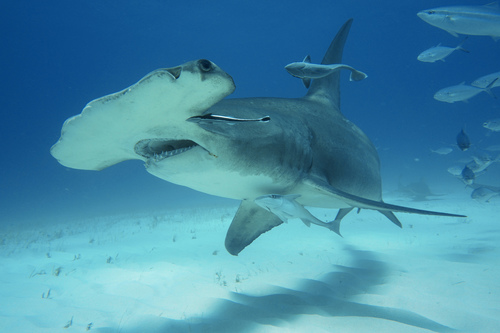
The scalloped hammerhead (Sphyrna lewini) is a species of hammerhead shark in the family Sphyrnidae. It was originally known as Zygaena lewini. The Greek word sphyrna translates into "hammer" in English, referring to the shape of this shark's head, which is its most distinguishing characteristic. The shark's eyes and nostrils are at the tips of the extensions. It is a fairly large hammerhead, but is still smaller than both the great and smooth hammerheads.

This shark is also known as the bronze, kinky-headed, or southern hammerhead. It primarily lives in warm, temperate, and tropical coastal waters all around the globe between latitudes 46°N and 36°S, down to a depth of 500 m (1,600 ft). It is the most common of all hammerheads.

Appearance

The scalloped hammerhead is easily distinguished from other hammerhead sharks by the central indentation on the anterior margin of the head. There are also two indentations on either side of the central indentation, which gives the "scalloped" look. They have a very large first dorsal fin that is slightly hooked and a smaller second dorsal fin. Scalloped hammerhead sharks are typically uniform grey, grayish brown, bronze, or olive with a white underside for countershading.
Habitat

The scalloped hammerhead is a coastal pelagic species; it occurs over continental and insular shelves and in nearby deeper water. It is found in warm temperate and tropical waters, worldwide from 46°N to 36°S. It can be found down to depths over 500 m (1,600 ft), but is most often found above 25 m (82 ft). During the day, they are more often found close to shore, and at night, they hunt further offshore. Adults are found alone, in pairs, or in small schools, while young sharks occur in larger schools.

Diet

The scalloped hammerhead has several advantages to capture its prey. The shape of its head allows it to burrow into the seafloor and pin stingrays down, while the wide head and special sensory cells allow the scalloped hammerhead to successfully detect fish.

Behaviour

These sharks are often seen during the night, day, and morning in big schools, sometimes numbering hundreds, most likely because large groups can obtain food more easily than singles or small groups, especially larger and trickier prey, as commonly seen. The younger the sharks, the closer to the surface they tend to be, while the adults are found much deeper in the ocean. They are not considered dangerous and are normally not aggressive towards humans.

Reproduction

The gestation period is reported to be around 12 months. Scalloped hammerheads give live birth. Compared to other species, the scalloped hammerhead produces large litters (12–41 pups), and this is most likely due to high infant mortality. Like most sharks, parental care is not seen. Nursery grounds for this species are predictable and repeated over the years, and they are faithful to their natal sites. Their natal sites still cause high infant mortality; a lack of resources prevents all the young from surviving. As a result, only the fittest grow to maturity. Also, should a population get depleted, it recovers through reproduction and not immigration. This species does not seem to attack each other even in periods of starvation. In addition, scalloped hammerheads have migratory behaviors. As a result, deprivation results from migration and young growth.

Humans & conservation

The scalloped hammerhead was the first shark species to be protected under the U.S. Endangered Species Act. As of 2019, the scalloped hammerhead has been categorized as Critically Endangered by the IUCN Red List. The IUCN cites overfishing as the main cause for the drop in population numbers. These sharks are slow growing, mature late, and have low fecundity, which makes them very vulnerable to fishing. Scalloped hammerheads are over harvested for their large sizes and fins that have 'high fin needle content;' their fins are sold for US $100–120 per kilogram. Many conservation efforts have been taken to protect this species, such as using genetic information from fins purchased from a Hong Kong market to pinpoint where scalloped hammerheads are being caught and track their exploitation levels. Another important effort has been protecting Sphyrna lewini nurseries.

Species in this group

Where to see it

Top-rated dive sites where divers have spotted Hammerhead Shark.

Blue Hole

Blue Hole

⭐ 5.0 (1)
Egypt, Dahab Saint Katherine Protectorate
World-famous deep wall dive with dramatic underwater topography.
👣 Shore Advanced
Biquelli Wall

Biquelli Wall

⭐ 4.0 Scout Score
Indonesia, Alor Alor Marine Protected Area
Coral-rich vertical wall with diverse reef life and critters.
🚤 Boat all levels
Shark City

Shark City

⭐ 5.0 Scout Score
Sheltered bay with seasonal sharks and abundant macro life.
🚤 Boat All levels
Tiputa Pass

Tiputa Pass

⭐ 5.0 Scout Score
World-renowned pass for dolphins, sharks, manta rays, and drift diving.
🚤 Boat Advanced
Grand Banc Extérieur

Grand Banc Extérieur

⭐ 4.0 Scout Score
Madagascar shark dive, stunning drop-off
🚤 Boat Intermediate
Colosseum

Colosseum

⭐ 4.0 Scout Score
Maldives channel dive with unique amphitheatre and abundant pelagics.
🚤 Boat Intermediate
Tokara Islands

Tokara Islands

⭐ 5.0 Scout Score
Remote Japanese islands offering rich pelagic life and unique hot springs.
🚤 Boat All levels
Reggies

Reggies

⭐ 5.0 Scout Score
Drop-off with sharks, mantas, cleaning stations, and a cave.
🚤 Boat advanced
Alibaba

Alibaba

Not yet rated
French Polynesia, Fakarava Fakarava Atoll Biosphere Reserve
Advanced drift dive in Fakarava's shark-rich North Channel.
🚤 Boat Advanced
El Cantil del Este

El Cantil del Este

⭐ 4.0 Scout Score
Colombia, San Bernardo Archipelago Corales de Profundidad National Natural Park
Stunning cliff dive with coral reefs and large pelagic species.
🚤 Boat intermediate
Vaadhoo thila

Vaadhoo thila

⭐ 5.0 Scout Score
Famous deep ocean thila with sharks, rays, and corals.
🚤 Boat Advanced
El Bajo (Marisla)

El Bajo (Marisla)

⭐ 5.0 Scout Score
Mexico, Baja California Sur, La Paz Archipelago Espiritu Santo National Park
World-famous seamounts for hammerheads and other pelagic life.
🚤 Boat Advanced
Contreras Dive Sites

Contreras Dive Sites

⭐ 4.0 Scout Score
Panama, Gulf Of Chiriqu Gulf of Chiriquí National Marine Park
Advanced Panama site for sharks, rays, and big fish.
🚤 Boat Advanced
Tonbara

Tonbara

⭐ 4.0 Scout Score
Popular Kumejima drift dive for big fish, hammerheads, whales.
🚤 Boat Intermediate
Enokuchi

Enokuchi

⭐ 4.0 Scout Score
Mikomoto Island's premier shark site, famous for hammerheads and currents.
🚤 Boat Advanced
Ski Slopes

Ski Slopes

⭐ 4.0 Scout Score
Australia, Great Barrier Reef Great Barrier Reef Marine Park
Sloping reef with abundant fish and excellent visibility.
🚤 Boat All levels
Kottefaru Kanmathi

Kottefaru Kanmathi

⭐ 4.0 Scout Score
Excellent drift dive with mantas, sharks, diverse macro, and vibrant corals.
🚤 Boat Intermediate
Trampa de Tortuga

Trampa de Tortuga

⭐ 4.0 Scout Score
Colombia, San Andrs Island Seaflower Biosphere Reserve
Deep wall dive on the San Andrés barrier reef.
🚤 Boat Advanced
Kudhu Falhagando

Kudhu Falhagando

⭐ 4.0 Scout Score
Maldives, Fuvahmulah Fuvahmulah UNESCO Biosphere Reserve
Popular Fuvahmulah site for spectacular tiger shark encounters.
🚤 Boat Advanced
Budaine

Budaine

⭐ 4.0 Scout Score
Japanese hammerhead hotspot with pelagic encounters driven by Kuroshio Current.
🚤 Boat Advanced