
← All marine life
Great Hammerhead
Species IUCN · Critically Endangered (CR)

Great Hammerhead

Sphyrna mokarran, (Rüppell, 1837)

marinebrackish

About Great Hammerhead

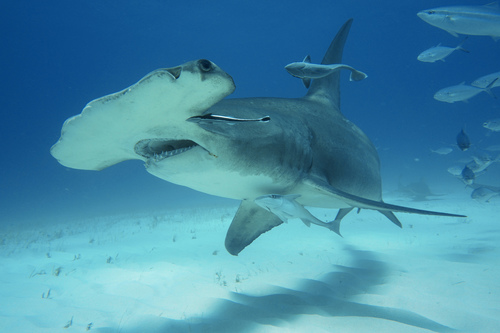
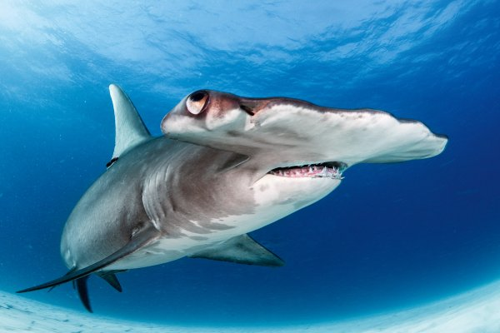
The great hammerhead (Sphyrna mokarran) is the largest species of hammerhead shark, belonging to the family Sphyrnidae, attaining an average length of 4.6 m (15 ft) and reaching a maximum length of 6.2 m (20 ft). It is found around the globe in all the warmer parts of the oceans. The great hammerhead can be distinguished from other hammerheads by the shape of its "hammer" (called the "cephalofoil"), which is wide with an almost straight front margin, its tall, sickle-shaped first dorsal fin, and its strongly falcated pelvic fins. A solitary, strong-swimming apex predator, the great hammerhead feeds on a wide variety of prey ranging from crustaceans and cephalopods, to bony fish, to smaller sharks. Observations of this species in the wild suggest that the cephalofoil functions to immobilize stingrays, a favored prey. This species has a viviparous mode of reproduction, bearing litters of up to 2-49 pups every two years.

Although potentially dangerous, the great hammerhead rarely attacks humans and can sometimes behave inquisitively toward divers. This shark is heavily fished for its large fins, which are valuable on the Chinese market as the main ingredient of shark fin soup. As a result, great hammerhead populations are declining substantially worldwide, and it has been assessed as critically endangered by the International Union for Conservation of Nature (IUCN) as of 2019.

Appearance

The streamlined body of the great hammerhead with the expanded cephalofoil is typical of the hammerhead sharks. Adults can be distinguished from the scalloped hammerhead and the smooth hammerhead by the shape of the cephalofoil, which has a nearly straight front margin (as opposed to arched), with prominent medial and lateral indentations. The width of the cephalofoil is 23–27% of the body length. The teeth are triangular and strongly serrated, becoming more oblique toward the corners of the mouth. Seventeen tooth rows are on either side of the upper jaw, with two or three teeth at the symphysis (the midline of the jaw), and 16–17 teeth on either side of the lower jaw and one to three at the symphysis.
Habitat

The great hammerhead inhabits tropical waters around the world, between the latitudes of 40°N and 37°S. In the Atlantic Ocean, it is found from North Carolina to Uruguay, including the Gulf of Mexico and the Caribbean Sea, and from Morocco to Senegal, and the Mediterranean Sea. It is found all along the rim of the Indian Ocean, and in the Pacific Ocean from the Ryukyu Islands to Australia, New Caledonia, and French Polynesia, and from southern Baja California to Peru. It may occur off Gambia, Guinea, Mauritania, Sierra Leone, Western Sahara, and occasionally seen near Hawaii but this has not been confirmed. Great hammerheads may be found from inshore waters less than 1 m (3.3 ft) deep, to a depth of 80 m (260 ft) offshore. They favor coral reefs, but also inhabit continental shelves, island terraces, lagoons, and deep water near land.

Diet

The great hammerhead shark is an active predator with a varied diet. Known prey of the great hammerhead include invertebrates such as crabs, lobsters, squid, and octopus; bony fishes such as tarpon, sardines, sea catfishes, toadfish, porgies, grunts, jacks, croakers, groupers, flatfishes, boxfishes, and porcupine fishes; and smaller sharks such as smoothhounds. At Rangiroa Atoll, great hammerheads prey opportunistically on grey reef sharks (Carcharhinus amblyrhynchos) that have exhausted themselves pursuing mates. The species is known to be cannibalistic. In the Gatun Formation of Panama, fossil teeth belonging to great hammerheads suggest the shark once preyed on juvenile Otodus megalodon, alongside the extinct snaggletooth shark Hemipristis serra, with which it was once contemporary.

Behaviour

The great hammerhead is a solitary, nomadic predator that tends to be given a wide berth by other reef sharks. If confronted, it may respond with an agonistic display, dropping its pectoral fins and swimming in a stiff or jerky fashion. Juveniles are preyed upon by larger sharks such as bull sharks (Carcharhinus leucas), while adults have no major predators except for killer whales, which hunt hammerheads of any age. Yellow jacks (Carangoides bartholomaei) have been seen rubbing themselves against the hammerhead's flanks, possibly to rid themselves of parasites. Schools of pilot fish (Naucrates ductor) sometimes accompany the great hammerhead. The great hammerhead is parasitized by several species of copepods, including Alebion carchariae, A. elegans, Nesippus orientalis, N. crypturus, Eudactylina pollex, Kroyeria gemursa, and Nemesis atlantica.

Humans & conservation

A 2016 study of specimens logged with accelerometers showed that great hammerhead sharks reduce drag and lessen energy expenditure by swimming on their side in a posture termed "rolled swimming". The shark uses its very large dorsal fin to help achieve lift, a habit that had previously been noted in captive specimens, and may spend up to 90% of its time in this swimming orientation. The technique is thought to save about 10% in drag and consequently movement costs.

Part of

Where to see it

No dive sites list Great Hammerhead yet. Explore the map to find sites near you.