← All marine life
Gurnard
Group

Gurnard

Triglidae, Rafinesque, 1815

marinebrackish

About Gurnard

Triglidae, commonly known as gurnards or sea robins, are a family of bottom-feeding scorpaenoid ray-finned fish. The gurnards are distributed in temperate and tropical seas worldwide.

Appearance

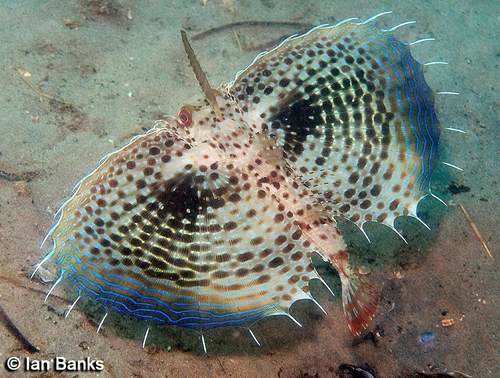
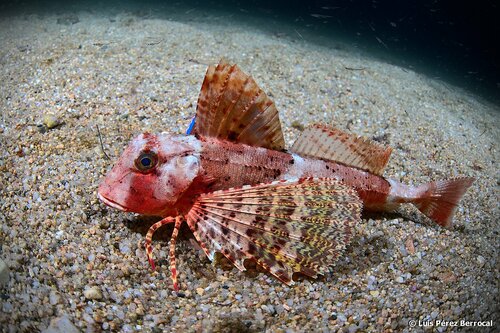
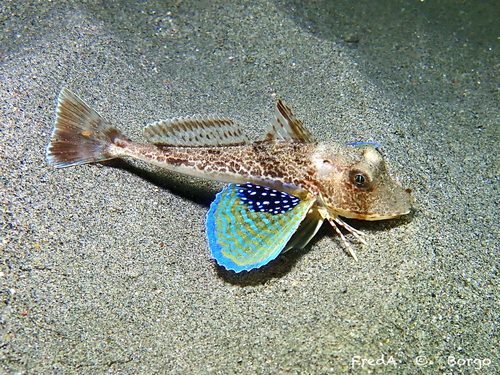
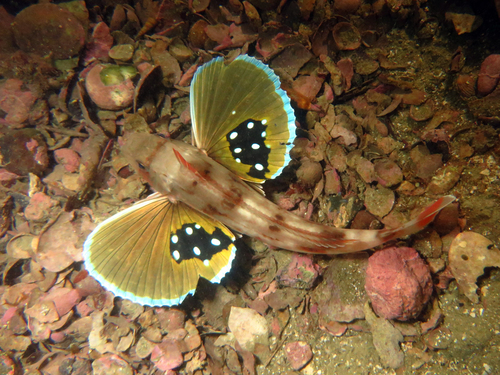
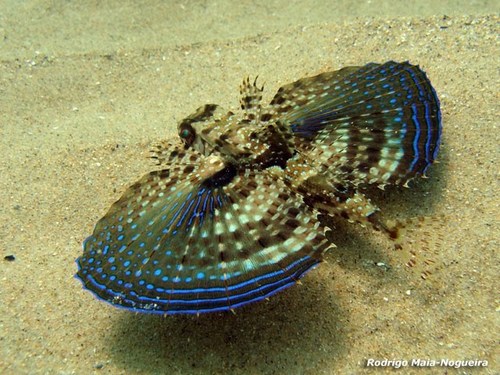
Triglidae gurnards have mouths which are either terminal or positioned slightly below the snout, which has its tip normally having paired rostral projections, frequently armed with spines, and these create the impression of a bilobed snout when seen from above. There are no barbels on the head, and the preorbital bones typically project forward. The lower three rays of the pectoral fins are enlarged and free of the fin membrane; they are said to look like legs. They have two separate dorsal fins, the first having between 7 and 11 spines while the second has 10 to 23 soft rays. The anal fin may not have any spines or it can have a single spine and 11 to 23 soft rays. The head is bony and resemble a casque. There are 9 or 10 branched rays in the caudal fin.
Diet

Gurnard have firm white flesh that holds together well in cooking, making them well-suited to soups and stews. They are commonly used in the French dish bouillabaisse. One source describes gurnards as "rather bony and lacking in flavour"; others praise its flavour and texture.

They were often caught in British waters as a bycatch and discarded. However, as other species became less sustainable and more expensive they became more popular, with the wholesale price between 2007 and 2008 reported to have increased from £0.25 per kg to £4, and sales increasing tenfold by 2011. Gurnards also are now appearing in fish markets in the U.S.

Reproduction

Classified as carnivores, gurnards mainly feed on crustaceans. Most species are opportunistic predators and will feed on prey such as teleost and mollusks as well. Gurnards do not have a primary predator; however, larger fish, marine mammals, birds, and humans will prey on gurnards. They are bottom-dwelling fish, living down to 200 m (660 ft), although they can be found in much shallower water. When it comes to preferred water depths, adult gurnards will favor deeper water while juveniles will favor shallower water. The different genera of gurnards have diverse offspring spawning periods, varying in length and time of year. For example, tub gurnard spawning period takes place from December to March, and red gurnard spawning takes place from September to May.

Species in this group

Where to see it

No dive sites list Gurnard yet. Explore the map to find sites near you.