
← All marine life
Bluefin Gurnard
Species IUCN · Least Concern (LC)

Bluefin Gurnard

Chelidonichthys kumu, (Cuvier, 1829)

marinebrackish

About Bluefin Gurnard

The bluefin gurnard or Pacific red gurnard (Chelidonichthys kumu) is a species of marine ray-finned fishes belonging to the family Triglidae, the gurnards and sea robins. Its Māori names are kumukumu and pūwahaiau. It is found in the western Indian Ocean and the western Pacific Ocean, being common around Australia and New Zealand at depths down to 200 metres (660 ft). The fish is one of the most important commercial fish species in New Zealand.

Appearance

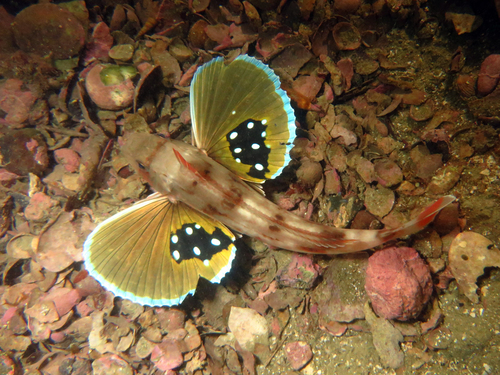
The bluefin gurnard is a bottom-dwelling fish known for its bright red body and large, colourful pectoral fins with a large black eye-spot in the center and surrounded by a bright blue edge. Its natural colour is a splotchy pale brown, generally only becoming red when stressed and the belly is paler or even white.

It has a boxy, bony head which is protected by backwards-facing spines along the front of the snout and around the eye as well as on the hind margin of the operculum and tapers into a laterally elongated body with 33-35 vertebrae.

There are 8-10 gill rakers and 70-80 scales on its lateral line, which is uninterrupted. Its two tall, triangular dorsal fins have a total of 15-16 soft rays and 9-10 spines. There is no adipose fin. The anal fin has 14-16 soft rays and no spines.

Habitat

The bluefin gurnard can be found throughout many central tropical and temperate Indo-West Pacific waters. It is commonly found along the coasts of New Zealand, Australia, South Africa, and many islands in the South Pacific. It is unsure whether or not previous records from Japan, Korea, China, and the Hawaiian Islands are mis-identifications.

Diet

The bluefin gurnard is an opportunistic feeder, preying principally on crustaceans, but pretty much any small macrofauna such as shrimp/prawns, crabs, crayfish, lobster, amphipods, small fish, and polychaete worms. It uses modified fin rays under its pectorals to probe the sand for prey and may also use the large fan-like pectoral fins to offer prey mock shelter. They can be found in shallow water with soft ground after being stirred by winter storms and around the seasonal migrations of small shoreline fish like whitebait, anchovy, and pilchard.

Along the Australian shores, the bluefin gurnard seems to be one of the apex predators with dogfishes, dories, lings and other flatheads.

A possible use for its large pectoral fins may be to make it appear larger to scare off potential predators.

Reproduction

Bluefin gurnard eggs develop for 7 days before hatching, and grow rapidly until they reach maturity at 2–3 years old. After reaching maturity growth slows considerably and they move into deeper water where bluefin gurnards found in deeper strata were older and longer on average than those found inshore.

Males are smaller than females at around 26 cm and 33 cm respectively and they may live for over 12 years.

Humans & conservation

The bluefin gurnard is a traditional food for Māori, however in some areas of New Zealand the fish had a poor reputation and was only rarely eaten. Early European settlers also shared this perception, often exporting the fish to Australia, where it had a better reputation. By the 20th Century, this reputation had reversed, and the bluefin gurnard became one of the most popular eating fish in New Zealand.

By the 1970s, the fish was the fourth-most caught species in New Zealand, and by the year 2000 approximately 4,000 tons were caught annually. Even if their number was low in the mid-1990s in New-Zealand, the population has increased and seems to stay constant. It has a very good, pink and firm flesh with a low rate of fat.

Part of

Where to see it

No dive sites list Bluefin Gurnard yet. Explore the map to find sites near you.