
← All marine life
Tub Gurnard
Species IUCN · Least Concern (LC)

Tub Gurnard

Chelidonichthys lucerna, (Linnaeus, 1758)

marine

About Tub Gurnard

The tub gurnard (Chelidonichthys lucerna), also known as the sapphirine gurnard, tube-fish, tubfish or yellow gurnard, is a species of marine ray-finned fish belonging to the family Triglidae, the gurnards and sea robins. It is found in the eastern Atlantic Ocean. It is exploited by commercial fisheries as a food fish.

Appearance

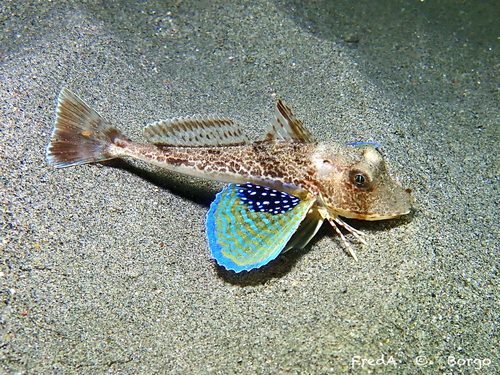
This species reaches a maximum total length of 75.1 cm (29.6 in), the largest species in the family Triglidae, although 30 cm (12 in) is more typical. The heaviest published specimen weighed 6 kg (13 lb). The overall colour is deep reddish brown to pinkish red, with a pinkish lower body. The blue pectoral fins are spotted green in the centres and red on the margins.The tub gurnard has a large, bony, triangular head which bears many ridges and spines but which does not have an occipital groove. There are two spiny lobes on the tip of the snout and the eyes are relatively small. The large mouth is set low on the head and the jaws and vomer are covered by densely set rows of teeth. There are two dorsal fins. The first contains 8 to 10 spines and the second 16 or 17 soft rays. The anal fin has between 14 and 16 soft rays.

Habitat

The tub gurnard is found in the Eastern Atlantic Ocean where it occurs from Norway south along the European and African coasts as far south as Ghana. It occurs throughout the Mediterranean Sea and in the Black Sea as well. It is also found in the Sea of Marmara and in the coastal waters of the British Isles. It is absent from Madeira and the Azores but is found around the Canary Islands. Its distribution is thought to be shifting northwards as its abundance is increasing in the central North Sea.

Reproduction

The tub gurnard spawns between May and July in the northern parts of its range, while it runs from November to February off Egypt. They have also been shown to spawn from May until September ranging from 100,000 to 300,000 pelagic eggs off the Georgian coasts of the Black Sea. Having pelagic eggs allows the females to have their young in wide, open spaces and closer to the shore. The eggs are described as being round, smooth and not sticky. The species is dioecious, meaning that each individual either has female or male reproductive parts, along with performing external fertilization. The male and female form a distinct pair to spawn. The eggs are pelagic and in the larvae and post-larvae all of the pectoral fin rays are contained within the fin membrane.

Humans & conservation

The tub gurnard is targeted by commercial fisheries but the amount caught is relatively low, average declared global landings in 2011 to 2015 were 4429 tonnes. Much of this catch is taken in the North Sea (52%) and the eastern English Channel (37%), however, the actual landings are often described as "gurnard" and are not sorted to species on landing. The tub gurnard, with the red gurnard ( Chelidonichthys cuculus) and the grey gurnard (Eutrigla gurnardus) have been recognised as potential commercial species and this has led to recommendations made by the ICES to monitor landings and discards and to get population biology data to be used to assess the stock. However, this data is lacking in all three exploited gurnard species, particularly the tub gurnard.

Part of

Where to see it

No dive sites list Tub Gurnard yet. Explore the map to find sites near you.