← All marine life
Crab
Group

Crab

Brachyura, Latreille, 1802

marinebrackishfreshwater
Where to see it

About Crab

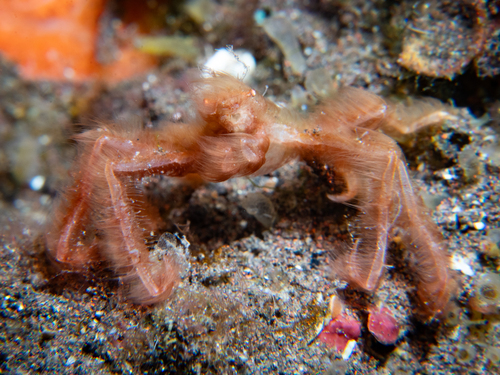
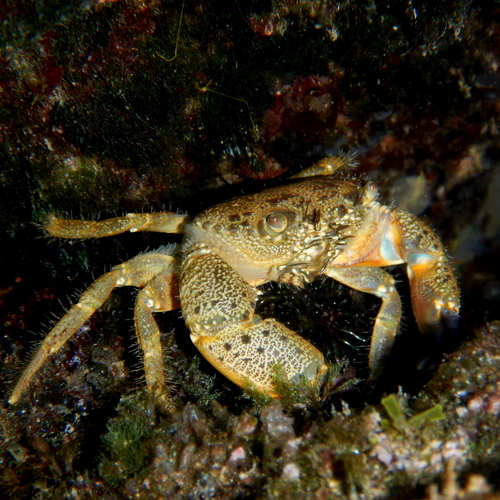
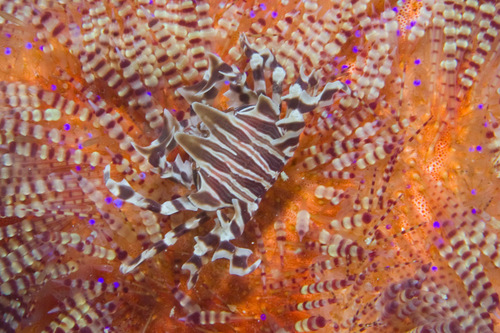
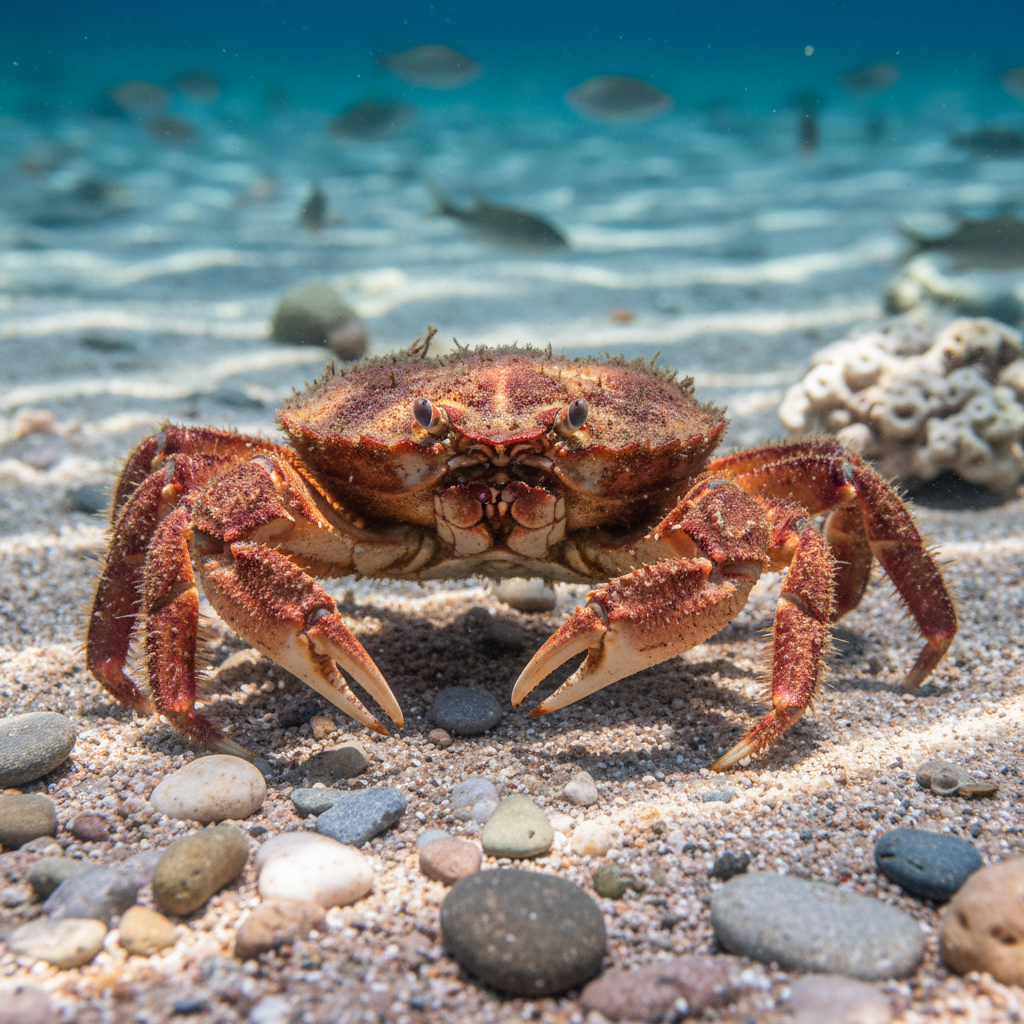
Brachyura is an infraorder of decapod crustaceans comprising the true crabs. They typically have a very short projecting tail-like abdomen, usually hidden entirely under the thorax. Their exoskeleton is often thickened and hard. They generally have five pairs of legs, and the frontmost pair end in chelae, which function as pincers. They are present in all the world's oceans, in freshwater, and on land, often hiding themselves in small crevices or burrowing into sediment. True crabs are omnivores, feeding on a variety of food, including a significant proportion of algae, as well as detritus and other invertebrates. True crabs are widely consumed by humans as food, with over 1.5 million tonnes caught annually.

True crabs first appeared in the fossil record during the Jurassic period, around 200 million years ago, achieving great diversity by the Cretaceous period; around 7,000 extant species in 96 families are known. The Brachyura are the largest of the crab decapod groups with carcinised body forms. Smaller groups include the porcelain crabs, king crabs, and hairy stone crabs which have independently evolved similar forms and lifestyles.

Diet

In Southeast Asia, mud crabs (Scylla serrata) are cooked with chilli peppers to make the "sweet, yet savoury" chilli crab. In Goa and Mozambique, crab curry is a typical dish, flavoured with chilis, garlic, coconut, and spices. For the British dish dressed crab, the crab meat is extracted and placed inside the hard shell. In the Chesapeake Bay region of Maryland, crab meat is mixed with mayonnaise, mustard, and breadcrumbs to make crab cakes. Crabs can be made into a bisque, a smooth, creamy, seasoned soup of French origin. Crab sticks, also called surimi, are made from minced fish meat that is crafted and colored to resemble crab meat. It is a popular sushi ingredient in Japan and South Korea.

Behaviour

True crabs typically walk sideways (hence the term crabwise), because of the articulation of the legs which makes a sidelong gait more efficient. Some crabs walk forward or backward, including raninids, Libinia emarginata and Mictyris platycheles. Some crabs, like the Portunidae and Matutidae, are also capable of swimming, the Portunidae especially so as their last pair of walking legs are flattened into swimming paddles.

Brachyuran crabs are mostly active animals with complex behaviour patterns such as communicating by drumming or waving their pincers. Crabs tend to be aggressive toward one another, and males often fight to gain access to females. On rocky seashores, where nearly all caves and crevices are occupied, crabs may also fight over hiding holes.

Reproduction

True crabs attract a mate through chemical (pheromones), visual, acoustic, or vibratory means. Pheromones are used by most fully aquatic species, while terrestrial and semiterrestrial crabs often use visual signals, such as fiddler crab males waving their large claws to attract females. The vast number of brachyuran crabs have internal fertilisation and mate belly-to-belly. For many aquatic species, mating takes place just after the female has moulted and is still soft. Females can store the sperm for a long time before using it to fertilise their eggs. When fertilisation has taken place, the eggs are released onto the female's abdomen, below the tail flap, secured with a sticky material. In this location, they are protected during embryonic development. Females carrying eggs are called "berried" since the eggs resemble round berries.

Humans & conservation

True crabs make up 20% of all marine crustaceans caught, farmed, and consumed worldwide, amounting to 1.5 million tonnes annually. One species, Portunus trituberculatus, accounts for one-fifth of that total. Other commercially important taxa include Portunus pelagicus, several species in the genus Chionoecetes, the blue crab (Callinectes sapidus), Charybdis spp., Cancer pagurus, the Dungeness crab (Metacarcinus magister), and Scylla serrata, each of which yields more than 20,000 tonnes annually.

In some species, meat is harvested by manually twisting and pulling off one or both claws and returning the live crab to the water in the knowledge that it may survive and regenerate the claws.

Species in this group

Where to see it

Top-rated dive sites where divers have spotted Crab.

Mcabee

Mcabee

⭐ 5.0 (1)
United States, California, Monterey Monterey Bay National Marine Sanctuary
Easy, protected shore dive ideal for training and macro life.
👣 Shore beginner
Mun Nai Jetty

Mun Nai Jetty

⭐ 5.0 (1)
Thailand, Rayong Khao Laem Ya–Mu Ko Samet National Park
Shallow jetty dive, a paradise for nudibranchs and macro.
🚤 Boat Beginner
Dado Pequeño

Dado Pequeño

⭐ 4.0 Scout Score
Spain, Ibiza Formentera Parque natural de ses Salines d'Eivissa i Formentera
Vibrant Ibiza wall dive with rich Mediterranean macro life.
🚤 Boat intermediate
El Acuario Ii

El Acuario Ii

⭐ 4.0 Scout Score
Spain, Almería Cabo de Gata-Níjar Natural Park
Vibrant site with diverse marine life and interesting topography.
🚤 Boat beginner/intermediate
Gustinja

Gustinja

⭐ 4.0 Scout Score
Dive site with abundant marine life near Rovinj.
🚤 Boat All Levels
Žusterna

Žusterna

⭐ 3.0 Scout Score
Slovenia, Koper Not in marine park
Easy shore dive, great for macro and night diving.
👣 Shore Beginner
Kraken Freighter

Kraken Freighter

⭐ 4.0 Scout Score
United States, Texas, Galveston Texas Parks and Wildlife Artificial Reef Program
Advanced deep wreck dive on a large artificial reef.
🚤 Boat advanced
Kaloutsi Reef

Kaloutsi Reef

⭐ 4.0 Scout Score
Expansive reef system with abundant and diverse marine life.
🚤 Boat all levels
Römerbucht

Römerbucht

⭐ 4.0 Scout Score
Croatia, Pula Not in marine park
Easy shore dive with a stunning canyon and rock formations.
👣 Shore Beginner
The Anchor

The Anchor

⭐ 3.0 Scout Score
Ancient anchor on a sandy plateau with historical artifacts.
🚤 Boat beginner
Neyo Kanmathi

Neyo Kanmathi

⭐ 4.0 Scout Score
Lunar landscape reef with mantas, sharks and drift current.
🚤 Boat Intermediate
Atlantic Princess

Atlantic Princess

⭐ 4.0 Scout Score
Dominican Republic, Bayahibe Parque Nacional Cotubanamá
Shallow, life-rich wreck dive suitable for all skill levels.
🚤 Boat all levels
Wall Reef

Wall Reef

⭐ 5.0 Scout Score
Maldives wall reef with diverse macro life and vibrant corals.
🚤 Boat All levels
Isola Gallinara

Isola Gallinara

⭐ 4.0 Scout Score
Italy, Liguria Gallinara Island Regional Nature Reserve
Historic Italian island dive with diverse marine life and topography.
🚤 Boat all levels
M/f Aerosund Ferry

M/f Aerosund Ferry

⭐ 4.0 Scout Score
Accessible, prepared ferry wreck dive with vibrant anemone growth.
🚤 Boat all levels
Fox Point Beach

Fox Point Beach

⭐ 3.0 Scout Score
Accessible, shallow shore dive with diverse small marine life.
👣 Shore beginner
Kontiki Marina

Kontiki Marina

⭐ 4.0 Scout Score
Protected house reef and wall teeming with fish and sardines.
all levels
Tegnue "G.s Monselice

Tegnue "G.s Monselice

⭐ 3.0 Scout Score
Italy, Veneto Tegnue di Chioggia Biological Protection Zone
Shallow rocky outcrop for macro photography on sandy bottom.
🚤 Boat intermediate
Knacker Hole

Knacker Hole

⭐ 4.0 Scout Score
Shallow, easy-access UK shore dive with abundant macro life.
👣 Shore all levels
Črni Mol

Črni Mol

⭐ 4.0 Scout Score
Croatia, Rovinj Not in marine park
Spectacular underwater canyons and passages near Rovinj.
🚤 Boat All levels