← All marine life
Japanese Spider Crab
Species

Japanese Spider Crab

Macrocheira kaempferi, (Temminck, 1836)

marine

About Japanese Spider Crab

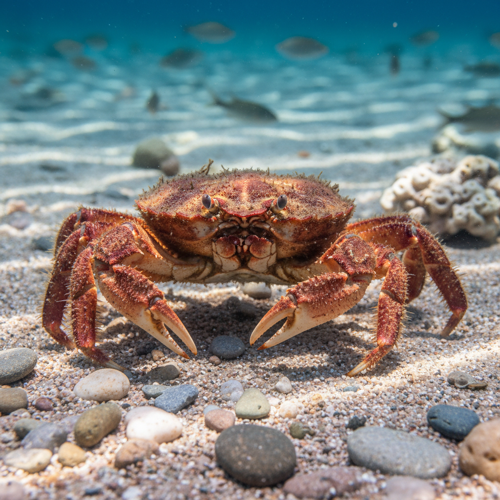
The Japanese giant spider crab (Macrocheira kaempferi) is a species of marine crab and is the largest crab found in the waters around Japan. At around 3.75 metres (12.3 ft), it has the largest leg-span of any arthropod. The Japanese name for this species is taka-ashi-gani, (Japanese: 高脚蟹; タカアシガニ), literally translating to "tall-legged crab". It goes through three main larval stages along with a prezoeal stage to grow to its full size.

The Japanese giant spider crab is the sole living member of the genus Macrocheira. Three fossil species of this genus are known: M. ginzanensis and M. yabei from the Miocene of Japan, and M. teglandi from the Oligocene. They are sought by crab fisheries, and are considered a delicacy in Japan. To prevent overexploitation from harming the species, conservation efforts have been put in place to protect them and their population from overfishing.

The Japanese giant spider crab is similar in appearance to the much smaller European spider crab (Maja squinado), though the latter, while within the same superfamily, belongs to a different family: the Majidae.

Appearance

The Japanese spider crab has the greatest leg span of any known arthropod, reaching up to 3.7 m (12.1 ft) from claw to claw. The body may grow to 40 cm (16 in) in carapace width and the whole crab can weigh up to 19 kg (42 lb)—second in mass only to the American lobster among all living arthropod species. The males have longer chelipeds; females have much shorter chelipeds, which are shorter than the following pair of legs.

Habitat

Japanese spider crabs are mostly found off the southern coasts of the Japanese island of Honshū, from Tokyo Bay to Kagoshima Prefecture. Outlying populations have been found in Iwate Prefecture and off Su-ao in Taiwan. Adults are found at depths between 50 and 600 m (160 and 1,970 ft). They like to inhabit vents and holes in the deeper parts of the ocean. The temperature preference of adults is unknown, but the species is regular at a depth of 300 metres (980 ft) in Suruga Bay, where the water generally is about 10 °C (50 °F). Based on results from public aquaria, Japanese spider crabs tolerate temperatures between 6 and 16 °C (43 and 61 °F), but are typically maintained at 10–13 °C (50–55 °F).

Humans & conservation

Temminck, in his original description, noted that the crab was known to the Japanese for the serious injuries it can cause with its strong claws. The Japanese spider crab is "occasionally collected for food", and even considered a delicacy in many parts of Japan and other areas in the region. In total, 24.7 tonnes (54,000 lb) were collected in 1976, but fell to only 3.2 tonnes (7,100 lb) in 1985. The fishery is centred on Suruga Bay. The crabs are typically caught using small trawling nets. The population has decreased in number due to overfishing, forcing fishermen into exploring deeper waters to catch them. The average size caught by fishermen is a legspan of 1.0–1.2 m (3 ft 3 in – 3 ft 11 in). Populations of this species of crab have diminished over recent years and many efforts are being made to protect them.

Part of

Where to see it

No dive sites list Japanese Spider Crab yet. Explore the map to find sites near you.