
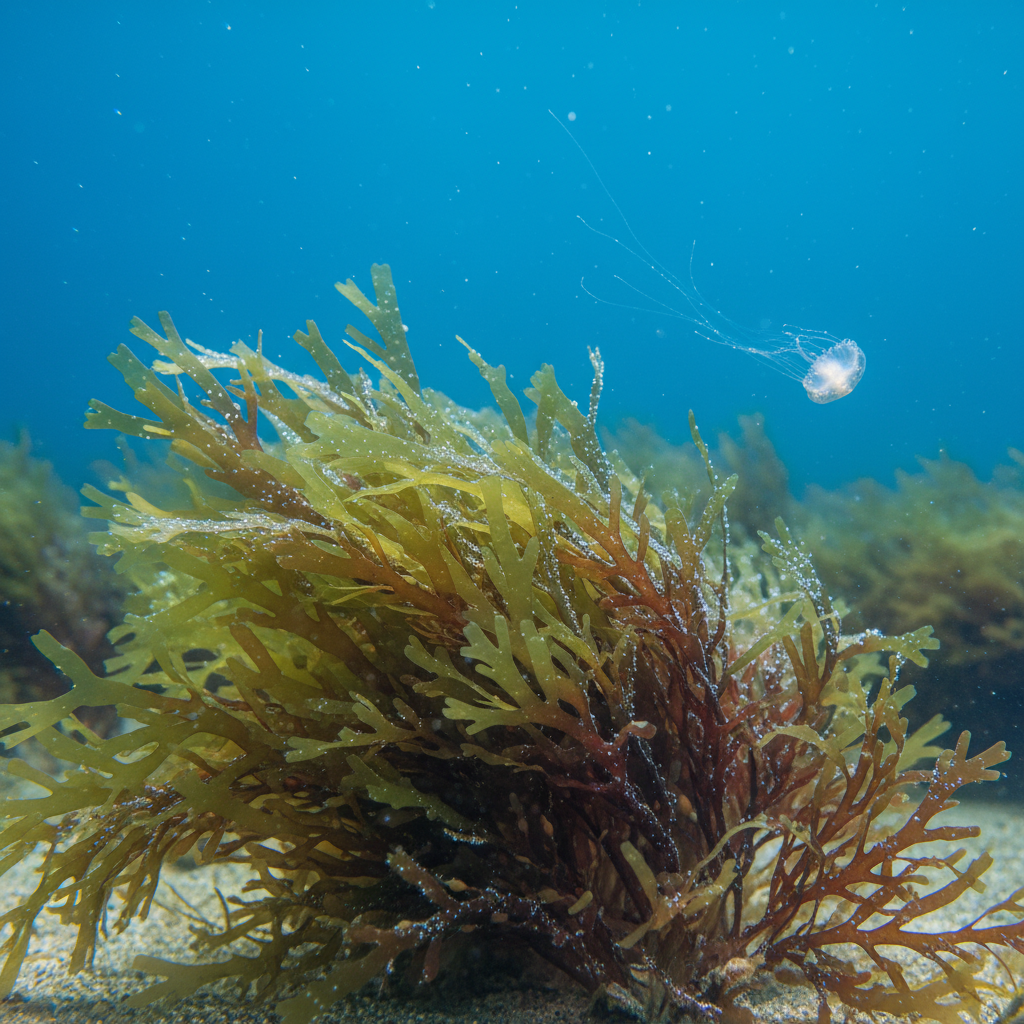
About Algae

Algae ( AL-jee, UK also AL-ghee; sing.: alga ) are any of a large and diverse group of photosynthetic organisms. It excludes the land plants (embryophytes). Such organisms range from microscopic unicellular microalgae (including cyanobacteria and phytoplankton) to seaweeds, multicellular macroalgae which may grow up to 50 metres (160 ft) in length. Most algae are aquatic (especially marine), and some form cohesive colonies. Freshwater algae include Charophyta such as the filamentous Spirogyra and the grasslike stoneworts. Most algae are plankton carried passively by water, although some macroalgae have holdfasts for anchorage.

Algae are polyphyletic as they have multiple evolutionary origins. Although algae with two-membraned chloroplasts seem to form a paraphyletic group within the clade Archaeplastida, other algae with chloroplasts that have three or more membranes evolved from protists that acquired photosynthesis after engulfing archaeplastids. Chlorophytes, rhodophytes (red algae) and glaucophytes (grey algae) have primary chloroplasts directly derived from endosymbiont cyanobacteria, while diatoms, cryptomonads, euglenoids and phaeophyceae (brown algae) have secondary chloroplasts derived from indirectly endosymbiont red algae or green algae.

Appearance

The algae are a heterogeneous group of mostly photosynthetic organisms that produce oxygen and lack the reproductive features and structural complexity of land plants. This concept includes the cyanobacteria, which are prokaryotes, and all photosynthetic protists, which are eukaryotes. They contain chlorophyll a as their primary photosynthetic pigment, and generally inhabit aquatic environments.

However, there are many exceptions to this definition. Many non-photosynthetic protists are included in the study of algae, such as the heterotrophic relatives of euglenophytes or the numerous species of colorless algae that have lost their chlorophyll during evolution (e.g., Prototheca). Some exceptional species of algae tolerate dry terrestrial habitats, such as soil, rocks, or caves hidden from light sources, although they still need enough moisture to become active.
Habitat

The distribution of algal species has been fairly well studied since the founding of phytogeography in the mid-19th century. Algae spread mainly by the dispersal of spores analogously to the dispersal of cryptogamic plants by spores. Spores can be found in a variety of environments: fresh and marine waters, air, soil, and in or on other organisms. Whether a spore is to grow into an adult organism depends on the species and the environmental conditions where the spore lands.

Diet

Algae are used as foods in many countries: China consumes more than 70 species, including fat choy, a cyanobacterium considered a vegetable; Japan, over 20 species such as nori and aonori; Ireland, dulse; Chile, cochayuyo. Laver is used to make laverbread in Wales, where it is known as bara lawr. In Korea, green laver is used to make gim.

Some of the most commonly used microalgae as food are:

Chlorella: This form of alga is found in freshwater and contains photosynthetic pigments in its chloroplasts.

Klamath AFA: A subspecies of Aphanizomenon flos-aquae found wild in many bodies of water worldwide but harvested only from Upper Klamath Lake, Oregon.

Spirulina: Known otherwise as a cyanobacterium (a prokaryote or a "blue-green alga")

Behaviour

Algae are prominent in bodies of water, common in terrestrial environments, and are found in unusual environments, such as on snow and ice. Seaweeds grow mostly in shallow marine waters, less than 100 m (330 ft) deep; however, some such as Navicula pennata have been recorded to a depth of 360 m (1,180 ft). A type of algae, Ancylonema nordenskioeldii, was found in Greenland in areas known as the 'Dark Zone', which caused an increase in the rate of melting ice sheet. The same algae was found in the Italian Alps, after pink ice appeared on parts of the Presena glacier.

The various sorts of algae play significant roles in aquatic ecology. Microscopic forms that live suspended in the water column (phytoplankton) provide the food base for most marine food chains. In very high densities (algal blooms), these algae may discolor the water and outcompete, poison, or asphyxiate other life forms.

Reproduction

Rhodophyta, Chlorophyta, and Heterokontophyta, the three main algal divisions, have life cycles which show considerable variation and complexity. In general, an asexual phase exists where the seaweed's cells are diploid, a sexual phase where the cells are haploid, followed by fusion of the male and female gametes. Asexual reproduction permits efficient population increases, but less variation is possible. Commonly, in sexual reproduction of unicellular and colonial algae, two specialized, sexually compatible, haploid gametes make physical contact and fuse to form a zygote. To ensure a successful mating, the development and release of gametes is highly synchronized and regulated; pheromones may play a key role in these processes.

Humans & conservation

The third island on Kunming Lake at Beijing's Summer Palace is called Zaojian Tang Dao (藻鑒堂島). The name comes from the classical Chinese character 藻, meaning both "algae" and "literary talent." As a result the islands name can be translated to either "Island of the Algae-Viewing Hall" or "Island of the Hall for Reflecting on Literary Talent."

Where to see it

Top-rated dive sites where divers have spotted Algae.

Mario Wreck

Mario Wreck

⭐ 5.0 (1)
Shallow, accessible Corsican wreck teeming with fish, ideal for all levels.
👣 Shore All levels
Dragon's Eye Lake

Dragon's Eye Lake

⭐ 4.0 Scout Score
Croatia, Rogoznica Protected Geomorphological Monument
Unique stratified lake dive with a visible chemocline layer.
👣 Shore Advanced
Las Calderas (Wreck)

Las Calderas (Wreck)

⭐ 4.0 Scout Score
20th-century wreck dive in Spain
🚤 Boat Intermediate
Trapiche de Bombinhas

Trapiche de Bombinhas

⭐ 4.0 Scout Score
Shallow, calm dive; beginner-friendly in Bombinhas
👣 Shore Beginner
Cenote Jardín del Edén

Cenote Jardín del Edén

⭐ 4.0 Scout Score
Lush jungle cenote with translucent green water and unique life.
👣 Shore Beginner
Jubilee Cavern

Jubilee Cavern

⭐ 4.0 Scout Score
Deep pinnacle dive featuring a large, life-filled cavern swim-through.
🚤 Boat Advanced
La Franata del Castello

La Franata del Castello

⭐ 4.0 Scout Score
Scilla castle cliffs, canyons, diverse marine life
🚤 Boat Intermediate
Nissaki

Nissaki

⭐ 4.0 Scout Score
Clear rocky cove, abundant fish, excellent for all levels.
👣 Shore All levels
Whaling Cove Beach

Whaling Cove Beach

⭐ 4.0 Scout Score
Australia, Albany Not in marine park
Pristine, protected cove with clear water and granite boulders.
👣 Shore Beginner
Punta Espinoza

Punta Espinoza

⭐ 4.0 Scout Score
Ecuador, Unknown Galápagos Marine Reserve
Unique shallow site for marine iguana encounters in Galápagos.
🚤 Boat Beginner
L' Arche

L' Arche

⭐ 4.0 Scout Score
L'Arche: Arch, drop-off, rich marine life
🚤 Boat Advanced
Jardim das Gorgónias

Jardim das Gorgónias

⭐ 4.0 Scout Score
Easy dive with diverse marine life in Portugal
🚤 Boat Beginner
Northern Erojacks

Northern Erojacks

⭐ 2.0 Scout Score
Shallow artificial reef off Fort Lauderdale, colonized by fauna.
🚤 Boat Beginner
Playa de Levante

Playa de Levante

⭐ 3.0 Scout Score
Shallow urban beach with stone slabs and small fish.
👣 Shore Beginner
Cala della Chiesa

Cala della Chiesa

⭐ 4.0 Scout Score
France, Bonifacio Bouches de Bonifacio Nature Reserve
Picture-perfect shallow snorkel spot with granite blocks and white sand.
🚤 Boat Beginner
Punta Chiappa

Punta Chiappa

⭐ 4.0 Scout Score
Rocky outcrop with diverse marine life at 25m depth
🚤 Boat Intermediate
Laka Wand

Laka Wand

⭐ 4.0 Scout Score
Austria, Carinthia, Weissensee Weissensee Nature Park
Dramatic freshwater wall dive with sunken trees and algae.
🚤 Boat Advanced
Baarah Corner

Baarah Corner

⭐ 4.0 Scout Score
Maldives reef wall with mantas, sharks, turtles, and variable currents.
🚤 Boat Intermediate
Garður

Garður

⭐ 4.0 Scout Score
Vibrant Icelandic dive with kelp forests and diverse marine life.
👣 Shore All levels

Sources

  • Wikipedia — licensed CC BY-SA 4.0 · Text adapted from the Wikipedia article; modifications by WikiBubbles are shared under the same license.