← All marine life
Yellow-Eyed Penguin
Species IUCN · Endangered (EN)

Yellow-Eyed Penguin

Megadyptes antipodes, (Hombron & Jacquinot, 1841)

marine

About Yellow-Eyed Penguin

The yellow-eyed penguin (Megadyptes antipodes), known also as hoiho, is a species of penguin endemic to New Zealand. It is the sole extant species in the genus Megadyptes, from Ancient Greek μέγας (mégas), meaning "large", and δύπτης (dúptes), meaning "diver".

Previously thought closely related to the little penguin (Eudyptula minor), molecular research has shown it more closely related to penguins of the genus Eudyptes. Like most penguins, it is mainly piscivorous.

The species breeds along the eastern and south-eastern coastlines of the South Island of New Zealand, as well as Stewart Island, Auckland Islands, and Campbell Islands. Colonies on the Otago Peninsula are a popular tourist venue, where visitors may closely observe penguins from hides, trenches, or tunnels.

On the New Zealand mainland, the species has experienced a significant decline over the past 20 years. On the Otago Peninsula, numbers have dropped by 75% since the mid-1990s and population trends indicate the possibility of regional extinction from the peninsula in the next 20 to 40 years. While the effect of rising ocean temperatures is still being studied, an infectious outbreak in the mid-2000s played a large role in the drop. Human activities at sea (fisheries, pollution) may have an equal if not greater influence on the species' downward trend.

Appearance

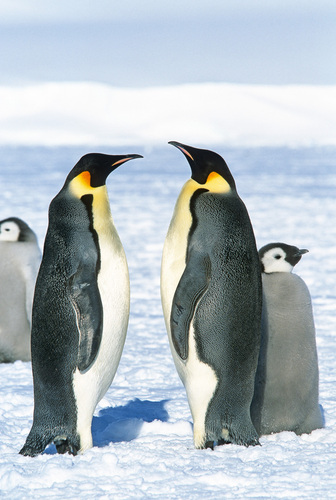
The yellow-eyed penguin (M. a. antipodes) is most easily identified by the band of pale yellow feathers surrounding its eyes and encircling the back of its head. Its forehead, crown and the sides of its face are slate grey flecked with golden yellow. Its eye is yellow. The foreneck and sides of the head are light brown. The back and tail are slate blue-black. Its chest, stomach, thighs and the underside of its flippers are white in colour. Juvenile birds have a greyer head with no yellow band around their eyes.

Habitat

Until recently, it was assumed that M. a. antipodes was widespread and abundant before the arrival of Polynesian settlers in New Zealand. However, genetic analysis has since revealed that its range only expanded to include mainland New Zealand in the past 200 years. Yellow-eyed penguins expanded out of the subantarctic to replace New Zealand's endemic Waitaha penguin (M. a. waitaha). The Waitaha penguin became extinct between about 1300 and 1500, soon after Polynesian settlers arrived in New Zealand. Jeremy Austin, a member of the team that discovered the Waitaha penguin, said, "Our findings demonstrate that yellow-eyed penguins on mainland New Zealand are not a declining remnant of a previous abundant population, but came from the subantarctic relatively recently and replaced the extinct Waitaha penguin".

Diet

Around 90% of the yellow-eyed penguin's diet is made up of fish, chiefly demersal species that live near the seafloor, including silversides (Argentina elongata), blue cod (Parapercis colias), red cod (Pseudophycis bachus), and opalfish (Hemerocoetes monopterygius). Other species taken are New Zealand blueback sprat (Sprattus antipodum) and cephalopods such as arrow squid (Nototodarus sloanii). They also eat some crustaceans, including krill (Nyctiphanes australis). Recently, jellyfish were found to be targeted by the penguins. While initially thought that the birds would prey on jellyfish itself, deployments of camera loggers revealed that the penguins were going after juvenile fish and fish larvae associated with jellyfish.

Behaviour

The nesting behaviour of yellow-eyed penguins is thought to be the least colonial of all penguin species. While other penguin species nest in large aggregations, yellow-eyed penguins tend to nest in solitary pairs or loose aggregations.

Yellow-eyed penguins begin forming pairs and breeding at around two years of age. An analysis of data collected from 1991 to 2002 showed that the species has a 63% rate of retaining mates each breeding season. The majority of changes were due to the death of their partner.

While they can be seen coming ashore in groups of four to six or more individuals, they then disperse along tracks to individual nest sites up to one kilometre inland. Accordingly, the consensus among New Zealand penguin workers is to use habitat rather than colony to refer to areas where yellow-eyed penguins nest.

Humans & conservation

The yellow-eyed penguin is considered one of the rarest penguin species in the world. It is listed on the IUCN Red List as being endangered. It was first included on the list in 1988 when it was listed as threatened, and was changed to endangered in the year 2000.

Part of

Where to see it

No dive sites list Yellow-Eyed Penguin yet. Explore the map to find sites near you.