
← All marine life
Whale Shark
Species IUCN · Endangered (EN)

Whale Shark

Rhincodon typus, Smith, 1828

marine
Where to see it

About Whale Shark

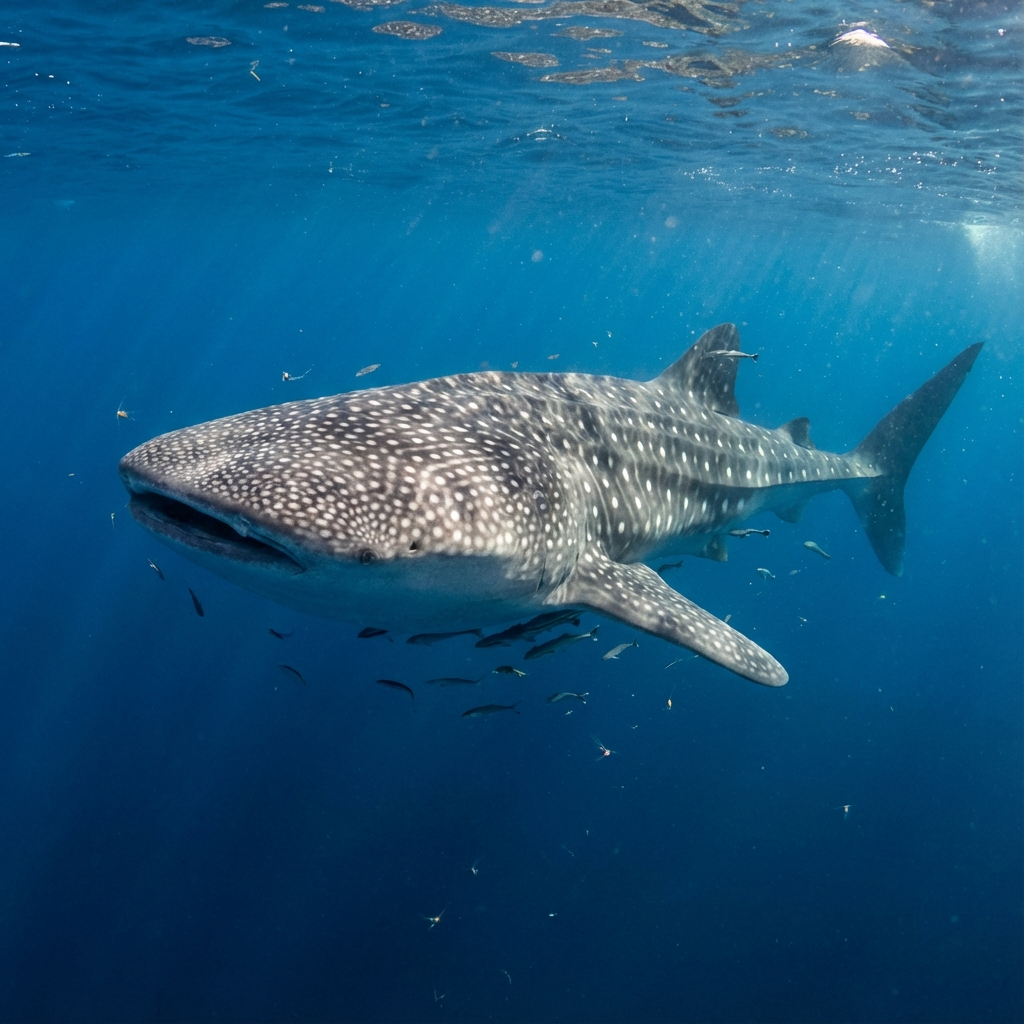
The whale shark (Rhincodon typus) is a slow-moving, filter-feeding carpet shark and the largest known extant fish species. An individual with a length of 18.8 m (61.7 ft) has been considered the largest reliably recorded. The whale shark holds many records for size in the animal kingdom, most notably being by far the largest living non-cetacean animal. It is the only living species of the genus Rhincodon and the only extant member of the family Rhincodontidae, which belongs to the subclass Elasmobranchii in the class Chondrichthyes. Before 1984, it was classified as Rhiniodon into Rhinodontidae. An extinct species, Rhincodon ferriolensis, was described in Europe (probably in Spain), in the Late Burdigalian stage.

Appearance

Whale sharks possess a broad, flattened head with a large mouth and two small eyes located at the front corners. Unlike many other sharks, whale shark mouths are located at the front of the head rather than on the underside of the head. Their mouths can be exceptionally wide; a 12.1 m (39.7 ft) individual was reported to have a mouth measuring 1.55 m (5.1 ft) across. Whale shark mouths can contain over 300 rows of tiny teeth and 20 filter pads which it uses to filter feed. The spiracles are located just behind the eyes. Whale sharks have five large pairs of gills. Their skin is dark grey with a white belly marked with an arrangement of pale grey or white spots and stripes that is unique to each individual. The skin can be up to 15 cm (5.9 in) thick and is very hard and rough to the touch.
Habitat

The whale shark inhabits all tropical and warm-temperate seas. The fish is primarily pelagic, and can be found in both coastal and oceanic habitats. Tracking devices have shown that the whale shark displays dynamic patterns of habitat utilization, likely in response to availability of prey. Whale sharks observed off the northeast Yucatan Peninsula tend to engage in inshore surface swimming between sunrise and mid-afternoon, followed by regular vertical oscillations in oceanic waters during the afternoon and overnight. About 95% of the oscillating period was spent in epipelagic depths (<200 metres (660 ft)), but whale sharks also took regular deep dives (>500 metres (1,600 ft)), often descending in brief "stutter steps", perhaps for foraging. The deepest recorded dive was 1,928 metres (6,325 ft).

Diet

The whale shark is a filter feeder – one of only three known filter-feeding shark species (along with the basking shark and the megamouth shark). It feeds on plankton including copepods, krill, chaetognaths, jellyfish, fish eggs, Christmas Island red crab larvae and small nektonic life, such as small squid or fish (sardines, anchovies, mackerels and small tunas). It also feeds on clouds of eggs during mass spawning of fish and corals. In addition, they have been found to ingest and partially digest Sargassum, thus making them omnivores. The many rows of vestigial teeth play no role in feeding. Feeding occurs either by ram filtration, in which the animal opens its mouth and swims forward, pushing water and food into the mouth, or by active suction feeding, in which the animal opens and closes its mouth, sucking in volumes of water that are then expelled through the gills.

Reproduction

Growth, longevity, and reproduction of the whale shark are poorly understood.

Vertebral growth bands have been used to estimate the age, growth, and longevity of whale sharks. However, there was uncertainty as to whether vertebrae growth bands are formed annually or biannually. A 2020 study compared the ratio of Carbon-14 isotopes found in growth bands of whale shark vertebrae to nuclear testing events in the 1950–60s, finding that growth bands are laid down annually. The study found an age of 50 years for a 10 m (33 ft) female and 35 years for a 9.9 m (32 ft) male. Various studies looking at vertebrae growth bands and measuring whale sharks in the wild have estimated their lifespans from ~80 years and up to ~130 years.

Humans & conservation

Despite their great size, whale sharks pose no danger to humans. Younger whale sharks are gentle and can play with divers. Underwater photographers such as Fiona Ayerst have photographed them swimming close to humans without any danger. Although whale sharks are docile fish, touching or riding the sharks is strictly forbidden and fineable in most countries, as it can cause them serious harm.

Where to see it

141 dive sites where divers have spotted Whale Shark.

Sort by
Ambrósio

Ambrósio

⭐ 5.0 (1)
Amazing manta ray and whale shark dives in Azores
🚤 Boat Intermediate
Aruh Fanno

Aruh Fanno

⭐ 5.0 (1)
Maldives, Fuvahmulah Fuvahmulah Biosphere Reserve
Renowned Maldivian reef slope famous for large pelagic encounters.
🚤 Boat Advanced
Banana Reef / Manta Point
Maldives Manta Ray cleaning and feeding station, diverse large marine life.
🚤 Boat Intermediate
Buyuk

Buyuk

⭐ 5.0 (1)
Indonesia, Bali, Nusa Penida Nusa Penida Marine Protected Area (MPA)
Easy drift dive with rich corals, macro and pelagics.
🚤 Boat all levels
Coral Bay

Coral Bay

⭐ 5.0 (1)
Coral Bay, Australia Ningaloo Marine Park
World-class reef diving with whale sharks and manta rays.
🚤 Shore & Boat All levels
Dixon's Pinnacle

Dixon's Pinnacle

⭐ 5.0 (1)
World-class pinnacles with pelagic cleaning stations and vibrant corals.
🚤 Boat Advanced
Farikede

Farikede

⭐ 5.0 (1)
Maldives, Fuvahmulah Fuvahmulah Biosphere Reserve
Advanced drift dive over a deep plateau with pelagic giants.
🚤 Boat Advanced
Farikede Plateau

Farikede Plateau

⭐ 5.0 (1)
Maldives, Fuvahmulah Fuvahmulah Biosphere Reserve
Deep plateau famous for sharks and pelagic life.
🚤 Boat Advanced
Gemiskiyy Fannu

Gemiskiyy Fannu

⭐ 5.0 (1)
Exhilarating Maldivian drift dive with vibrant corals and pelagics.
🚤 Boat Advanced
Hanifaru Bay

Hanifaru Bay

⭐ 5.0 (1)
Maldives, Baa Atoll Baa Atoll UNESCO Biosphere Reserve
World-famous bay for manta ray and whale shark congregations.
🚤 Boat Beginner
Hin Daeng

Hin Daeng

⭐ 5.0 (1)
Thailand, Andaman Sea Mu Koh Lanta National Park
Vibrant red coral pinnacle, a magnet for pelagic life.
🚤 Boat Advanced
Hin Daeng - Hin Muang
Thailand, Koh Lanta Mu Koh Lanta National Park
Vibrant soft coral pinnacles with mantas and whale sharks.
🚤 Boat Advanced
Hin Muang

Hin Muang

⭐ 5.0 (1)
Thailand, Koh Lanta Mu Ko Lanta National Marine Park
Deep pinnacle with purple corals, mantas, and whale sharks.
🚤 Boat Advanced
Koh Bon

Koh Bon

⭐ 5.0 (1)
Thailand, Khao Lak Mu Ko Similan National Park
World-class manta ray encounters on a stunning underwater ridge.
🚤 Boat All levels
Koh Tachai Similan National Park
Thailand, Similan Islands Similan Islands National Park
Plateau with manta rays, whale sharks, and huge fan corals.
🚤 Boat All levels
Molokini Back Wall

Molokini Back Wall

⭐ 5.0 (1)
United States, Hawaii, Maui Molokini Shoal Marine Life Conservation District
Deep, advanced drift dive along a dramatic volcanic wall.
🚤 Boat Advanced
Pescador Island

Pescador Island

⭐ 5.0 (1)
Philippines, Cebu, Moalboal Pescador Island Marine Park
World-renowned wall dive with a cavern and rich biodiversity.
🚤 Boat All levels
Richelieu Rock

Richelieu Rock

⭐ 5.0 (1)
Thailand, Khao Lak Mu Ko Surin National Park
Vibrant pinnacle with whale sharks and incredible macro life.
🚤 Boat Advanced
Robs Bottom

Robs Bottom

⭐ 5.0 (1)
Mozambique, Tofo Inhambane Bay Community Marine Conservation Area
Advanced deep reef known for exceptionally frequent large animal encounters.
🚤 Boat Advanced
Sail Rock

Sail Rock

⭐ 5.0 (1)
Iconic pinnacle with huge fish schools and vertical swim-through.
🚤 Boat All levels