
← All marine life
Weddell Seal
Species IUCN · Least Concern (LC)

Weddell Seal

Leptonychotes weddellii, (Lesson, 1826)

marine

About Weddell Seal

The Weddell seal (Leptonychotes weddellii) is a relatively large and abundant true seal with a circumpolar distribution surrounding Antarctica. The Weddell seal was discovered and named in the 1820s during expeditions led by British sealing captain James Weddell to the area of the Southern Ocean now known as the Weddell Sea. The life history of this species is well documented since it occupies fast ice environments close to the Antarctic continent and often adjacent to Antarctic bases. It is the only species in the genus Leptonychotes.

Appearance

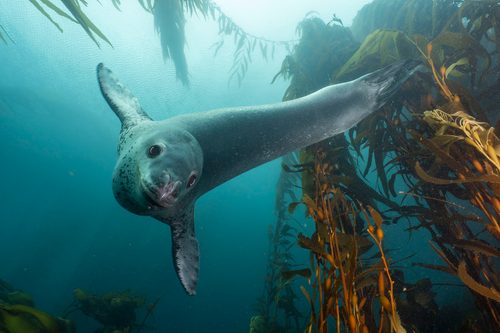
Weddell seals measure about 2.5–3.5 m (8 ft 2 in – 11 ft 6 in) long and weigh 400–600 kg (880–1,320 lb). They are amongst the largest seals, with a rather bulky body and short fore flippers relative to their body length. Males weigh less than females, usually about 500 kg (1,100 lb) or less. Male and female Weddell seals are generally about the same length, though females can be slightly larger. However, the male seal tends to have a thicker neck and a broader head and muzzle than the female. A molecular genetic-based technique has been established to confirm the sex of individuals in the laboratory. The Weddell seal face has been compared to that of a cat due to a short mouth line and similarities in the structure of the nose and whiskers.
Behaviour

Weddell seals are commonly found on fast ice, or ice fastened to land, and gather in small groups around cracks and holes within the ice. In the winter, they stay in the water to avoid blizzards, with only their heads poking through breathing holes in the ice. These seals are often observed lying on their sides when on land. Weddell seals are non-migratory phocids (earless seal) that move regionally to follow the distribution of breathing holes and exit cracks within the ice changes between seasons. The species is primarily restricted to Antarctic waters: physical factors, such as glacial movement and tidal action, may increase fluctuations in distributions.

Reproduction

Weddell seals return to fast ice colonies during the spring for birthing and breeding. Weddell seal populations will often return to the same breeding sites over consecutive breeding seasons. Depending on the latitude it inhabits, this marine mammal gives birth from early September through November, with those living at lower latitudes giving birth earlier. Weddell seals usually give birth to one pup per year, however the Weddell seal is one of the only species of seals that can give birth to twin pups. Birthing of the pup takes only one to four minutes. Newborn pups weigh about 25–30 kg (55–66 lb) and grow to two times their weight within their first week of life. The pups take their first swim around one to two weeks of age. During the first two weeks, mother Weddell seals distinguish their pups through scent and specialised vocalisations, and stay in the same spatial area.

Humans & conservation

Weddell seals are the second most abundant species of Antarctic phocid, after the crabeater seal.

The most recent estimate suggests a population of about 202,000 female seals, based on high-resolution satellite images from November 2011 that cover the full habitat range of the species. This number includes females only, as males are mostly underwater guarding their territories in November. There are likely to be fewer males than females, as the ratio skews towards females with increasing age.

Previous estimates, with lower geographic coverage and thus relying more heavily on extrapolations, tended to be much higher, reporting numbers in the range of 800,000 or so.

Part of

Where to see it

No dive sites list Weddell Seal yet. Explore the map to find sites near you.