
← All marine life
Undulate Ray
Species IUCN · Near Threatened (NT)

Undulate Ray

Raja undulata, Lacepède, 1802

marine

About Undulate Ray

The undulate ray (Raja undulata) is a species of skate and cartilaginous fish found in the Mediterranean and East Atlantic from southern Ireland and England to the Gulf of Guinea. It is found in areas with mud or sand, and may occur as deep as 200 m (660 ft), though it prefers shallower depths. It is considered endangered due to overfishing.

Appearance

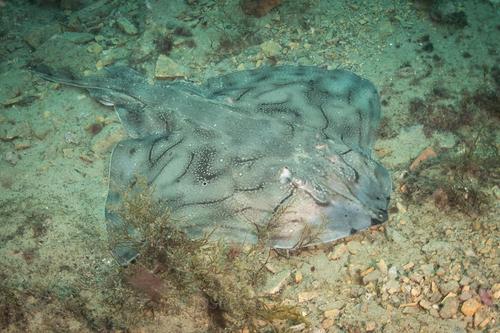
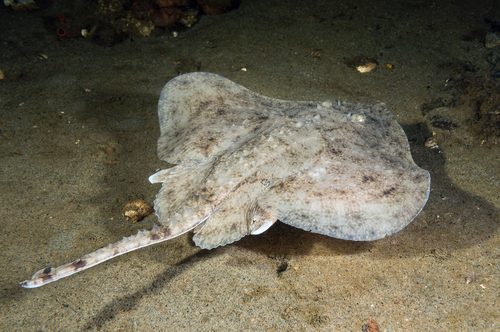
The undulate ray features a disc-shaped body, triangular in the front and near-circular in the rear, and dermal denticles developed as spines for protection. Median spines are scattered in adults, regular on young. The males have one lateral row each side, whereas the females have three. There are 0-2 interdorsal spines. Adult males have alar spines. The eyes are medium-sized and followed by spiracles. The mouth is on the ventral surface and is slightly arched, followed by the five pairs of small gill slits. Tail is as long as body, and has two well separated dorsal fins near its end, usually with two spines between them. The colouring of the dorsal surface varies from light brown to citrine or grey, with darker waved bands and numerous small white patches. Snout and margins are frequently clearer with dark spots. The underside is creamy-white with a greyish margin.
Habitat

This species has a patchy and discontinuous distribution in northeastern Atlantic. It is found from southern Ireland and England to Senegal, and in the western Mediterranean. It is uncommon overall but can be locally abundant, mainly around the north-west of Ireland, in the eastern side of the English Channel, and near the south coast of Portugal. It is also present sporadically across the northern Mediterranean Sea. It is usually found on sandy, muddy or detrital bottoms, at depths of 50–200 m from coastal regions to the upper continental slope, even if it's sometimes possible to find it in shallower water.

Reproduction

During a study it was found that the gonadosomatic index for the females was higher in the winter, which means that this specie reproduces during this season. Females also matured at significantly larger sized and older ages than males.

Humans & conservation

Like other benthonic species of similar size this ray is caught incidentally or intentionally by commercial fisheries using trawls, gillnets, and line gears. It is a common host in public aquariums as fares relatively well.

Part of

Where to see it

No dive sites list Undulate Ray yet. Explore the map to find sites near you.