
← All marine life
Torpedo Scad
Species IUCN · Least Concern (LC)

Torpedo Scad

Megalaspis cordyla, (Linnaeus, 1758)

marinebrackish

About Torpedo Scad

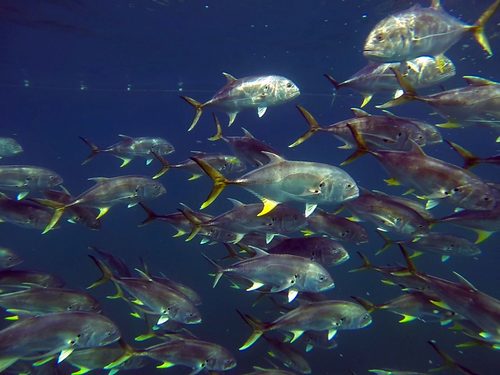
The torpedo scad (Megalaspis cordyla), also known as the hardtail scad, finny scad, finletted mackerel scad or cordyla scad, is a species of moderately large marine fish classified in the jack and horse mackerel family, Carangidae. The torpedo scad is distributed throughout the tropical Indo-Pacific region, ranging from South Africa in the west to Tonga in the east, extending to Japan in the north and Australia in south. It is a schooling pelagic fish which occupies the surface layers of both inshore and offshore oceanic waters. The torpedo scad is easily identified by both its 'torpedo' shaped body and a series of detached finlets at the rear of both the dorsal and anal fins. The largest recorded individual was 80 cm long and weighed 4 kg, although it is more common at lengths less than 40 cm. It is a predatory species, taking a variety of fish, cephalopods and crustaceans by both active and filter feeding. There is a shift in diet as the species grow; however fish is the dominant prey in all size classes. Torpedo scad reach sexual maturity at 22 cm in females and 26.4 cm in males, with spawning occurring between March and July in India, where significant research into larval growth and morphometrics has been carried out.

Appearance

The torpedo scad is a moderately large fish, growing to a maximum recorded length of 80 cm and a weight of 4 kg, however is more common between 30 and 40 cm length. It is rare at lengths greater than 80 cm. The species is often considered to have a rather unusual body form, having features superficially similar to tunas, mackerels and other carangids. The body is elongate and subcylindrical, becoming highly compressed toward the tail and caudal fin, with a marked median keel on the caudal peduncle. The dorsal and ventral profiles of the fish are nearly evenly convex, with the two profiles intersecting at the pointed snout. There are two separate dorsal fins; the first consisting of 8 moderately high spines and the second of a single spine followed by 18 to 20 soft rays. The anal fin consists of two anteriorally detached spines followed by a single spine attached to 16 or 17 soft rays.
Habitat

The torpedo scad is distributed throughout the tropical and subtropical waters of the Indian and west Pacific Oceans. In the west, the range of the species extends from the tip of South Africa north along the east African coastline to the Persian Gulf and Red Sea. Records of the fish are common from most Indian Ocean islands including the Maldives, Seychelles and Madagascar. The species is found along the Indian and Asian coastlines, extending north to China and South Korea on the mainland. It is abundant through the central Indo-Pacific and the Indonesian Archipelago, with its offshore range extending to Taiwan and Japan in the north. Around Australia, torpedo scad have been recorded as far south as Fremantle on the west coast and Sydney on the east coast. The range of the species extends to several eastern Pacific islands including Samoa, New Caledonia and Tonga.

Behaviour

The torpedo scad is an important species to commercial fisheries in parts of Asia, and as such has had significant research published on its biology and ecology. All of this information is published in relatively obscure Indian journals and is unavailable to most institutions. The torpedo scad is a predatory fish which both consumes larger prey and filter feeds to consume planktonic organisms. Larger prey items include a variety of fish and cephalopods including squid and cuttlefish. Smaller foods are mostly crustaceans such as shrimps, prawns, stomatopods, cladocerans and crabs. Molluscs and gastropods are also reported to be minor constituents of the diet of the species. The species also appears to have dietary shifts as it grows, however in all size classes fish are the dominant prey. Species recorded as being predators of torpedo scad include species of drums and requiem shark.

Humans & conservation

The torpedo scad is of major importance to commercial fisheries in the central Indo-Pacific region (including India), and of moderate to minor importance elsewhere. Statistics recorded by the FAO do not include India, however even without this country the annual take of torpedo scad has increased from 70,000 tonnes in 1997 to 107,000 tonnes in 2007. On the basis of these statistics, the biggest utiliser of the species is Indonesia, with a take of 42,000 tonnes followed by Malaysia with a take of 22,000 tonnes. Thailand and the Philippines also take large quantities of the fish, with around 18,000 tonnes each annually. Middle Eastern countries also record this species in their hauls, but at lower amounts of between 50 and 5000 t. In more southerly regions such as South Africa, it is a rare catch, usually appearing in beach seines.

Part of

Where to see it

No dive sites list Torpedo Scad yet. Explore the map to find sites near you.