
← All marine life
Steller Sea Lion
Species IUCN · Near Threatened (NT)

Steller Sea Lion

Eumetopias jubatus, (Schreber, 1776)

marine

About Steller Sea Lion

The Steller sea lion (Eumetopias jubatus), also known as Steller's sea lion or the northern sea lion, is a large, near-threatened species of sea lion, predominantly found in the coastal marine habitats of the northeast Pacific Ocean and the Pacific Northwest regions of North America, from north-central California to Oregon, Washington and British Columbia to Alaska. Its range continues across the Northern Pacific and the Aleutian Islands, all the way to Kamchatka, Magadan Oblast, and the Sea of Okhotsk, south to Honshu's northern coastline. It is the sole member of the genus Eumetopias, and the largest of the so-called eared seals (Otariidae). Among pinnipeds, only the walrus and the two species of elephant seal are bigger. The species is named for the naturalist and explorer Georg Wilhelm Steller, who first described them in 1741. Steller sea lions have attracted considerable attention in recent decades, both from scientists and the general public, due to significant (and largely unexplained) declines in their numbers over an extensive portion of their northern range, notably in Alaska.

Appearance

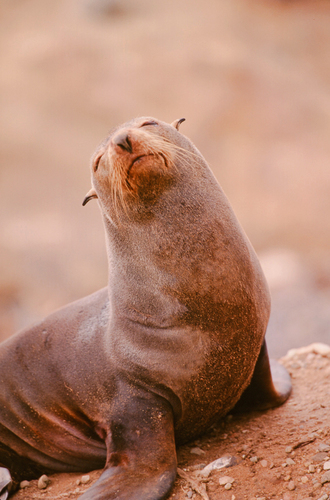
Adult animals are lighter in color than most sea lions, ranging from pale yellow to tawny and occasionally reddish. Steller sea lion pups are born almost black, weighing around 23 kg (51 lb), and remain dark in coloration for several months. Females reach sexual maturity between four and six years of age, while males have a wider window, reaching maturity between three and eight years of age. Females and males both grow rapidly until the fifth year, after which female growth slows considerably. Adult females measure 2.3–2.9 m (7.5–9.5 ft) in length, on average being 2.5 m (8.2 ft), and weigh 240–350 kg (530–770 lb), with an average of 263 kg (580 lb). Males continue to grow until their secondary sexual traits appear in their fifth to eighth year. Males are slightly longer than the females, growing to about 2.82–3.25 m (9.3–10.7 ft) long and averaging 3 m (9.8 ft) in length.
Habitat

The range of the Steller sea lion extends from the north shore of Honshu in Japan to the Gulf of Alaska in the north, down to Año Nuevo Island off the coast of central California and Oregon to the south. They formerly bred as far south as the Channel Islands, but have not been observed there since the 1980s. Based on genetic anаlyses and local migration patterns, the global Steller sea lion population has traditionally been divided into an eastern and western stock at 144°W longitude, roughly through the middle of the Gulf of Alaska. Recent evidence suggests the sea lions in Russia in the Sea of Okhotsk and the Kuril Islands comprise a third Asian stock, while the sea lions on the eastern seaboard of Kamchatka and the Commander Islands belong to the western stock.

Diet

Steller sea lions are top-tier carnivores, but are susceptible to predation, primarily by killer whales. Shark species are also possible predators: Pacific sleeper sharks, salmon sharks and great white sharks may prey on juvenile sea lions.

Behaviour

Steller sea lions tend to live in the coastal waters of the subarctic because of the cooler temperate climate of the area. Like all otariids, Steller sea lions are amphibious and spend some time in water and some on land. Typically, Steller sea lions spend their time in the water feeding but haul-out onto land to reproduce, raise their pups, molt, and rest. Steller sea lions usually congregate on isolated islands because they are the ideal terrestrial habitat. These isolated islands are preferred by Steller sea lions because they can avoid predation from terrestrial predators, easily thermoregulate (by means of cooling winds), and access offshore prey more easily. Some haul-out sites, known as rookeries, are commonly used for reproduction while other haul-out sites are used for other purposes like molting.

Humans & conservation

Steller sea lion were hunted for meat and other commodities by prehistoric communities everywhere their range intersected with human communities. Aside from food and clothing, their skin was used to cover baidarkas and kayaks. A subsistence harvest on the order of 300 animals or less continues to this day in some native communities in Alaska.

Historically, the sea lion has had only very slight commercial value. For example, in the 19th century their whiskers sold for a penny apiece for use as tobacco-pipe cleaners.

Part of

Where to see it

No dive sites list Steller Sea Lion yet. Explore the map to find sites near you.