
← All marine life
Squaretail Coralgrouper
Species IUCN · Vulnerable (VU)

Squaretail Coralgrouper

Plectropomus areolatus, (Rüppell, 1830)

marine

About Squaretail Coralgrouper

The squaretail coral grouper (Plectropomus areolatus) is a species of marine ray-finned fish. It is a grouper from the subfamily Epinephelinae, which is part of the family Serranidae. This family also includes anthias and sea basses. The squaretail coral grouper is also known as the spotted coral trout or the squaretail coral trout, and is fast-growing, short-lived, and early-maturing. However, due to the continued decrease in its population, it is now classified as vulnerable, as it continues to face threats from human activity.

Appearance

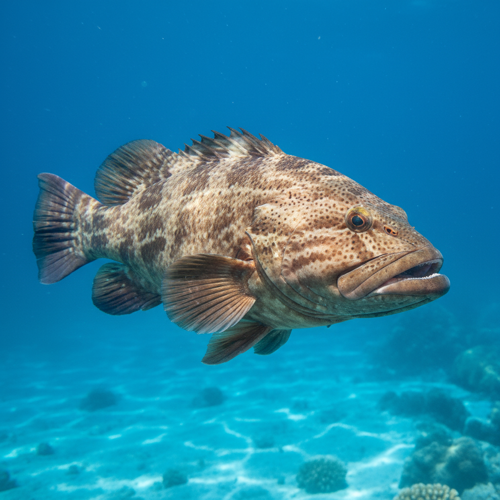
The squaretail coral grouper has a long body. At first maturity, it is around 36.65 cm long and weighs around 771.2 grams, but it can grow to a maximum length of 80 cm, with the female fish usually larger in length. It is characterized by having 7 to 8 dorsal spines and 10 to 12 soft rays, while the anal fin has 3 spines and 8 soft rays. It has 1 to 4 canines on the upper jaw. The caudal fin (tail) is truncated, ending in a vertical edge, which gives this fish its name. There are also a variety of possible colors that the squaretail coral grouper can exhibit, ranging from a whitish gray color with dark spots to a greenish-gray or a red and brown pattern. Its fins are dark brown in color.
Habitat

The squaretail coral grouper is commonly found in the western Pacific, including the waters around Japan, southeastern China, the Philippines, Indonesia, and Australia. It is also found in the Indian Ocean, near East Africa.

Squaretail coral groupers live in shallow lagoonal and seaward coral-rich areas, especially in channels at the reef front. They are often widely distributed in coral reefs or rocky reefs in tropical and subtropical waters. They typically live in depths ranging from 1 to 70 m (3 ft 3 in to 229 ft 8 in) in the marine neritic, the nearshore marine environment that reaches depths of 200m along the continental shelf.

Diet

The squaretail coral grouper is mainly a piscivore, meaning it eats other fish. It hunts like other groupers do, by creating a suction that pulls fish into its mouth and most often hunts alone.

Reproduction

The peak spawning season of the squaretail coral grouper is from January to April for 2 to 3 months. The spawning times occur during new and full moons, which may suggest a linkage to associated high tidal variation and flow to enhance dispersal or retention. Thus, similar to temperature, specific lunar periodicity lacks dependability as an indicator of spawning times and demonstrates the variability within the species for reproduction relative to lunar periodicity. While some regional similarities exist, temperature profiles cannot be used reliably as an indicator of spawning in these species, because the temperature profiles during reproductive periods vary.

Humans & conservation

Humans are the main threat to the squaretail coral grouper. The squaretail coral grouper is a highly sought out fish in the food industry, with its consumption most common in southern China. Squaretail coral groupers have a slow maturation and long life span, meaning that they cannot easily replenish their population when overfished. Overfishing is the leading cause of these groupers' vulnerable status, especially when the spawning sites are targeted. They are one of the most common members of the Plectropomus genus to be sold in restaurants.

Part of

Where to see it

No dive sites list Squaretail Coralgrouper yet. Explore the map to find sites near you.