← All marine life
Spotted Seal
Species IUCN · Least Concern (LC)

Spotted Seal

Phoca largha, Pallas, 1811

marine

About Spotted Seal

The spotted seal (Phoca largha), also known as the larga seal or largha seal, is a species of earless seal (or true seal, Phocidae). It inhabits ice floes and waters of the north Pacific Ocean and adjacent seas. It is primarily found along the continental shelf of the Beaufort, Chukchi, Bering and Okhotsk Seas and south to the northern Yellow Sea and it migrates south as far as northern Huanghai and the western Sea of Japan. It is also found in Alaska from the southeastern Bristol Bay to Demarcation Point during the ice-free seasons of summer and autumn when spotted seals mate and have pups. Smaller numbers are found in the Beaufort Sea. It is sometimes mistaken for the harbor seal to which it is closely related and spotted seals and harbor seals often mingle together in areas where their habitats overlap.

The reduction in arctic ice floes due to global warming led to concerns that the spotted seal was threatened with extinction. Studies were conducted on its population numbers, with the conclusion, as of 15 October 2009, that the spotted seal population in Alaskan waters is not currently to be listed as endangered by NOAA. However, as of 2026, the NOAA considers the distinct population group of southern spotted seals to be threatened.

Appearance

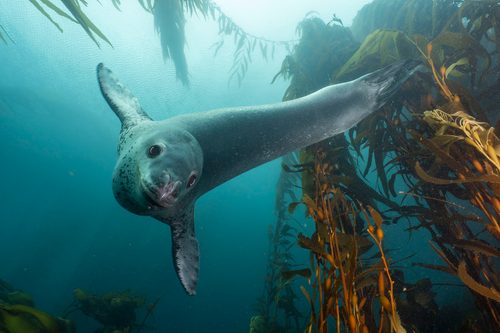
The spotted seal is of the family, Phocidae, or "true seals". Compared to other true seals, they are intermediate in size, with mature adults of both sexes generally weighing between 82–109 kg (180–240 lb) and measuring 150–210 cm (59–83 in), roughly the same size as a harbor seal or ribbon seal. The head of a spotted seal is round, with a narrow snout resembling that of a dog.

Habitat

Spotted seals are inhabitants of arctic or sub-arctic waters, often in the outer areas of ice floes during the breeding season. They tend not to live within dense drift ice. In the summer months they live in the open ocean or on nearby shores.

Behaviour

Spotted seals are relatively shy and are difficult for humans to approach. They can be solitary in general but are gregarious and form large groups during pupping and molting seasons when they haul out on ice floes or, if lacking ice, on land. The numerically largest groups in Alaska are at Kasegaluk Lagoon in the Chukchi Sea, near Cape Espenburg in Kotzebue Sound, and in Kuskokwim Bay on sandbars and shoals, where several thousand may collect.

Humans & conservation

On 28 March 2008, the U.S. National Oceanic and Atmospheric Administration (NOAA) initiated a status review under the Endangered Species Act (ESA) to determine if listing this ice seal species under the ESA was warranted. After an 18-month review of the status of the spotted seal, NOAA announced on 15 October 2009 that two of the three spotted seal populations, together numbering 200,000 seals in or adjacent to Alaska, are not in danger of becoming extinct, nor are they likely to become so in the "foreseeable future", even though global warming has caused a loss in arctic ice mass. The announcement stated: "We do not predict the expected fluctuations in sea ice will affect them enough to warrant listing at this time." However, a distinct population group of spotted seals off the coast of Russia and China is listed as threatened under the Endangered Species Act.

Part of

Where to see it

No dive sites list Spotted Seal yet. Explore the map to find sites near you.