
← All marine life
Spotfin Scad
Species IUCN · Least Concern (LC)

Spotfin Scad

Caranx rhonchus, Geoffroy Saint-Hilaire, 1817

marinebrackish

About Spotfin Scad

The false scad (Caranx rhonchus), also known as the spotfin scad, ten-finned horse mackerel and yellow horse mackerel, is a species of medium-sized marine fish classified in the jack family Carangidae. The false scad is distributed throughout the tropical and temperate waters of the eastern Atlantic Ocean from Namibia in the south to Spain and throughout most of the Mediterranean in the north. The species has an atypical body form compared to other species of Caranx, and can be distinguished from these on its elongate 'scad-like' body shape alone. Distinguishing the species from members of Decapterus and Trachurus is more difficult, requiring detailed anatomical analysis. The false scad is known to grow to a length of 60 cm and a weight of 1 kg. The species lives both pelagically and demersally in continental shelf waters, ranging from depths of 15 to 200 m. It is a predatory fish, taking small fishes, crustaceans including euphausiids and shrimps, and cephalopods as its main prey, with significant dietary shifts as it ages. The false scad reaches sexual maturity at 2 years of age, with spawning occurring between April and July in shallow inshore waters, where the juveniles remain. The species is of major importance to fisheries throughout its range, but particularly from Morocco to Senegal, with annual catches ranging from 500 to 19000 t. The species is caught using trawls, seine nets and gill nets and sold fresh, frozen or salted.

Appearance

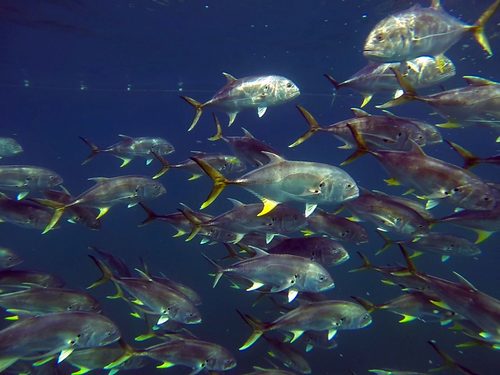
The false scad is a moderately large species, growing to a known maximum length of 60 cm and a weight of 1 kg, although is more common at lengths of around 35 cm. The species has a much different body profile to most other species of Caranx, possessing an elongate, slightly compressed body in place of the deep, oblong shaped forms of its larger relatives. The species dorsal profile is approximately as equally convex as the ventral profile. The dorsal fin is in two distinct parts, the first consisting of 8 spines while the second has 1 spine and 28 to 32 soft rays. The anal fin consists of 2 detached spines anteriorly, followed by 1 spine and 25 to 28 soft rays. The soft rays located at the end of both the dorsal and anal fins are detached and only connected by a basal interradial membrane, forming a partially detached finlet. The pectoral and pelvic fins are both short.
Habitat

The false scad is distributed throughout the tropical and temperate waters of the eastern Atlantic Ocean, although the species is more abundant in certain regions of its range. The species has been reported from as far south as Namibia, but southern Angola appears to be the furthest south the species normally ventures. It is distributed north along the west African coastline, reaching as far north as Spain in Europe, with its range also extending well into the Mediterranean Sea. Here it is known as far east as Turkey, Egypt and Israel and as far north as Italy, Greece and Albania.

Diet

It is a predatory species, with several studies conducted to determine its diet and feeding habits. A study in the Cape Blanc region found Branchiostoma lanceolatum (a cephalochordate), euphausiids, small fish and other small crustaceans were the predominantly taken food items, with a surprising absence of copepods which other small species included in the study did take. This lack of copepods in the false scad's diet was also noticed in an earlier similar study, which looked at the diet of slightly smaller fish. A much later study in the same location found similar results, with fish being the most common prey followed by crustaceans including shrimps and mysids, molluscs and annelids.

Reproduction

The false scad reaches sexual maturity during its second year of life at a length of around 20 cm in both sexes. The timing of spawning appears to vary slightly between locations, with a study in the Mediterranean indicating a period from June to August, while a study off Senegal found the period to be more protracted, occurring from April to November. Spawning occurs in shallow inshore waters, with the event occurring at an optimum water temperatures of 18.7 degrees Celsius. Studies on females between 29 and 35 cm in length found each fish releases between 480,000 and 990,000 eggs, with the species a partial spawner, in which a proportion of the mature oocytes are not released from the ovary and are instead reabsorbed by the female. Larvae and juveniles remain in the shallow water environment, with growth quite rapid in the species.

Humans & conservation

The false scad is of major importance to commercial fisheries throughout its range, with fisheries off Morocco, Senegal and in the Mediterranean taking the highest numbers of fish. They are fished for primarily with trawls, purse seines and gill nets; although juveniles occasionally turn up inshore nets such as beach seines. The species is part of a number of fish that live a similar semi-pelagic lifestyle that make up what is often referred to as a 'small pelagics fishery'. Some of these are the similar Trachurus species, and due to these also being present in the catch, Caranx rhonchus is often not differentiated, leading to lower than accurate catch statistics. Furthermore, vendors are known to fraudulently market C. rhonchus as 'horse mackerel', which is strictly applied to members of Trachurus.

Part of

Where to see it

No dive sites list Spotfin Scad yet. Explore the map to find sites near you.