
← All marine life
Southern Elephant Seal
Species IUCN · Vulnerable (VU)

Southern Elephant Seal

Mirounga leonina, (Linnaeus, 1758)

marine

About Southern Elephant Seal

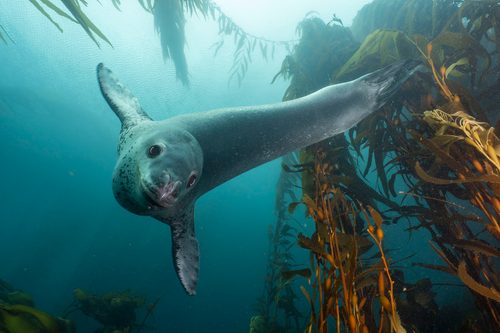
The southern elephant seal (Mirounga leonina) is one of two species of elephant seals. It is the largest member of the clade Pinnipedia and the order Carnivora, as well as the largest extant marine mammal that is not a cetacean. It gets its name from its massive size and the large proboscis of the adult male, which is used to produce very loud roars, especially during the breeding season. A bull southern elephant seal is about more than twice the weight of a male northern elephant seal (Mirounga angustirostris) as large sub-adult southern elephant seals have weighed 3 tons, as well as more than twice the weight of a male Pacific walrus (Odobenus rosmarus divergens).

Appearance

The southern elephant seal is distinguished from the northern elephant seal (which does not overlap in range with this species) by its greater body mass and a shorter proboscis. The southern males also appear taller when fighting, due to their tendency to bend their backs more strongly than the northern species. This species may also exhibit the greatest sexual dimorphism of any mammal in terms of mass ratio, with males typically four to five times heavier than females. On average female southern elephant seals weigh 350 to 900 kg (770 to 1,980 lb) and measure 2.6 to 3 m (8.5 to 9.8 ft) long, whereas adult bulls can range from 3,000 to 3,700 kg (6,600 to 8,200 lb) and grow to 4.6 to 5.8 m (15 to 19 ft) in length if including rear flippers.
Habitat

Southern elephant seal world population was estimated at 650,000 in the mid-1990s, and was estimated in 2005 at between 664,000 and 740,000. As of 2025, the population has been estimated at close to 700,000 globally. Studies have shown the existence of three geographic subpopulations, one in each of the three oceans.

Tracking studies have indicated the routes traveled by elephant seals, demonstrating their main feeding area is at the edge of the Antarctic continent. While elephant seals may come ashore in Antarctica occasionally to rest or to mate, they gather to breed in subantarctic locations.

Diet

Satellite tracking revealed the seals spend very little time on the surface, usually a few minutes for breathing. They dive repeatedly, each time for more than 20 minutes, to hunt their prey—squid and fish—at depths of 400 to 1,000 m (1,300 to 3,300 ft). They are the deepest diving air-breathing non-cetaceans and have been recorded at a maximum of 2,388 m (7,835 ft) in depth.

As for the duration, depth and sequence of dives, the southern elephant seal is the best performing seal. In many regards, they exceed even most cetaceans. These capabilities result from nonstandard physiological adaptations, common to marine mammals, but particularly developed in elephant seals. The coping strategy is based on increased oxygen storage and reduced oxygen consumption.

Behaviour

Elephant seals are among the seals that can stay on land for the longest periods of time, as they can stay dry for several consecutive weeks each year. Males arrive in the colonies earlier than the females and fight for control of harems when they arrive. Large body size confers advantages in fighting, and the agonistic relationships of the bulls gives rise to a dominance hierarchy, with access to harems and activity within harems being determined by rank. The dominant bulls ("harem masters") establish harems of several dozen females. The least successful males have no harems, but they may try to copulate with a harem male's females when the male is not looking. The majority of primiparous females and a significant proportion of multiparous females' mate at sea with roaming males away from harems.

Humans & conservation

After their near extinction due to hunting in the 19th century, the total population was estimated at between 664,000 and 740,000 in 2005. The reasons for this are unclear, but are thought to be related to the distribution and declining levels of the seals' primary food sources. As of 2025 the ICUN red list, the regional population trend is increasing, and has been downlisted compared to 2016. Most of their important breeding sites are now protected by international treaty, as UNESCO World Heritage Sites, or by national legislation.

Part of

Where to see it

No dive sites list Southern Elephant Seal yet. Explore the map to find sites near you.