
← All marine life
South American Sea Lion
Species IUCN · Least Concern (LC)

South American Sea Lion

Otaria flavescens, (de Blainville, 1820)

marine

About South American Sea Lion

The South American sea lion (Otaria flavescens, formerly Otaria byronia), also called the southern sea lion and the Patagonian sea lion, is a sea lion found on the western and southeastern coasts of South America. It is the only extant member of the genus Otaria, which also includes the extinct Otaria josefinae. The species is highly sexually dimorphic. Males have a large head and prominent mane. They mainly feed on fish and cephalopods and haul out on sand, gravel, rocky, or pebble beaches. Breeding males typically defend both territories and individual females, though this can vary. Less dominant males may try to achieve success by causing chaos in the group. The overall population of the species is considered stable, estimated at 265,000 animals.

Appearance

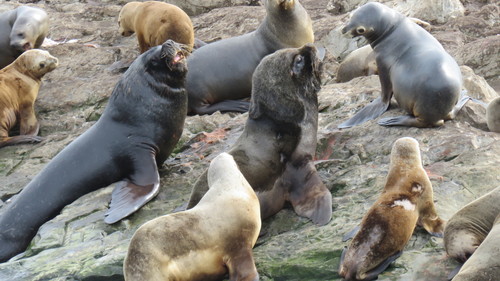
The South American sea lion is among the largest of and most sexually dimorphic of the eared seals. Males measure up to 3 m (9.8 ft) in length with a weight of 350 kg (770 lb) while females reach a length 2 m (6 ft 7 in) and reach 150 kg (330 lb) in weight. Pups are born 0.86 m (2 ft 10 in) long and weigh 12–15 kg (26–33 lb). Size differences between the sexes exists in both newborns and juveniles.

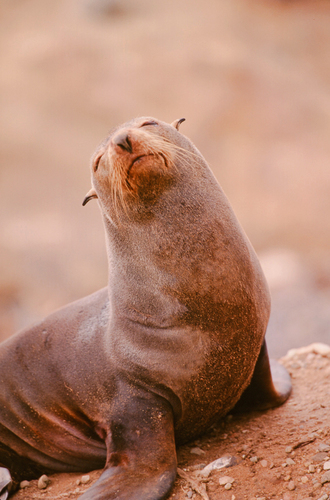
Adult males have large heads with short, upturned snouts and long manes which reach the shoulders. The fur is mainly brownish with adult males being dark brown and females being nearly yellowish. Pups are born black but become reddish-brown after their first molt.
Behaviour

The South American sea lion is found along the coasts and offshore islands of South America, from Peru south to Cape Horn and then north to southern Brazil. Notable breeding colonies include Lobos Island, Uruguay; Peninsula Valdes, Argentina; Beagle Channel, and the Falkland Islands. Some individuals wander as far north as southern Ecuador, although apparently they never bred there. However, the movement ecology of South American sea lions remains poorly understood, although biologging studies in recent years have advanced our understanding of their at-sea movements at some breeding locations. There is no evidence of a winter migration of sea lions from the Falkland Islands.

Humans & conservation

The Moche people of ancient Peru worshipped the sea and its animals. They often depicted South American sea lions in their art. Two statues of this species are the symbol of the city of Mar del Plata.

This species was exploited by Indigenous peoples of South America for millennia and by Europeans around the 16th century. The hunting has since gone down and the species is no longer threatened. The species is protected in most of its range. Numerous reserves and protected areas at rookeries and haul-out sites exist for the sea lions. Despite this, protection regulations are not effectively enforced in much of animals' range.

Part of

Where to see it

No dive sites list South American Sea Lion yet. Explore the map to find sites near you.