
← All marine life
Short-Finned Pilot Whale
Species IUCN · Least Concern (LC)

Short-Finned Pilot Whale

Globicephala macrorhynchus, Gray, 1846

marine

About Short-Finned Pilot Whale

The short-finned pilot whale (Globicephala macrorhynchus) is one of the two species of cetaceans in the genus Globicephala, which it shares with the long-finned pilot whale (G. melas). It is part of the oceanic dolphin family (Delphinidae).

It has a worldwide distribution with a global population of about 700,000, and there may be 3 or 4 distinct populations—two in the Pacific and one in the Atlantic and Indian Oceans. Its range is moving northward due to global warming. In the Pacific, males average 4–6 m (13–20 ft) and females 3–5 m (9.8–16.4 ft). It generally has a stocky build with black to dark gray or brown skin, and can be distinguished from its counterpart by shorter flippers, fewer teeth, and a shorter beak. It is thought to pursue fast-moving squid typically at a depth of 700 m (2,300 ft), but the maximum recorded depth is 1,018 m (3,340 ft).

The short-finned pilot whale has been reported as being highly playful and social. It typically travels in pods of 10–30 members, usually family, but has been observed moving in groups of several hundred. Like killer whales, it has a matrilineal social hierarchy with an elder female at the head and a sizable post-reproductive lifespan. It is polygynous; females often outnumber males 8:1 in a pod.

Pods are known to mass strand, possibly due to sheer accident, biosonars confused by geomagnetic anomalies, injury from loud military sonar, or disease. It was historically whaled, and is still whaled today by Japan and the Lesser Antilles, but it is protected by several international treaties.

Appearance

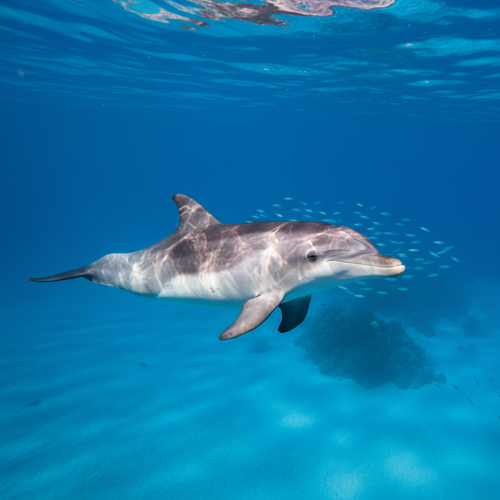
Short-finned pilot whales are black to dark gray/brown, with a thick tail stock, fluke with sharply pointed tips, bulbous head, and a broad, sickle-shaped dorsal fin. Coloration typically includes light grey to white areas such as a saddle patch behind the dorsal fin, a light grey or white anchor-shaped patch under the chin and belly, and a blaze marking behind the eye. These traits, however, can vary between populations. For example, two distinct forms are described from on the Pacific coast of central Japan: the Shiho morphotype is the larger of the two– females 4 to 5 m (13 to 16 ft), males 5 to 6 m (16 to 20 ft), and has a white dorsal patch and round melon, while the Naisa type is smaller– females 3 to 4 m (10 to 13 ft), males 4 to 5 m (13 to 16 ft)– with a characteristic flattened or squarish melon and a darker, indistinct saddle patch.
Habitat

Short-finned pilot whales are found in both coastal and pelagic waters in temperate and tropical regions of the Indian, Atlantic, and Pacific Oceans. Information on the spatial habitat use of pilot whales in the northwest Atlantic is limited, however short-finned pilot whales are thought to range from the southern end of Georges Bank into the tropics, overlapping with the range of the long-finned pilot whales along the mid-Atlantic shelf break between Delaware and Georges Bank.

Behaviour

Short-finned pilot whales are long-lived, slow to reproduce, and highly social animals. They are usually found in pods of 10 to 30 individuals, though groups of up to several hundred short-finned pilot whales have been reported in the Caribbean. These pods are stable social structures, meaning that they form hierarchical associations that remain stable for generations, and are primarily thought to be matrilineal, i.e. led by an elder female relative, similar to those of resident killer whales. However, a study by Van Cise et al. (2017) showed that, in the Hawaii islands, the social organization of pods was indicative of familial behaviour rather than matrilineal, and was driven by genetic relatedness.

Reproduction

Males are polygynous, meaning they will mate with multiple females at one time and throughout their lives. Pods are often found with around one mature male per every eight mature females. During mating aggregations, males will temporarily leave their pods to mate with females from other pods, but will return to their own pods once mating is over, which helps to prevent inbreeding. Female pilot whales mature at about 7–12 years of age, and will start having calves every five to eight years, averaging about 4 to 5 calves in a lifetime. A calf will suckle its mother for a minimum of two years, with most continuing to suckle for five years, and some evidence suggests that females may continue to lactate for up to 15 years after the birth of their last calf. A female will usually stop reproducing once reaching the age of 40 years, even though the maximum lifespan exceeds 60 years.

Humans & conservation

The total of all available abundance estimates for short-finned pilot whales is approximately 700,000 individuals, but populations vary worldwide, and large parts of the species' range have not been surveyed, therefore actual abundance could be considerably greater than this.

In the western Pacific, population estimates range from 5,300 individuals in Northern Japan to 53,608 in Southern Japan. 7,700 individuals are reported in the eastern Sulu Sea (Philippines), and in the Eastern tropical Pacific the most recent estimate from 2000 gives 589,000 individuals. The resident population in Tenerife, Spain, is estimated at only 350 individuals.

Part of

Where to see it

No dive sites list Short-Finned Pilot Whale yet. Explore the map to find sites near you.