
← All marine life
Sei Whale
Species IUCN · Endangered (EN)

Sei Whale

Balaenoptera borealis, Lesson, 1828

marine

About Sei Whale

The sei whale ( SAY; Balaenoptera borealis) is a baleen whale. It is one of ten rorqual species, and the third-largest member after the blue and fin whales. It can grow to 19.5 m (64 ft) in length and weigh as much as 28 t (28 long tons; 31 short tons). Two subspecies are recognized: B. b. borealis and B. b. schlegelii. The whale's ventral surface has sporadic markings ranging from light grey to white, and its body is usually dark steel grey in colour. It is among the fastest of all cetaceans, and can reach speeds of up to 50–55 km/h (31–34 mph) over short distances.

It inhabits most oceans and adjoining seas, and prefers deep offshore waters. It avoids polar and tropical waters and semi-enclosed bodies of water. The sei whale migrates annually from cool, subpolar waters in summer to temperate, subtropical waters in winter with a lifespan of 70 years. It is a filter feeder, with its diet consisting primarily of copepods, krill, and other zooplankton. It is typically solitary or can be found in groups numbering half a dozen. During the breeding period, a mating pair will remain together. Sei whale vocalizations usually last approximately half a second, and occur at 240–625 hertz.

Appearance

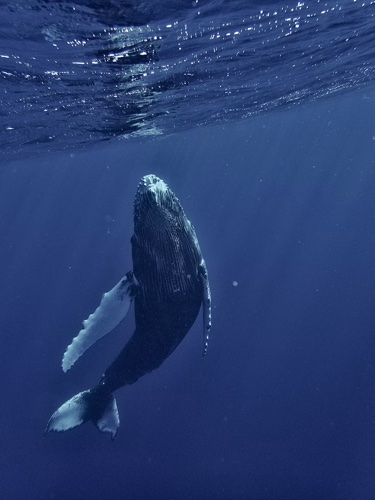
The sei whale's body is typically a dark steel grey with irregular light grey to white markings on the ventral surface, or towards the front of the lower body. The whale has a relatively short series of 32–60 pleats or grooves along its ventral surface that extend halfway between the pectoral fins and umbilicus (in other species it usually extends to or past the umbilicus), restricting the expansion of the buccal cavity during feeding compared to other species. The rostrum is pointed and the pectoral fins are relatively short, only 9–10% of body length, and pointed at the tips. Sei whales have a solitary ridge extending from the tip of the rostrum to the paired blowholes that are a distinctive characteristic of baleen whales.
Habitat

Sei whales live in all oceans, although rarely in polar or tropical waters. The difficulty of differentiating them at sea from their close relatives, Bryde's whales and in some cases from fin whales, creates confusion about their range and population, especially in warmer waters where Bryde's whales are most common.

In the North Atlantic, its range extends from southern Europe or northwestern Africa to Norway, and from the southern United States to Greenland. The southernmost confirmed records are strandings along the northern Gulf of Mexico and in the Greater Antilles. It rarely enters the Mediterranean Sea and the Gulf of Mexico, which are both considered to be small waterbodies. Sei whales are pelagic and are typically found in basins in oceans or open seas.

Diet

This rorqual is a filter feeder, using its baleen plates to obtain its food by opening its mouth, engulfing or skimming large amounts of the water containing the food, then straining the water out through the baleen, trapping any food items inside its mouth.

Behaviour

Very little is known about the sei whale social structure. They have been documented traveling alone or in pods of up to six individuals; larger groups may assemble at particularly abundant feeding grounds. During the southern Gulf of Maine influx in mid-1986, groups of at least three sei whales were observed "milling" on four occasions – i.e. moving in random directions, rolling, and remaining at the surface for over 10 minutes. One whale would always leave the group during or immediately after such socializing bouts. The sei whale is among the fastest cetaceans. The American naturalist Roy Chapman Andrews compared the sei whale to the cheetah, because it can swim at great speeds "for a few hundred yards", but it "soon tires if the chase is long" and "does not have the strength and staying power of its larger relatives".

Reproduction

Mating occurs in temperate, subtropical seas during the winter. Gestation is estimated to vary around 103⁄4 months, 111⁄4 months, or one year. During the breeding period, a mating pair will remain together.

A newborn is weaned from its mother at 6–9 months of age, when it is 8–9 m (26–30 ft) long, so weaning takes place at the summer or autumn feeding grounds. Females reproduce every 2–3 years, usually to a single calf. In the Northern Hemisphere, males are usually 12.8–12.9 m (42–42 ft) and females 13.3–13.5 m (44–44 ft) at sexual maturity, while in the Southern Hemisphere, males average 13.6 m (45 ft) and females 14 m (46 ft). The average age of sexual maturity of both sexes is 5.6–11.7 years. The whales can reach ages up to 70 years. The documented oldest living sei whale was 74 years old.

Humans & conservation

The sei whale is listed by the IUCN Red List as endangered, and with an increasing population trend, as of 2018. The sei whale did not have meaningful international protection until 1970, when the International Whaling Commission first set catch quotas for the North Pacific for individual species. Before quotas, there were no legal limits. Complete protection from commercial whaling in the North Pacific came in 1976.

Part of

Where to see it

No dive sites list Sei Whale yet. Explore the map to find sites near you.