
← All marine life
Seaweed
Group

Seaweed

Phaeophyceae, Kjellman, 1891

marinebrackishfreshwater
Where to see it

About Seaweed

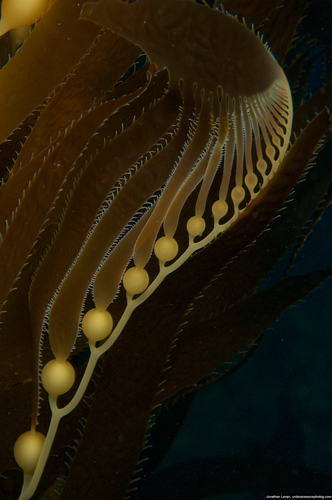
Brown algae (sing.: alga) are a large group of photoautotrophic, multicellular SAR comprising the class Phaeophyceae. They include many seaweeds located in colder waters of the Northern Hemisphere. Brown algae are the major seaweeds of the temperate and polar regions. Many brown algae, such as members of the order Fucales, commonly grow along rocky seashores. Most brown algae live in marine environments, where they play an important role both as food and as a potential habitat. For instance, Macrocystis, a kelp of the order Laminariales, may reach 60 m (200 ft) in length and forms prominent underwater kelp forests that contain a high level of biodiversity. Another example is Sargassum, which creates unique floating mats of seaweed in the tropical waters of the Sargasso Sea that serve as the habitats for many species. Some members of the class, such as kelps, are used by humans as food.

Between 1,500 and 2,000 species of brown algae are known worldwide. Some species, such as Ascophyllum nodosum, have become subjects of extensive research in their own right due to their commercial importance. They also have environmental significance through carbon fixation.

Appearance

Brown algae exist in a wide range of sizes and forms. The smallest members of the group grow as tiny, feathery tufts of threadlike cells no more than a few centimeters (a few inches) long. Some species have a stage in their life cycle that consists of only a few cells, making the entire alga microscopic. Other groups of brown algae grow to much larger sizes. The rockweeds and leathery kelps are often the most conspicuous algae in their habitats. Kelps can range in size from the 60-centimeter-tall (2 ft) sea palm Postelsia to the giant kelp Macrocystis pyrifera, which grows to over 50 m (150 ft) long and is the largest of all the algae. In form, the brown algae range from small crusts or cushions to leafy free-floating mats formed by species of Sargassum.
Behaviour

Brown algae have adapted to a wide variety of marine ecological niches including the tidal splash zone, rock pools, the whole intertidal zone and relatively deep near shore waters. They are an important constituent of some brackish water ecosystems, and have colonized freshwater on a minimum of six known occasions. A large number of Phaeophyceae are intertidal or upper littoral, and they are predominantly cool and cold water organisms that benefit from nutrients in up welling cold water currents and inflows from land; Sargassum being a prominent exception to this generalisation.

Brown algae growing in brackish waters are almost solely asexual.

Reproduction

Most brown algae, with the exception of the Fucales, perform sexual reproduction through sporic meiosis. Between generations, the algae go through separate sporophyte (diploid) and gametophyte (haploid) phases. The sporophyte stage is often the more visible of the two, though some species of brown algae have similar diploid and haploid phases. Free floating forms of brown algae often do not undergo sexual reproduction until they attach themselves to substrate. The haploid generation consists of male and female gametophytes. The fertilization of egg cells varies between species of brown algae, and may be isogamous, oogamous, or anisogamous. Fertilization may take place in the water with eggs and motile sperm, or within the oogonium itself.

Where to see it

Top-rated dive sites where divers have spotted Seaweed.

Kurnell

Kurnell

⭐ 4.5 (2)
Shallow Botany Bay site, diverse macro life, seahorses, seagrass.
👣 Shore Beginner
Cala Berretta

Cala Berretta

⭐ 4.0 Scout Score
Italy, San Vito Lo Capo Zingaro Nature Reserve
Excellent snorkeling in a natural reserve with vibrant rocky bottom.
🚤 Shore & Boat All levels
Isola dei Conigli

Isola dei Conigli

⭐ 4.0 Scout Score
Italy, Lampedusa Area Marina Protetta Isole Pelagie
Beautiful shallow protected reserve with excellent visibility and rich biodiversity.
🚤 Shore & Boat Beginner