
← All marine life
Sea Otter
Species IUCN · Endangered (EN)

Sea Otter

Enhydra lutris, (Linnaeus, 1758)

marine

About Sea Otter

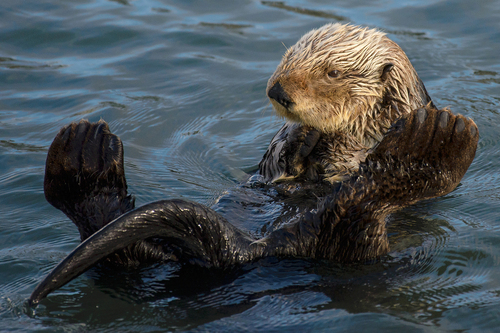
The sea otter (Enhydra lutris) is a marine mammal native to the coasts of the northern and eastern North Pacific Ocean. Adult sea otters typically weigh between 14 and 45 kg (30–100 lb), making them the heaviest members of the weasel family, but among the smallest marine mammals. Unlike most marine mammals, the sea otter's primary form of insulation is an exceptionally thick coat of fur, the densest in the animal kingdom. Although it can walk on land, the sea otter is capable of living exclusively in the ocean.

The sea otter inhabits nearshore environments, where it dives to the sea floor to forage. It preys mostly on marine invertebrates such as sea urchins, various mollusks and crustaceans, and some species of fish. Its foraging and eating habits are noteworthy in several respects. Its use of rocks to dislodge prey and to open shells makes it one of the few mammal species to use tools. In most of its range, it is a keystone species, controlling sea urchin populations which would otherwise inflict extensive damage to kelp forest ecosystems. Its diet includes prey species that are also valued by humans as food, leading to conflicts between sea otters and fisheries.

Appearance

The sea otter is one of the smallest marine mammal species. Male sea otters usually weigh 22 to 45 kg (49–99 lb) and are 1.2 to 1.5 m (47–59 in) in length, though specimens up to 54 kg (119 lb) have been recorded. Females are smaller, weighing 14 to 33 kg (31–73 lb) and measuring 1.0 to 1.4 m (39–55 in) in length. The average weight for adult sea otters that are in more densely populated areas, at 28.3 kg (62 lb) in males and 21.1 kg (47 lb) in females, was considerably lighter than the average weight of otters in more sparse populations, at 39.3 kg (87 lb) in males and 25.2 kg (56 lb) in females Presumably less populous otters are more able to monopolize food sources, For its size, the male otter's baculum is very large, massive and bent upwards, measuring 150 mm (5+7⁄8 in) in length and 15 mm (9⁄16 in) at the base.
Habitat

Sea otters live in coastal waters 15 to 23 metres (49–75 ft) deep, and usually stay within a kilometre (2⁄3 mi) of the shore. They are found most often in areas with protection from the most severe ocean winds, such as rocky coastlines, thick kelp forests, and barrier reefs. Although they are most strongly associated with rocky substrates, sea otters can also live in areas where the sea floor consists primarily of mud, sand, or silt. Their northern range is limited by ice, as sea otters can survive amidst drift ice but not land-fast ice. Individuals generally occupy a home range a few kilometres long, and remain there year-round.

Diet

The leading mammalian predator of this species is the orca. Sea lions and bald eagles may prey on pups. On land, young sea otters may face attack from bears and coyotes. In California, great white sharks are their primary predator, though this is the result of investigatory bites or mistaking otters for seals and they do not consume otters after biting them. In Katmai National Park, grey wolves have been recorded to hunt and kill sea otters.

Urban runoff transporting cat feces into the ocean brings Toxoplasma gondii, an obligate parasite of felids, which has killed sea otters. Parasitic infections of Sarcocystis neurona are also associated with human activity. According to the U.S. Geological Survey and the CDC, northern sea otters off Washington have been infected with the H1N1 flu virus and "may be a newly identified animal host of influenza viruses".

Behaviour

The sea otter is diurnal. It has a period of foraging and eating in the morning, starting about an hour before sunrise, then rests or sleeps in mid-day. Foraging resumes for a few hours in the afternoon and subsides before sunset, and a third foraging period may occur around midnight. Females with pups appear to be more inclined to feed at night. Observations of the amount of time a sea otter must spend each day foraging range from 24% to 60%, apparently depending on the availability of food in the area.

Reproduction

Sea otters are polygynous: males have multiple female partners, typically those that inhabit their territory. If no territory is established, they seek out females in estrus. When a male sea otter finds a receptive female, the two engage in playful and sometimes aggressive behavior. They bond for the duration of estrus, or 3 days. The male holds the female's head or nose with his jaws during copulation. Visible scars are often present on females from this behavior. In some severe cases, trauma to the face or nose may kill the female. Sea otters have been seen mating throughout the year, but peak breeding periods have been observed in summer and early autumn. In the Alaskan population, two distinct peaks, one in June and July and one in September and October, have been found, while in the Californian population, copulations peak between July and October.

Humans & conservation

Sea otters have the thickest fur of any mammal, which makes them a common target for many hunters. Archaeological evidence indicates that for thousands of years, indigenous peoples have hunted sea otters for food and fur. Large-scale hunting, part of the Maritime Fur Trade, which would eventually kill approximately one million sea otters, began in the 18th century when hunters and traders began to arrive from all over the world to meet foreign demand for otter pelts, which were one of the world's most valuable types of fur.

Part of

Where to see it

No dive sites list Sea Otter yet. Explore the map to find sites near you.