
← All marine life
Sea Angel
Species

Sea Angel

Clione limacina, (Phipps, 1774)

marine

About Sea Angel

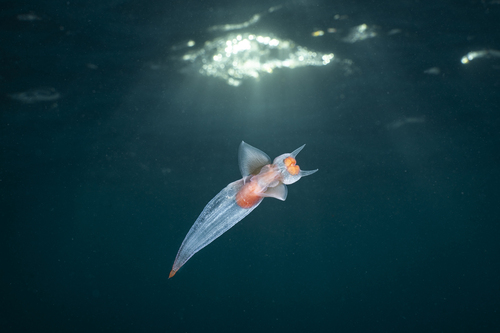
Clione limacina, known as the naked sea butterfly, sea angel, and common clione, is a sea angel (pelagic sea slug) found from the surface to greater than 500 m (1,600 ft) depth. It lives in the Arctic Ocean and cold regions of the North Atlantic Ocean. It was first described by Friderich Martens in 1676 and became the first gymnosomatous (without a shell) "pteropod" to be described.

Appearance

There are two subspecies that differentiate in body length. The northern subspecies lives in colder water, matures at 3 cm (1.2 in) and can reach a size of 7–8.5 cm (2.8–3.3 in). This makes it by far the largest sea angel. In comparison, the size of the southern subspecies is 1.2 cm (0.5 in), C. elegantissima is up to 3 cm (1.2 in), C. okhotensis up to 0.8 cm (0.3 in), and C. antarctica up to 3 cm (1.2 in).

C. limacina swims by beating its two wings to move upwards or maintain itself at a constant depth. To keep itself upright during swimming, it uses two statocyst gravity-sensing organs that correct it to an upright posture using its tail.

Habitat

Clione limacina is found in cold waters of the Arctic Ocean and North Atlantic Ocean, ranging south at least to the Sargasso Sea. There are three other species in the genus, which formerly were included in C. limacina (either as subspecies, variants or subpopulations). These are C. elegantissima of the cold North Pacific (at least north to the Gulf of Alaska; the Beaufort Sea is inhabited by C. limacina), C. okhotensis of the Okhotsk Sea (where it overlaps with C. elegantissima), and C. antarctica of Antarctic waters.

Diet

Adults feed in a predator-prey relationship almost exclusively on the sea butterflies of the genus Limacina: on Limacina helicina and on Limacina retroversa. The feeding process of Clione limacina is somewhat extraordinary. The buccal ("mouth") apparatus consists of three pairs of buccal cones. These tentacles grab the shell of Limacina helicina. When the prey is in the right position, with its shell opening facing the radula of Clione limacina, it then grasps the prey with its chitinous hooks, everted from hook sacs. Then it extracts the body completely out of its shell and swallows it whole.

Behaviour

Clione limacina inhabits both the epipelagic and mesopelagic regions of the water column.

Reproduction

In Svalbard, the life cycle of C. limacina appears to be at least 2 years. It is a hermaphrodite and observations suggest this is simultaneous. It breeds during the spring and summer, and the eggs are about 0.12 mm (4.7 thou).

Clione limacina is a prey of planktonic feeders, such as the baleen whales, which historically led to sailors naming it "whale-food". Some fishes are also its predators. For example, the Chum Salmon, Oncorhynchus keta, is a major predator of sea angels.

Part of

Where to see it

No dive sites list Sea Angel yet. Explore the map to find sites near you.